
Table of Contents
Q.1. (a) Name and explain the different classical cuts of fish.
Fillets
Round fish are de-headed then filleted by cutting through the belly, gutting the fish, opening it flat then removing the backbone and smaller bones, leaving the two fillets on each side of the fish joined in a ‘butterfly’ style . The central bone can also be removed by cutting along the back after which the guts can be taken removed without splitting the belly.
Suitable fish:Any small to medium sized whole round fish, usually single portion specimens such as bass, herring, mackerel, mullet, sardines, tilapia, trout, whiting.
Cheeks
As the name implies, these are cut from the head of larger mature fish and are the small pockets of flesh found just below each eye. Hailed by many as one of the tastiest parts of a fish, they are roundish [su_user field=”display_name”] [su_user field=”user_email”]
Suitable fish:Usually taken from larger specimens such as monk fish, cod, hake, haddock, halibut
Cutlets
A single-serving cross-section portion sliced straight through the backbone of a whole, dressed, round fish. In general, they are slightly thinner than a steak, usually around 12mm/½-inch thick, and most often cut from the section between the head and mid-body.
Suitable fish:Any medium sized round fish. See also darnes and steaks
Darnes
Single-serving portions taken from a cross section straight through the backbone of a whole, dressed, round fish, In general, they are slightly thinner than a steak, usually around 12mm/½-inch thick, and most often cut from the section between the head and mid-body. Also known as cutlets.
Suitable fish:Any medium sized round fish See also cutlets, steaks and tronçons – the flat fish version
Dressed
Whole fish of any size which have been scaled, gutted and had the gills and fins removed. Sometimes the head is removed and most often the tail is left intact.
Suitable fish:All except the largest of fish.See also Pan-dressed fish and Whole fish
Fillets
Available from any fish – round or flat. Fillets can be the boneless or ‘pin bone-in’ and consist of the complete sides of a fish from just below the gills to tail, being cut away from the backbone and removed in one piece. Fillets from larger fish can be further cut down into single-serving size portions such as Suprêmes, Pavés or Goujons.
Suitable fish:Most, whether round or flat, large or small. Exceptions include ray, skate and monkfish
Goujons
Narrow strips up to 10cm/4-inches long x 1cm/½-inch wide x 1cm/½-inch thick which are cut from a fillet. Goujons are best known for being coated with breadcrumbs before being deep fried.
Suitable fish:Any so long as the fillet is thick enough.
Loins
The prime part of a fillet taken from larger round fish such as Cod or from either side of the backbone of large game fish like Tuna. Smaller loins from fish such as Hake may be single-portion size.
Suitable fish:Large round fish such as cod, haddock, hake or monkfish and large game fish such as swordfish or tuna
Pan-Dressed
Small to medium sized whole fish which have been scaled, gutted and had the fins, head and tail removed so as to fit into a frying pan. Usually single-serving whole fish.
Suitable fish:All small to medium sized round or flat fish.
Pavés
Boneless portions taken from the fillets of larger flat fish which can serve 1 – 2 people depending on how large the fish is. The fillets are cut in half or into thick portions widthways and normally the skin is left on. Sometimes referred to as Suprêmes or just fillets, both of which are incorrect and and can lead to confusion.
Suitable fish:Larger flat fish such as Halibut, Turbot and Brill
Steaks
A thick, usually boneless piece of fish cut from larger fish such as tuna or swordfish
Suitable fish:Larger round fish such as Salmon, Haddock, Cod, Hake and Tuna or larger flat fish such as Halibut, Brill and Turbot See also cutlets, darnes and tronçons
Suprêmes
Also sometimes called fillet steaks, these are boneless single-serving portions cut from larger fillets of both round and flat fish. The fillets are cut width ways into slices around 5cm/2-inches wide. Sometimes referred to as pavés, but often just called fillets both of which names are incorrect and can lead to much confusion.
Suitable fish:Larger round and flat fish fillets such as Salmon, Cod, Halibut, Turbot and Snapper
Tail
These are generally larger all-in-one pieces, consisting of the part of the fish nearest to the tail fin in a solid piece which always include the bone. They can be likened to meat “joints” in that they can be large enough to serve several people and are excellent roasted in one piece.
Suitable fish:Any large round fish such Salmon, Hake, Cod, Monk fish, Sea Bass.
(b) What are the quality points to be checked while selecting fish and shellfish.
In a whole fish, the eyes should be bright and clear, not cloudy or sunken in. The gills of fresh fish are deep red, not brownish. The skin should be firm, clear, and bright with no trace of slime.
Fish that’s fresh from the ocean smells like the ocean, briny, fresh, and mild. If it smells sour or has a strong “fishy” odor, shop elsewhere.
If possible, get fresh-cut fillets from whole fish. Purchase pre-cut fillets only if they’re displayed on a bed of ice, not sealed under plastic, which can trap bacteria and foul odors. Fillets should look moist and lie flat, with no curling at the edges.
The fish should be free from slime yet moist and not dry to touch.
Should be firmly closed and odorless when purchased. Eat fresh clams, oysters, and mussels as soon as possible. Store for no more than 24 hours in the refrigerator in a plastic bag poked with small holes, allowing air to circulate. Never overcook shellfish because it gets rubbery.
Make sure the gills are clean and a bright red. As a fish ages, its gills will dull and start to turn brown (slimy gills are a sure sign the fish is starting to go bad).
Q.2. (a) Draw a neat diagram and label the different cuts of lamb/mutton.
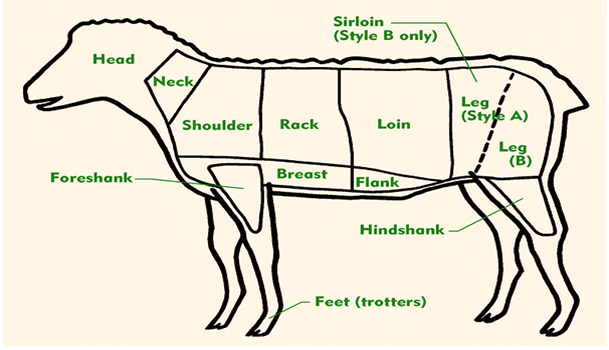
(b) Give three examples of lamb preparations with a brief description of each dish.
- Lamb Chops
There are two kinds of lamb chops: little ones you can cut off a rack of lamb, or thicker lamb loin chops. Both can be roasted or seared like you would a pork tenderloin or steak, and they contain tender meat that’s delicious when paired with an easy pan sauce or topping. [su_user field=”display_name”] [su_user field=”user_email”]
- Leg of Lamb
You might think of a leg of lamb as something you only eat at Easter or for special occasions, but it’s really quite simple to roast. Whether you get a bone-in or boneless leg of lamb, all you need to do is rub it with herbs and olive oil before roasting it in the oven. The meat is tender, juicy, and great for leftover sandwiches — and seriously, cooking a leg of lamb isn’t really much different than roasting a whole chicken.
- Lamb Meatballs
It is for crisp lamb meatballs cooked through in a fragrant, vaguely North African sauce of tomato sauce zipped up with orange juice and warm spices, then topped with feta and mint. It can be cooked in an hour’s time, not all of it busy, and served with pita or plain pasta, bulgur or couscous.
- Mutton Stew
Ingredients in a stew can include any combination of vegetables (such as carrots, potatoes, onions, beans, peppers, mushrooms, and tomatoes) or meat, especially tougher meats suitable for slow-cooking, such as beef. Poultry, sausages, and seafood are also used.in mutton stew we cook all vegetables with mutton.
Q.3. Write short notes on (any two):
(a) Rigor-Mortis
Rigor mortis is famous for setting in from the head down, but actually all muscles experience it equally. The stiffness is just more noticeable in the smaller muscles around the face and head than in the large muscles of the legs and abdomen. The stiffness generally goes away after about two days.Rigor mortis (Latin: rigor “stiffness”, mortis “of death”) or postmortem rigidity, the third stage of death, is one of the recognizable signs of death, caused by chemical changes in the muscles post mortem, which cause the limbs of the corpse to stiffen.
Rapid refrigeration of meat after slaughter reduces the risk of dangerous bacteria on the meat and is generally a good thing. But rapid refrigeration may cause sarcomeres to shorten, thus making the meat tough. Electrical stimulation is used to deplete ATP, thus initiating the early development of rigor mortis.
(b) Laminated Pastries
Laminated dough gets its name from how it’s made. “Laminating” dough refers to the process of folding butter into dough multiple times to create very thin alternating layers of butter and dough. The gluten in the flour also gets developed during the folding and rolling process.
This is unlike other baked goods where butter is creamed in with the sugar and flour, so the result when baked is a pastry with hundreds of flaky, airy layers.
The two most common types of laminated dough are puff pastry and croissants. Puff pastry is the simplest form of laminated dough, with just butter folded into a basic dough of flour, water, and salt. Croissants take it one step further and add yeast and milk to the dough, which make the pastries richer, rise more, and end up more bread-like. Danishes, palmier cookies, kouign amann, and sticky buns are also pastries made with laminated dough. [su_user field=”display_name”] [su_user field=”user_email”]
(c) Baking Powder
Baking powder is a dry chemical leavening agent, a mixture of a carbonate or bicarbonate and a weak acid and is used for increasing the volume and lightening the texture of baked goods. Baking powder works by releasing carbon dioxide gas into a batter or dough through an acid-base reaction, causing bubbles in the wet mixture to expand and thus leavening the mixture.
Baking powder was discovered by English food manufacturer Alfred Bird in 1843.[1] It is used instead of yeast for end-products where fermentation flavors would be undesirable[2] or where the batter lacks the elastic structure to hold gas bubbles for more than a few minutes,[3] or to speed the production. Because carbon dioxide is released at a faster rate through the acid-base reaction than through fermentation, breads made by chemical leavening are called quick breads.
(d) Pastry Creams.
Pastry cream, or crème patissière, is a staple that every baker should know how to make. Pastry cream is a thick custard that can be used as a filling for any number of cakes, tarts or pastries. It is made with milk, eggs, sugar, cornstarch (or a mixture of flour and cornstarch) and flavoring. Vanilla is the most popular flavor for pastry cream, but the cream can be flavored with any number of different things, from extracts to liqueurs to chocolates to fruit purees.
Pastry cream is made by bringing the milk almost to a boil, then tempering a mixture of eggs, sugar and cornstarch with the hot milk. The mixture is returned to the stovetop and cooked, stirring constantly, over a low heat until it has thickened. Vanilla beans can be infused into the milk at the beginning of the cooking process, or extract can be stirred in at the end. The use of cornstarch (or flour) is what sets pastry cream apart from other custard sauces, giving it is very thick consistency that makes it so versatile.
Q.4. List and explain the role of each ingredient in bread making.
- Yeast
Yeast is the heart of the bread-making process. It’s the essential ingredient that makes the dough rise and gives home-baked bread its wonderful taste and aroma. Other ingredients are added to complete the reactions that result in a perfectly baked loaf of hot, crusty homemade bread. In each yeast packet, there are thousands of living plant-like microorganisms. When activated by warm liquid, and fed by sugar or starch, the yeast releases tiny bubbles of carbon dioxide gas. This gas is what makes the dough rise and achieve its light texture after baking.
- Flour
Wheat is the most common type of flour used in bread baking. It includes all-purpose flour, bread flour and whole wheat flour. Wheat is rich in gluten, a protein that gives the dough its elasticity and strength. When yeast and flour are mixed with liquid and then kneaded or beaten, the gluten forms and stretches to create a network that traps the carbon dioxide bubbles produced by the yeast.
Recipes with whole wheat flour have less gluten and make denser loaves. That’s why these recipes generally require some all-purpose flour which increases the gluten and makes lighter, taller loaves.
- Water
It is the most important liquid because it dissolves and activates the yeast and it blends with the flour to create a sticky and elastic dough.
- Milk, Buttermilk, Cream or Juice
May be added to enhance the flavor or texture. Only warm liquids should be added to dry ingredients in a recipe because a too-cool liquid will slow or stop yeast action. A too-hot liquid will destroy the yeast and prevent it from rising. Ideal temperature ranges are 100°F–110°F, when yeast is dissolved directly in water; 120°F-130°F when undissolved yeast is added to dry ingredients.
- Sweetener
Sugar adds flavor and rich brown color to a bread’s crust. Brown sugar, honey, molasses and jams may also be used.
- Salt
Salt is an important ingredient in bread baking because it slows rising time allowing the flavor of the dough to develop, and it adds to the flavor of the baked product. For best results, we do not recommend omitting the salt in a yeast recipe.
- Eggs
Eggs add food value, color and flavor to breads. They also help make the crumb fine and the crust tender. Eggs add richness and protein. Some recipes call for eggs to be used as a wash, which adds color.
- Fat
Butter, margarine, shortening or oil add flavor and make bread tender and moist. Fat slows moisture loss, helping bread stay fresh longer. Fat is heated with liquid when using Rapid Rise Yeast. Do not substitute oil for margarine/shortening unless the recipe calls for it.
OR (a) Draw a neat diagram and label the different parts of a wheat grain.

(b) Name different flours and their uses.
- All-Purpose Flour: If a recipe calls simply for “flour,” it’s calling for all-purpose flour. Milled from a mixture of soft and hard wheat, with a moderate protein content in the 10 to 12 percent range, all-purpose flour is a staple among staples. While not necessarily good for all purposes, it is the most versatile of flours, capable of producing flaky pie crusts, fluffy biscuits and chewy breads. A-P flour is sold bleached or unbleached; the two are largely interchangeable, but it’s always best to match your flour to your recipe.
- Flour: The flour with the lowest protein content (5 to 8 percent). The relative lack of gluten-forming proteins makes cake flour ideal for tender baked goods, such as cakes (of course), but also biscuits, muffins and scones. Cake flour is generally chlorinated, a bleaching process that further weakens the gluten proteins and, just as important, alters the flour’s starch to increase its capacity to absorb more liquid and sugar, and thus ensure a moist cake.
- Pastry Flour: An unbleached flour made from soft wheat, with protein levels somewhere between cake flour and all-purpose flour (8 to 9 percent). Pastry flour strikes the ideal balance between flakiness and tenderness, making it perfect for pies, tarts and many cookies. To make your own pastry flour, mix together 1 1/3 cups A-P flour and 2/3 cup cake flour.
- Bread Flour: With a protein content of 12 to 14 percent, bread flour is the strongest of all flours, providing the most structural support. This is especially important in yeasted breads, where a strong gluten network is required to contain the CO2 gases produced during fermentation. The extra protein doesn’t just make for better volume and a chewier crumb; it also results in more browning in the crust. Bread flour can be found in white or whole wheat, bleached or unbleached. Unbleached all-purpose flour can generally be substituted for bread flour with good results.
- Self-Rising Flour: Flour to which baking powder and salt have been added during milling. Long a Southern staple, self-rising flour is generally made from the low-protein wheat traditionally grown in the South. It’s best for tender biscuits, muffins, pancakes and some cakes. Self-rising flour is best stored tightly wrapped in its original box and used within six months of purchase — longer than that and the baking powder in it begins to lose its oomph.To make your own self-rising flour, combine 1 cup pastry flour with 1 1/2 teaspoons baking powder and 1/4 teaspoon salt. [su_user field=”display_name”] [su_user field=”user_email”]
- Whole-Wheat Flour: During milling, the wheat kernel is separated into its three components: the endosperm, the germ (the embryo) and the bran (the outer coating). In whole-wheat flours, varying amounts of the germ and bran are added back into the flour. Whole-wheat flour tends to be high in protein, but its gluten-forming ability is compromised by the bran and germ — just one of the reasons whole-wheat flour tends to produce heavier, denser baked goods.In most recipes, whole-wheat flour can be substituted for up to half of the all-purpose flour. Because wheat germ is high in oils prone to rancidity, whole-wheat flour is far more perishable than white. Store it for up to three months at cool room temperature, and then transfer it to the freezer.
- Gluten-Free Flours: There is a wide variety of gluten-free flours available today, made from all sorts of grains, nuts and starches. Some of the most widely available are based on rice flour blended with tapioca and potato starch. A small proportion of xanthan gum is sometimes added to help simulate the chewiness normally associated with gluten. Consult the specific recipe or packaging for information on how to substitute gluten-free flour for wheat flour in your favorite baking recipes.
Q.5. (a) Explain step by step cheese manufacturing process.
General Cheese Processing Steps are as follows:
- Standardize Milk
- Pasteurize/Heat Treat Milk
- Cool Milk
- Inoculate with Starter & Non-Starter Bacteria and Ripen
- Add Rennet and Form Curd
- Cut Curd and Heat
- Drain Whey
- Texture Curd
- Dry Salt or Brine
- Form Cheese into Blocks
- Store and Age
- Package
The times, temperatures, and target pH values used for cheddar cheese will depend on individual formulations and the intended end use of the cheese. These conditions can be adjusted to optimize the properties of Cheddar cheese for shredding, melting, or for cheese that is meant to be aged for several years.
- Standardize Milk
Milk is often standardized before cheese making to optimize the protein to fat ratio to make a good quality cheese with a high yield
- Pasteurize/Heat Treat Milk
Depending on the desired cheese, the milk may be pasteurized or mildly heat-treated to reduce the number of spoilage organisms and improve the environment for the starter cultures to grow. Some varieties of milk are made from raw milk so they are not pasteurized or heat-treated. Raw milk cheeses must be aged for at least 60 days to reduce the possibility of exposure to disease causing microorganisms (pathogens) that may be present in the milk.
- Cool Milk
Milk is cooled after pasteurization or heat treatment to 90°F (32°C) to bring it to the temperature needed for the starter bacteria to grow. If raw milk is used the milk must be heated to 90°F (32°C).
- Inoculate with Starter & Non-Starter Bacteria and Ripen
The starter cultures and any non-starter adjunct bacteria are added to the milk and held at 90°F (32°C) for 30 minutes to ripen. The ripening step allows the bacteria to grow and begin fermentation, which lowers the pH and develops the flavor of the cheese. [su_user field=”display_name”] [su_user field=”user_email”]
- Add Rennet and Form Curd
The rennet is the enzyme that acts on the milk proteins to form the curd. After the rennet is added, the curd is not disturbed for approximately 30 minutes so a firm coagulum forms.
- Cut Curd and Heat
The curd is allowed to ferment until it reaches pH 6.4. The curd is then cut with cheese knives into small pieces and heated to 100°F (38°C). The heating step helps to separate the whey from the curd.
- Drain Whey
The whey is drained from the vat and the curd forms a mat.
- Texture Curd
The curd mats are cut into sections and piled on top of each other and flipped periodically. This step is called cheddaring. Cheddaring helps to expel more whey, allows the fermentation to continue until a pH of 5.1 to 5.5 is reached, and allows the mats to “knit” together and form a tighter matted structure. The curd mats are then milled (cut) into smaller pieces.
- Dry Salt or Brine
For cheddar cheese, the smaller, milled curd pieces are put back in the vat and salted by sprinkling dry salt on the curd and mixing in the salt. In some cheese varieties, such as mozzarella, the curd is formed into loaves and then the loaves are placed in a brine (salt water solution).
- Form Cheese into Blocks
The salted curd pieces are placed in cheese hoops and pressed into blocks to form the cheese.
- Store and Age
The cheese is stored in coolers until the desired age is reached. Depending on the variety, cheese can be aged from several months to several years.
- Package
Cheese may be cut and packaged into blocks or it may be waxed.
(b) List five international cheeses with their uses.
Mozzarella: Pizza lovers swear by this cheese, which is a specialty of Italy. What makes it stand out is the fact that the Mozzarella requires no aging and can be consumed fresh, the moment it’s made. The cheese, unlike several others, is made from buffalo’s milk.
Feta: If anyone knows the Feta inside out, it has to be the Greeks. In Greece, the Feta cheese is accepted as unadulterated only if it has been produced in Thessaly, Macedonia, Lesvos, Thrace, the Peloponnese and Central Mainland Greece. If it’s made somewhere else, it is called ‘white cheese’. This cheese, which matures after a period of two months, is made from goat’s milk, and is usually squashy in texture, though certain kinds may be a bit more crumbly. [su_user field=”display_name”] [su_user field=”user_email”]
Cheddar: England’s pride, the Cheddar is also quite a popular fromage, that’s relished all across the globe. This is one of those cheeses that have no patents, and hence any cheese maker can name his product ‘Cheddar’. Depending on the temperature and climatic conditions of an area, the cheese may take 9-24 months to age. The color of the cheese may range from white to yellow to a dark orange. Cheddar is known for its luscious texture that seems to melt in the mouth.
Parmesan: Commonly known as the Parmesan, the Parmigiano-Reggiano is probably the world’s most preferred cheese. It takes anywhere from 18 months to three years to mature. The Italians proved their skills in cheese production with this nutty gem of the culinary world. Respected by the best of chefs across the globe, the Parmigiano-Reggiano is highly versatile and can be used either as an accompaniment to a beverage of your choice, or in rice and pasta dishes. The fact that it is low in calories, and has high quantities of calcium, is the icing on the cake.
Mascarpone: The Mascarpone looks more like thick cream, which is the base ingredient for its preparation. This Italian creation is acidic because of the lime added to it, and is high in fat owing to its use of full fat cream. The Mascarpone is widely used in cheesecakes and scones, or with fresh fruits. However, its robust flavors don’t last for a long time, and it needs to be consumed within days of preparing it, or else it may go stale.
OR (a) List the differences between a sauce and a gravy.
Gravy: Gravy is a sauce made from meat juices, usually combined with a liquid such as chicken or beef broth, wine or milk and thickened with flour, cornstarch, or some other thickening agent. A gravy may also be the simple juices left in the pan after the meat, poultry, or fish has been cooked.
Sauce: The word “sauce” is a French word that means a relish to make our food more appetizing. Sauces are liquid or semi-liquid foods devised to make other foods look, smell, and taste better, and hence be more easily digested and more beneficial. Because of the lack of refrigeration in the early days of cooking, meat, poultry, fish, and seafood didn’t last long. Sauces and gravies were used to mask the flavor of tainted foods.
(b) Give two derivatives each of the basic mother sauces.
1. Béchamel:
It is also known as white sauce. Its derivatives are shown in Table 10.2.

2. Velouté:
It is made from chicken stock and blond roux. Its derivatives are shown in Table 10.3.

3. Espagnole:
It is a brown coloured sauce made from beef stock and tomatoes. Its derivatives are shown in Table 10.4.

4. Hollandaise:
It is an emulsion of eggs and butter. Its derivatives are shown in Table 10.5.

5. Mayonnaise:
It is a cold sauce often used as a spread. Its derivatives are shown in Table 10.6.

Q.6. (a) Define soups.
Soup is a primarily liquid food, generally served warm or hot (but may be cool or cold), that is made by combining ingredients such as meat and vegetables with stock, juice, water, or another liquid. Hot soups are additionally characterized by boiling solid ingredients in liquids in a pot until the flavors are extracted, forming a broth.
(b) Classify soups with two examples of each type.
The flavorful, nutritious liquid is known as soup. soup may be served for luncheon, dinner,supper and snack meals. A portion is usually between 200-250 ml depending on the type of soup and the number of courses to follow. [su_user field=”display_name”] [su_user field=”user_email”]
Classification of Soups:
Soups are broadly classified into two types—thick soups and thin soups, which are further classified into various categories. This is done based on the texture of the soups. However, neither there are certain soups that are neither thin nor thick and so sometimes certain soups are also classified into a category called ‘international soups’.
These soups would essentially be the national soups of different countries. ‘Mulligatawny’ from India and ‘Minestrone’ from Italy are two examples of national soups.
- Clear Soups:
- Broth:
A broth is a stock-based soup, which is not thickened. It is served unpassed and garnished with chopped herbs, vegetables, or meats. For example, minestrone, scotch broth, etc. Clear soups are thin like liquid; they never coat the back of the spoon. It is important to have full-bodied thin soups; otherwise they would taste like water.
The difference between a stock and a broth or bouillon as commonly referred to in French. While serving broths as soups, one should add reduced stock or glaze to give body to the soup.
Consommé: A consommé is a clear soup which is clarified with egg whites. It is an old saying that if one can read the date on the dime thrown in four liters of consommé, then it is a good consommé. It is named after the garnish used in the soup.
Puree: Puree soups are thick soups made by cooking and then pureeing vegetables or ingredients used in the soup. For example, lentil soup, potato soup, etc. One can roast the vegetables to give a better flavour.
Velouté: A velouté is a thick soup, which is thickened with a blond roux, passed and finished with a liaison. They may be vegetable or chicken stock based, for example, velouté of chicken. A roux is made by cooking equal amounts of flour and butter over a medium heat. The degree of cooking of the flour gives its name to the roux. A blonde roux is obtained by cooking roux until it turns blonde in color. The texture of velouté is smooth and velvet like.
Cream: A cream soup is a passed thick soup. It may be vegetable based or even meat based; but most commonly vegetables are used to prepare cream soups. In classical recipes it is thickened with béchamel and finished with cream. Examples include cream of tomato, cream of mushroom, cream of chicken, etc. Modern trends, however, avoid usage of béchamel sauce because of health reasons and to retain the delicate flavors of the vegetables.
Bisque: It is a shellfish-based soup, which is passed and may be garnished with dices of the seafood used. Traditionally it is thickened with rice and finished with cream, for example, lobster bisque.
Chowder: Chowders are not strained and traditionally they are seafood-based soups thickened with potatoes and finished with cream or milk, for example, clam chowder, seafood chowder, etc. Chowders are from the USA and the most classical version comes from Manhattan and hence the name Manhattan chowder.
Cold Soups: As the name suggests, these soups are served cold but not chilled. Chilling would dull the flavours and the soup would taste bland. They do not form a separate classification, as they may again be thin or thick, passed or unpassed. Examples of cold soups include jellied consommé, gazpacho, vichyssoise, etc.
International Soups: These again do not form a separate classification as they represent the region of origin. For example, green turtle soup from England, French onion soup from France, and mulligatawny from India.
Q.7. (a) Discuss the role of spices in Indian cookery.
The Indian cooks use loads of seasoning in different types of shapes and colors. Cinnamon, black mustard seed, golden turmeric, cardamom, chilies, ginger root is the common spices used to cook the Indian dishes. Depending of the type of dish like vegetable, chicken, fish or red meat, the required spices are added during the cooking time. The great thing about the spices is that different flavors can be extracted from the same spice by using different methods of using like grinding, roasting, adding the whole spice or by combining the spice with other spices. [su_user field=”display_name”] [su_user field=”user_email”]
(b) Discuss the different methods of cooking rice.
Rice is cooked by either boiling or steaming. In the process, rice absorbs water during cooking. You can cook the rice in just as much water as it absorbs, or in a large quantity of water, which is drained before serving.
There are many methods to cook the rice. We can cook the rice in Pressure cooker, Electric cooker, Microwave, or even directly in a pan.
Rice may also be made into rice porridge (also called congee or rice gruel or kanji) by adding more water than usual, so that the cooked rice is saturated with water to the point that it becomes very soft, expanded, and fluffy. Rice porridge is commonly eaten as a breakfast food in certain areas, and is also a common food for the sick.
Q No. 8 to 10
Q.8. Explain the following terms (any ten):
(a) Au gratin
Veg. or non veg. food covered with sauce.sprinkle with cheese or breadcrumbs and browned.
(b) Zest
Rind of lemon or orange use to add flavor to the dish.
(c) Rind
The tough outer skin of certain fruit, especially citrus fruit.
(d) Court Bouillon
A stock made from wine and vegetables, typically used in fish dishes.
(e) Chasseur
Sauce chasseur, sometimes called “hunter’s sauce”, is a simple or compound brown sauce used in French cuisine. It is typically made using demi-glace or an espagnole sauce as a base, and often includes mushrooms and shallots.
(f) Gluten
A mixture of two proteins present in cereal grains, especially wheat, which is responsible for the elastic texture of dough.
(g) Offals
The entrails and internal organs of an animal used as food.
(h) Shortening
Shortening is any fat that is a solid at room temperature and used to make crumbly pastry and other food products.
(i) Au Jus
Served with natural juice(comes naturally at the time of roasting or grilling).
(j) Croquette
A croquette is a small bread crumbed fried food roll containing, usually as main ingredients, mashed potatoes or ground meat, shellfish, fish, cheese, vegetables and coated with flour,eggs and breadcrumbs.
(k) Meringue
An item of sweet food made from a mixture of egg whites and sugar baked until crisp.
(l) Chateaubriand
Chateaubriand steak is a meat dish cooked with a thick cut from the tenderloin filet.
Q.9. (a) Write the composition of milk.
The Milk Composition section describes the chemical and physical properties and effects of pasteurization on the compounds in milk. A brief overview of the variation in milk composition is provided below as an introduction to this section. [su_user field=”display_name”] [su_user field=”user_email”]
- Carbohydrate (Lactose)
- Fat
- Protein
- Vitamins and Minerals
- Enzymes
- Literature Related to Milk Composition
Unless otherwise stated, the information presented in this website refers to cow’s milk.
In general, the gross composition of cow’s milk in the U.S. is 87.7% water, 4.9% lactose (carbohydrate), 3.4% fat, 3.3% protein, and 0.7% minerals (referred to as ash). Milk composition varies depending on the species (cow, goat, sheep), breed (Holstein, Jersey), the animal’s feed, and the stage of lactation. Although there are minor variations in milk composition, the milk from different cows is stored together in bulk tanks and provides a relatively consistent composition of milk year round in the U.S.
(b) Briefly explain the benefits of homogenized milk.
The biggest pro of homogenized milk, at least from an industry standpoint, is usually the milk’s improved shelf life, though uniform color and consistency usually also rank high on the list. Some researchers also think that the homogenization process makes the milk easier to digest, though there is some controversy on this point. Some of the common cons include nutritional disadvantage homogenized milk almost always has to be fortified to make up for vitamins and minerals lost in processing and possible free radical build-up. In general, though, the process is considered safe, and is widely practiced by most commercial dairies around the world.
Q.10. Match the following:
(a) |
Minestrone |
(i) |
Cut of beef |
(b) |
Bercy |
(ii) |
Egg yolk and cream |
(c) |
Spaghetti |
(iii) |
Espagnole |
(d) |
Cheddar |
(iv) |
Pasta |
(e) |
Eclairs |
(v) |
Italy |
(f) |
Muesli |
(vi) |
Choux paste |
(g) |
Liaison |
(vii) |
Cereals and dry fruit |
(h) |
Potato |
(viii) |
England |
(i) |
Goujon |
(ix) |
France |
(j) |
Leg of Mutton |
(x) |
Tuber |
(xi) |
Cut of fish |
- a) Minestrone- Italy
- b) Bercy- France
- C) Spaghetti- Pasta
- D) Cheddar- England
- E) Eclairs- Choux Paste
- F) Muesli- Cereals and Dry Fruits
- G) Laision- Egg Yolks and Cream
- H) Potato- Tuber
- I) Goujon- Cut of Fish
- J) Leg of Mutton- Cut of Beef