
Table of Contents
Cheeses are normally classified according to firmness, which varies with the degree of moisture. The moisture content of firm cheeses may be as low as 30%, while that of soft or fresh cheeses may be as high as 80%. The most common designations include fresh (or unripened) cheeses, soft ripened cheeses, firm or semi-firm cheeses, blue-veined, processed and goats milk cheeses.
Fresh cheeses
Fresh or unripened cheeses are coagulated under the action of lactic acid fermentation in the milk instead of adding rennet. While they are drained after formation of the curd, they are neither ripened nor fermented. This category includes cottage cheese, ricotta, mascarpone, cream cheese and quark. Fresh cheeses are mainly used in baking and desserts, plain or flavoured with vegetables, fruits, herbs or spices.
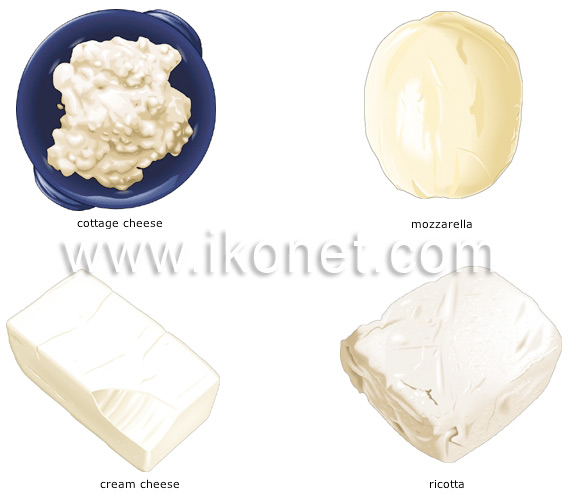 |
| Fresh cheeses |
Soft Cheeses
Soft cheeses are ripened for a relatively short period of time before being drained and turned into molds without being pressed or cooked. They have a moisture content of 50% to 60% and their fat content represents 20% to 26% of the cheese’s weight. They develop a soft rind that can be more or less satiny and are usually eaten with bread, since they tend to lose a lot of flavor when heated.
Soft cheeses are divided in two categories according to the characteristics of the rind: the surface-ripened soft cheeses (covered with a thin layer of a white down or mold) like Brie, Camembert and Coulommiers, and the interior-ripened soft cheeses (washed in light brine to maintain the moisture level and softness of the cheese) like Munster, Pont-l’Évèque and Époisses.
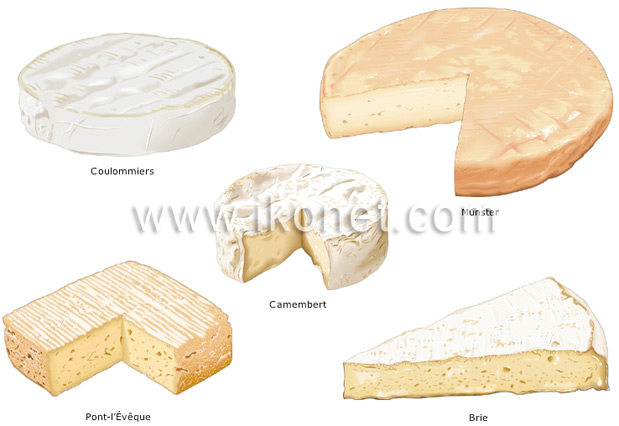 |
| Soft cheeses |
Firm and semi-firm cheeses
Semi-firm cheeses are uncooked pressed cheeses that are dense and usually pale yellow in color. They include Cheddar, Cantal, Reblochon, Edam, Gouda and Monterey Jack. Firm cheeses are cheeses that have been cooked and pressed. The curd is heated for an hour in order to make it more concentrated, which, upon pressing, produces a more compact cheese. Their texture is usually firm, although some hard cheeses, like Parmesan and Romano, may have a rather granular texture. Gruyère, Emmenthal, Jarlsberg, Raclette and Beaufort also are a part of that category.
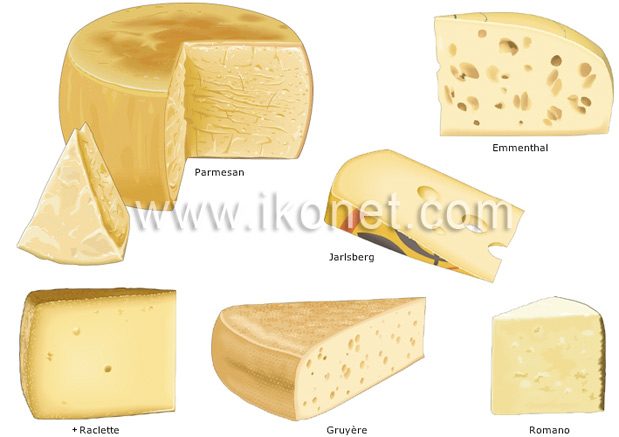 |
| Pressed cheeses |
Blue-veined cheeses
Blue-veined (or blue) cheeses are neither cooked nor pressed; the curd is inoculated with a species of blue-green mold, which is injected into the cheese by means of long needles. Fermentation occurs from the inside toward the outside. Those cheeses – including Roquefort, Gorgonzola, Stilton, Bleu de Bresse and Danish Blue – have a strong and sharp, peppery flavor and are often crumbled in texture.
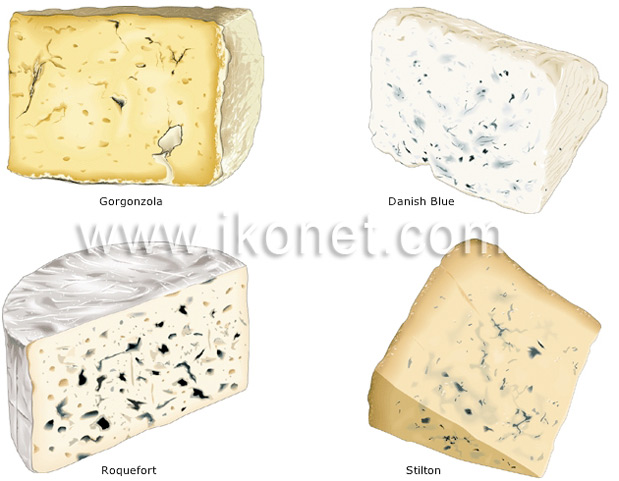 |
| Blue-veined cheeses |
Process cheeses
Process cheeses are cheeses made from one or several cooked or uncooked pressed cheeses that are remelted, and to which milk, cream or butter is added; they keep for a long time. Depending on the product, stabilizers, emulsifiers, salt, colours, sweeteners and seasonings may be added. A more or less soft and elastic texture and a mild flavor are obtained. In North America, these cheeses are mostly made using Cheddar cheese, whereas in Europe, Emmental and Gruyère predominate. Process cheeses have different names depending on the quantity of cheese they contain (process cheese, process cheese food, cheese spread).
Goats-milk cheeses
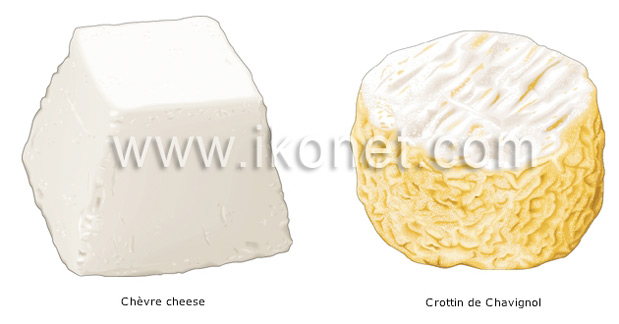
Goat’s-milk (or goat) cheeses are soft cheeses with a natural rind; they may be made from 100% goat’s milk or from a mixture of goat’s milk and cow’s milk. They are available unripened, soft and surface-ripened, or in some cases hard. Whiter than cheeses made from cow’s milk, they also tend to have a more pronounced flavor. These cheeses are often very salty, a factor which has the effect of prolonging their storage life.
Cheeses in this family include Crottin de Chavignol, Valençay, Chevrotin and feta.
 |
| Goat’s-milk cheeses |