
Table of Contents
Q.1. List the factors that you would keep in mind while selecting the city, to host an international convention. Who would be key players responsible for management of such a convention? (10)
Factors that should be keep in mind while selecting the city, to host an international convention are –
1. Cost or budget
2. Weather in the city
3. Ambiance and mood of the city
4. Capacity and size of the hotels in the city
5. Abundant technology
6. Parking facility in the city near venue
7. Acoustics
8. Location of the city from the countries Metro cities
9. Availability of Technology
10. Transportation facilities in the city
11. Distance of the venue from the nearest airport or railway station
12. Availability of the venue according to the date
13. City’s crime record
14. Health facilities in the city
15. Fooding & Lodging facilities in the city
16. Legal formalities/permission required to organise a event in the city
17. Safety facilities in the city
18. Political stability in the city
19. Cities rules and regulations
20. Environmental conditions of the city
Key persons responsible for the management of the convention will be –
1. Organizer
- Event Management Company
- Event Manager Event
- Management Team Supervisors
2. Central Govt.
To grant various permission required to allowing foreign in the country
3. Local Govt.
i.e. City’s Administration Team to grant various permission required such as sound permission, environmental permission, etc.
Q.2. Write short notes on any two: (2×5=10)
a. Sole proprietorship
It is that type of business organization which is owned, managed and controlled by a single owner.
The word “sole” means “only” and “proprietor” notes to “owner”.
A sole proprietor is the beneficiary of all profits. All risks are to be borne by the sole proprietor.
The sole proprietor has unconditional and full control over its business.
Example: Beauty parlour, barbershop, general store and sweet shop run by a single owner.
Advantages of Sole Proprietorship
1. Quick decision making
A sole proprietor has the freedom to make any decision. Therefore, the decision would be prompt as they don’t have to take the permission of others.
2. Confidentiality of information
Being only the owner of the business, it allows him/her to keep all the business information to be private and confidential.
3. Direct incentive
A sole proprietor directly has the right to have all the profit or benefits of a company.
4. Sense of accomplishment
He/she can have the personal satisfaction associated with working without any guidance or alone.
5. Ease of formation and closure
A single proprietor can enter the business with minimum legal formalities.
Limitations of a Sole Proprietorship
1. Limited Resources
Resources of a sole proprietor are limited to his savings and borrowings from the relatives. Banks also hesitate or deny giving the long term loans or extend the limit of long term loans due to the weak financial position of the business.
2. Life of a Business Concern
The owner and its business is the same entity and due to lack of successor or heir, the life of the business is limited. Due to death, insolvency, illness of a proprietor gives a detrimental impact on the business which results in closure of the business.
3. Unlimited Liability
The major demerit of a sole proprietorship is that the owner has unlimited liability. If the sole owner becomes fails to pay the debts, due to the failure of a business, the creditors would not only claim from business assets but also from his personal estate.
4. Limited Managerial Ability
The sole proprietor has to accept all the responsibilities to carry out its business. Sometimes the proprietor has to perform all the managerial functions like sales, purchase, marketing, selling, dealings with clients, etc.
b. Package tours
A package tour, package vacation, or package holiday comprises transport and accommodation advertised and sold together by a vendor known as a tour operator. Other services may be provided such a rental car, activities or outings during the holiday. Transport can be via charter airline to a foreign country, and may also include travel between areas as part of the holiday. Package holidays are a form of product bundling.
Package holidays are organised by a tour operator and sold to a consumer by a travel agent. Some travel agents are employees of tour operators, others are independent.
Some forms of packaged tours are
a. Organised tours
The first organised tours dated back to Thomas Cook who, on 5 July 1841, chartered a train to take a group of temperance campaigners from Leicester to a rally in Loughborough, eleven miles away. By 1872 he was undertaking worldwide tours, albeit with small groups. His company, Thomas Cook & Son (commonly called Thomas Cook or simply “Cook’s”), grew to become one of the largest and most well known travel agents before being nationalised in 1948.
With the gradual decline of visits to British seaside resorts after the Second World War, Thomas Cook & Son began promoting foreign holidays (particularly Italy, Spain and Switzerland) in the early 1950s. Information films were shown at town halls throughout Britain. However they made a costly decision by not going into the new form of cheap holidays which combined the transport and accommodation arrangements into a single ‘package’. The company went further into decline and were only rescued by a consortium buy-out on 26 May 1972.
b. Group tours
Vladimir Raitz, the co-founder of the Horizon Holiday Group, pioneered the first mass package holidays abroad with charter flights between Gatwick airport and Corsica in 1950, and organised the first package holiday to Palma in 1952, Lourdes in 1953, and the Costa Brava and Sardinia in 1954. In addition, the amendments made in Montreal to the Convention on International Civil Aviation on 14 June 1954 was very liberal to Spain, allowing impetus for mass tourism using charter planes.
c. Dynamic Packaging
Dynamic packaging is a method that is becoming increasingly used in package holiday booking procedures that enables consumers to build their own package of flights, accommodation, and rental car instead of a pre-defined packages. Dynamic Packaging allows guests to create their own vacation, similar to a private or custom tour. This method allows guests to use a company’s itinerary or create their own to allow for more flexible options while using an agency’s services.
c. Heritage hotels
‘Heritage Hotels’ cover running hotels in palaces/castles/forts/havelies/hunting loges/residence of any size built prior to 1950. The facade, architectural features and general construction should have the distinctive qualities and ambience in keeping with the traditional way of life of the area. The architecture of the property to be considered for this category should not normally be interfered with.
Any extension, improvement, renovation, change in the existing structures should be in keeping with the traditional architectural styles and constructional techniques harmonising the new with the old. After expansion/renovation, the newly built up area added should not exceed 50% of the total built up (plinth) area including the old and new structures. For this purpose, facilities such as swimming pools, lawns etc. will be excluded.
According to Ministry of tourism, the heritage hotels are further subdivided as follows:
a. Heritage
This category covers hotels in residences, havelis, hunting lodges, castles or forts and palaces built during 1935-1950.
b. Heritage Classic
This category covers hotels in residences, havelis, hunting lodges, castles or forts and palaces built prior to 1935 but after 1920.
c. Heritage Grand
This category covers hotels in residences, havelis, hunting lodges, castles or forts and palaces built prior to 1920.
Q.3. What factors are considered in selecting a hotel project? Prepare a feasibility report for setting up a 4-star hotel of 100 rooms. (10)
Factors that affect hotel project selection is mainly based on two factors are-
1. Factors concerning before construction of the project
• Availability of skilled labour
• Availability of cheap labour
• Transportation facilities
• Availability of local or natural materials to reduce construction and transportation costs
• Rate of population growth and urbanization in that area
• Town planning and environmental conditions
These are the factors that are to be examined and kept in mind while selecting a site prior to the construction of the project.
2. Factors concerning after construction of the structure (after use efficiency)
• Access to Parks and Playgrounds
• Agricultural potentiality of the land
• Availability of Public Utility Services especially water, electricity and sewage disposal
• contour of the land in relation to the building costs
• cost of land
• distance from places of work
• ease of drainage
• location with respect to schools, colleges and public buildings
• nature of use of adjacent areas
transport facilities
• wind, velocity and direction
Feasibility report for setting up a 4-star hotel of 100 rooms –
• Project Name- XYZ Hotel
• Location- 13/1A
• Rooms- 100
• Type of Project – Construction of New Building
• Total plot area – 25131.08 sq.m
• Built up area- 110853 sq.m.
• OSR- 2513.09sq.m
• Building of height- 45m
• No of floors or blocks – 4
• Road width – 30m
• Parking facilities- 300+
• Power requirements- Hotel 764kVA
• Water requirements- 445KLD
• Project cost – 147.9 cr, etc
Q.4. How can the property be classified as ECOTEL? What are some of its unique standard and facilities? (10)
The Ecotel Certification is based on five areas of environmentalism, each of which is designated by a Globe award.
These five areas are referred to as the ‘cornerstones of environmental responsibility’ or simply as ‘Globes’. These Globes are:
1. Energy conservation
This requires the existence of a formalized framework to actually reduce the energy consumption of the hotel. For instance, whether the hotel has been designed and constructed keeping in mind maximum energy conservation. Factors like whether minimum lighting is being used, the extent of involvement of the guests as well as the employees etc. also make a difference to the final score.
2. Water conservation
Evaluates the effective conservation of water in all departments of the hotel, across all levels. The extent to which water is recycled and utilized is also considered an important factor. Again, all employees are expected to be well-versed with the water conservation operations of the hotel. Water is an increasingly scarce resource in most parts of the world and the United Nations estimates that more than half the world population could be living in severely water stressed areas by 2032.
3. Solid waste management
The hotel must effectively recycle and manage waste wherever generated. Proper systems for collection, recycling and disposal of these wastes in all departments of the hotel are a must for the Ecotel certification. Moreover, all employees of the hotel must undergo training in the basic solid waste management techniques.
4. Employee environmental education
Evaluates how involved the employees are in the efforts of the hotel to contribute towards the environment. The hotel should have training modules in place for employees at all levels to familiarize them with the eco-friendly initiatives of the hotel.
5. Environmental commitment
The hotel/ resort/ inn must demonstrate the existence of a formalized commitment towards the preservation and enhancement of the natural environment. It must, through all operations, activities and written statements, communicate its commitment to the environment. For e.g. the mission statement of the hotel/ resort must mention its environmental dedication. Additionally, every hotel should have a green team headed by a member of the top management ensuring that all departments are working in consonance with the hotel’s mission of environmental responsibility.
Facilities in Ecotel
An Ecotel or eco hotel, or a green hotel, is an environmentally sustainable hotel or accommodation that has made important environmental improvements to its structure in order to minimize its impact on the natural environment. The basic definition of an eco-friendly hotel is an environmentally responsible lodging that follows the practices of green living. These hotels have to be certified green by an independent third-party or by the state they are located in.
Some of these best practices include serving local organic food in restaurants, reusing linens when a guest is staying for more than one night, and incorporating in-room recycling and composting programs. Hotels that have these certifications and best practices can attract environmentally conscious travellers and stand out from other hotels.
An eco hotel must usually have following facilities-
• Dependence on the natural environment
• Ecological sustainability
• Proven contribution to conservation
• Provision of environmental training programs
• Incorporation of cultural considerations
• Provision of an economic return to the local community
• Housekeeping uses non-toxic cleaning agents and laundry detergent
• 100% organic cotton sheets, towels and mattresses
• Non-smoking environment
• Renewable energy sources like solar or wind energy
• Bulk organic soap and amenities instead of individual packages to reduce waste
• Guest room and hotel lobby recycling bins
• Towel and sheet re-use (guests can tell housekeeping to leave these slightly used items to reduce water consumption)
• Energy-efficient lighting
• On-site transportation with green vehicles
• Serve organic and local-grown food
• Non-disposable dishes
• Offers a fresh-air exchange system
• Greywater recycling, which is the reuse of kitchen, bath and laundry water for garden and landscaping
• Newspaper recycling program
Q.5. What are the special features of a holiday package? Develop a holiday package for any adventure sports destination. (10)
Holiday Packages, popularly known as a tour package or simply the word ‘tour’ in the travel and tourism industry refers either to a package tour escorted or not escorted by the tourist guide.
When we say tour package, it means a pre-arrangement, prepaid trip that combines two or more travel components like airfare, airport transfer, accommodation, and other services. Practically, to define the tour package concept is complex one rather understand.
Holloway defines a tour package as “a total tourism product consisting of transportation from the market area to the destination, accommodation at the destination and recreational activities promoted by the tourists.”
Technically, a package tour/tour package is a total tourism product as it generally includes transport from the origin place to the destination, accommodation at an en route place or at the destination and other recreational or travel services. These components are purchased by an individual, firm or company called the ‘tour operator‘. He combines all the travel components in a package and sells them at all-inclusive prices to the clients.
Holiday packages was developed because of the following reasons:
• Social and Economic Conditions
• Lower Cost
• Increase in Aircrafts
• Marketing Conditions
• Legal Requirements
• Integration took place.
Significances of Tour Package
Tour package is beneficial to travel companies, travelers, destinations and other organizations which are directly or indirectly involved in the tourism business. The main benefits are:
• Time Saver
• Increase the seasonality of a destination cost/price
• Earn foreign currency
• Better quality of products professional services
• Wide-variety of the tour package
• Provide bulk business to organizers
Holiday Package for Adventures Sports Destination
Destination- Rishikesh
Package Name- Stupendous Rishikesh Tour Package
Duration- 2 Nights/3 Days
Inclusion-
• Upto 3 Stars hotels,
• Meals,
• Sightseeing,
• Hotel
• Airport Transfer/ Railway Station
• Breakfast, Dinner
• Sightseeing/Activities
Price – ₹ 9,499/- per person
Highlights
• Visit Ram Jhula, Triveni Ghat, etc
• Go to Vashistha Cave
• Visit Daksh Temple, Moti Bazar, etc
• Partake in Ganga Aarti
Day 1
Rishikesh: Arrival and sightseeing
• Lakshman Jhula
• Triveni Ghat
• Bharat Mandir
• Nilkantha Mahadev
• Water Rafting
• Mountain climbing
Day 2
Haridwar: Enjoy the beauty of this gateway to lords
• Pawan Dham
• Daksh Temple
• Ganga Aarti
Day 3
Haridwar: Departure back home
Q.6. Explain in detail star classification for hotels in India. What are some of the committees that are involved in classification of hotels? (10)
Hotel classification systems were developed to ensure safe and reliable lodging and food for travellers at a time when very few such trustworthy establishments existed.
Many countries allow various classification systems for hotels in accordance to chain name and type of hotel, however, there is no international classification which has been adopted.
Star Classification
1. One-Star Hotels
Hotels in this classification are likely to be small and independently owned, with a family atmosphere. Services may be provided by the owner and family on an informal basis. There may be a limited range of facilities and meals may be fairly simple. Lunch, for example, may not be served. Some bedrooms may not have an en suite bath/shower rooms. Maintenance, cleanliness and comfort should, however, always be of an acceptable standard.
2. Two-Star Hotels
In this classification hotels will typically be small to medium sized and offer more extensive facilities than at the one-star level. Some business hotels come into the two-star classification and guests can expect comfortable, well equipped, overnight accommodation, usually with an en-suite bath/shower room. Reception and other staff will aim for a more professional presentation that at the one-star level, and offer a wider range of straightforward services, including food and drink.
3. Three-Star Hotels
At this level, hotels are usually of a size to support higher staffing levels, and a significantly greater quality and range of facilities than at the lower star classifications. Reception and the other public rooms will be more spacious and the restaurant will normally also cater to non-residents. All bedrooms will have an en suite bath and shower rooms and offer a good standard of comfort and equipment, such as a hair dryer, direct dial telephone and toiletries in the bathroom. Besides room service, some provisions for business travellers can be expected.
4. Four-Star Hotels
Expectations at this level include a degree of luxury as well as quality in the furnishings, decor and equipment, in every area of the hotel. Bedrooms will also usually offer more space than at the lower star levels, and well designed, coordinated furnishings and decor. The en-suite bathrooms will have both bath and fixed shower. There will be a high enough ratio of staff to guests to provide services like porterage, 24-hour room service, laundry and dry-cleaning. The restaurant will demonstrate a serious approach to its cuisine.
5. Five-Star Hotels
Here you should find spacious and luxurious accommodation throughout the hotel, matching the best international standards. Interior design should impress with its quality and attention to detail, comfort and elegance. Furnishings should be immaculate. Services should be formal, well supervised and flawless in attention to guests’ needs, without being intrusive. The restaurant will demonstrate a high level of technical skill, F&B production to the highest international standards. Staff will be knowledgeable, helpful, well versed in all aspects of customer care and combining efficiency with courtesy.
6. Heritage Hotels
a. Heritage
This category will cover hotel in Residences/Havelies/Hunting Lodges/Castles/Forts/Palaces built during 1935 to 1950. The hotel should have a minimum of 5 rooms (10 beds).
b. Heritage Classic
This category will cover hotels in Residences/Havelies/Hunting Lodges/Castles/Forts/Palaces built Prior to 1935 but after 1920. The hotel should have a minimum of 15 room (30 beds).
c. Heritage Grand
This category will cover hotels in Residence/Havelis/Hunting Lodges/Castles/Forts/Palaces built prior to 1920. The hotel should have minimum of 15 rooms (30 beds).
Classification Committees
The hotel will be inspected by a classification committee which will be constituted as follows:
(a) For 4 & 5 star with and without Alcohol Service, 5 Star Deluxe and Heritage (Basic, Classic with and with out Alcohol Service & Grand) categories:
• Chaired by Additional Director General (Tourism), Govt. of India/ Chairperson (HRACC) or a representative nominated by him
• Representative from FHRAI
• Representative from HAI
• Representative from IATO
• Representative from TAAI
• Principal Institute of Hotel Management OR his / her representative who shall be the member of teaching faculty of the Institute
• Regional Director, India tourism Office / local India tourism office
• Member Secretary HRACC
• In case of Heritage category, a representative of Indian Heritage Hotels Association (IHHA)
(b) For 1, 2 & 3 Star hotels:
• Chairperson, Secretary (Tourism) of the concerned State Govt. or Additional Secretary (Tourism) or Director (Tourism) or Additional Director (Tourism) of the concerned State Govt.
• Regional Director, India tourism Office/ local India tourism office
• Representative from FHRAI
• Representative from HAI
• Representative from IATO
• Representative from TAAI
• Principal Institute of Hotel Management or his / her representative who shall be the member of teaching faculty of the Institute
Q.7. What are the architectural design considerations in planning a hotel building? Draw the layout plan of a luxury suite in a 5-star deluxe category hotel detailing the space requirement for all essential items. (10)
Architectural Considerations-will include the Site Design and the Design Phase
A. Site Design
The Architect is responsible for site planning, analysis of site, its constraints and opportunities. Before firming up design, the Architect must consider-
1. Visibility and Accessibility
Consider road surrounding street patterns.
2. Surface Conditions
Analyse terrain, vegetation, existing buildings and roads and environmental constraints.
3. Sub Surface Condition
Confirm location and underground utilities, height of the water table, bearing capacity of the soil, existence of environmental hazards etc.
4. Regulatory restriction
Height restrictions, parking requirements, highway restrictions etc.
5. Site Character
Describe qualities of the site such as surrounding uses and views.
6. Orientation
for Sunlight
7. Adaptability
Potential for future development
B. Design Phase
Commences with the preparation of schematic design (set of alternate plans) and establish design directions considering the space allocation program. Provide design teams with approvals. Establish design schedule. Freeze structural drawings and specifications of finishes etc.
While working on design, it is important to consider-
1. Site Benefit
Potential sites needs to be considered in relation to the main tourist and service attraction. View influences the plan from compensatory attraction (garden view, recreational focuses) should be provided for disadvantaged rooms. The orientation of sun, shade and prevailing winds will affect building design.
2. Traffic Analysis
An analysis of traffic flows is necessary to identify-
• Counter flow of traffic.
• Restrictions on new entries to the highway and,
• Condition relating to signage on highway
3. Density and Height
The density and massing of building is dictated by location, land costs and local regulation.
4. Circulations
The movement of guests, non-resident visitors, staff and suppliers in a hotel tend to flow distinct circulatory patterns. Where practical guest, supply and staff circulation be kept separate.
5. Guest Room Plans
Guest room may be arranged in rows od one on both sides, of the corridor forming a slab plan or stacked around the circulation core of a tower structure, which are explained as under-
a. Slab Plan
Can be double loaded slab or a single loaded slab. In a double loaded slab the rooms are laid out on both the sides of the corridor where as in single loaded slab the rooms are only on one side of the corridor. Double loaded corridors are most efficient as far as space utilization is concerned and work out to be more cost effective and economical.
b. Atrium designs
These are internal corridors overlooking the central space which may be open or sub divided by mezzanine extensions to increase utilization. Elevators extending through the atrium are invariably transparent. The guest rooms are arranged in a single loaded corridor.
c. Tower Structure
The rooms are spread over around a central core which enables the guest rooms to be cantilevered, propped or suspended around the sides. The proportion of space taken up in circulation including corridors on each floor is high and tower structures are generally used for high rise buildings where the advantage of view justify the higher costs.
Layout of the Suite Room
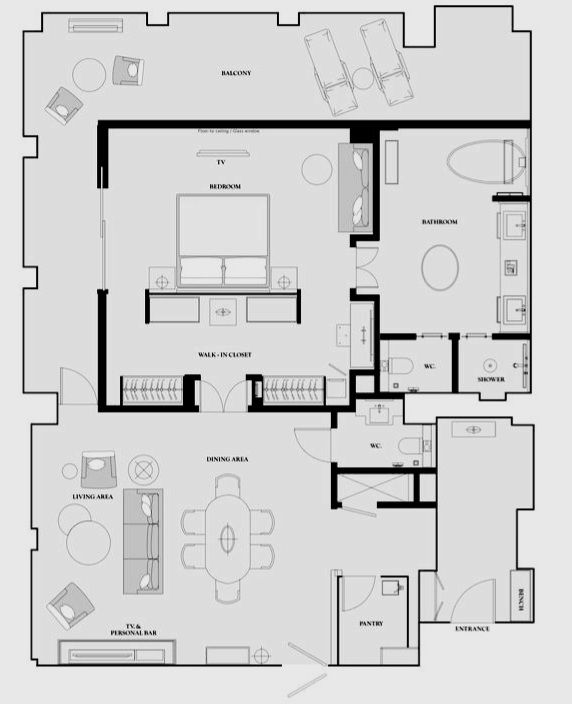
Layout of a luxury suite room
Space Requirements
- Bedroom – 400 sq.ft i.e. 14×16ft
- Bed- 76in×80in
- Walk-in closet- 7ft×10ft
- Sofa- 6ft×4ft
- Writing Table- 24in×12in
- Bathroom- 90 sq ft
- WC- 12 sq ft
- Shower Area – 80in×40in
- Bath Tub – 60in×30in
- Vanitary Counter- 30in×92in
- Living Area- 319 sq.ft or 12ft×18ft
- Pantry- 9in×36in
- Balcony- 1.5ft×2ft
- Personal Bar area- 42in tall× 8in wide
OR a. Pollution control is a critical area in hotel operation. Discuss. (5)
Pollution of various forms is a cause of great concern for existence of life on the earth. One of the most disconcerting effects of pollution is global warming. Other direct effects include increasing health problems, mental stress and strain, increase in the number of endangered species, ecological imbalance among others.
Hotels are properties where very high intensity of human and machine activities occur day in and day out. This is bound to produce all sorts of pollution and is subject to very stringent pollution control measures.
In tourist destinations, there will be surface transport carrying guests to and from the hotels, thereby causing great pollution from automobile emission.
Hotel Industry contributes to the following types of pollution:
• Water pollution
• Air pollution
• Soil pollution
• Noise pollution
Ways to control pollution in hotels
1. Install Energy Saving Technologies
It has been estimated that 75% of hotels’ environmental impacts can be directly related to excessive consumption—including energy consumption. Installing energy-efficient technologies such as appliances, lighting, and heating and cooling systems can make a difference for both the environment and your hotel’s bottom line.
2. Embrace Recycling
Another huge impact the hospitality industry has on the environment is due to the amount of waste hotels create. It’s time to embrace recycling, and we’re not just talking about using cloth napkins instead of paper.
3. Encourage Guests to be Green
Put cards in each room asking guests to turn out the lights when they leave, or reuse towels if possible. Make recycling bins readily available to guests and be sure that they are aware of your green programs. When guests see that your hotel is making an effort to help the environment, they will want to do their part as well.
4. Start Composting
An increasing number of hotels are realizing the benefits of composting food waste rather than throwing it out. Not only is it a popular and well-known green initiative that will impress your guests, it can save your hotel money on landscaping since composted waste can be used as organic fertilizer.
5. Save Water
There are so many ways hotels can save water: Installing toilet tank fill diverters in older toilets can save about 3/4 of a gallon of water per flush. Transitioning to nearly waterless laundry machines can save 80% of hotel water usage. Making water stations available to guests can discourage the use of bottled water. Follow the examples from other hotels that have implemented water-saving initiatives.
b. List the focus areas on energy conservation in hotels and indicate the latest trends in energy conservation.(5)
Focus Areas on energy conservation in Hotels –
1. Smart climate control
Hotels, with their random occupancy patterns, are finding that smart energy-management systems maximize their energy savings. These systems use sophisticated machine-learning algorithms and diverse data sets such as historical thermodynamics, local weather patterns and peak demand loads to optimize energy consumption in real-time, all year round
2. Air Source Heat Pumps
Smart thermostats aren’t the only way that business can save on their heating costs. Advances in HVAC hardware technology also offer businesses new opportunities to save on energy costs. Specifically, air source heat pumps make it possible to transfer heat from outside a building to inside it (or vice versa). The science behind ASHPs involves using the principles of vapor compression-refrigeration to absorb heat from one place and release it to another. The advantage for hotels is that ASHPs can be used as energy-efficient space heaters or coolers, removing the need to overload a central HVAC system to accommodate the specific needs of a smaller or compartmental space.
3. Smart Lighting Technology
Smart energy-management systems are not limited only to HVAC systems. Smart lighting technology also enables hotels to better understand their energy needs, automate their consumption and adapt to real-time to changes in occupancy. Some companies have managed to cut energy costs by 75 percent and improved productivity by 20 percent by converting to a smart LED lighting system. Just like EMS helps hotels adjust energy consumption based on real-time climate-control needs, smart lighting systems also enable properties to set preferred lighting times and track activity to improve workflow throughout the facility.
4. Solar Panel Technology
Rising economic superpowers and Australian suburbanites aren’t the only ones benefiting from the rise and proliferation in solar technology. Hotels of all sizes are leveraging increasingly affordable photovoltaic technology to reduce their energy costs. Solar power technology offers businesses a two-fold opportunity: to reduce energy consumption from the grid and sell excess production back into that grid. Therefore, hotels can save on their energy costs and subsidize whatever energy consumption they still have to pay for.
5. Automatic Shutdown Sockets
A significant energy cost for many hotels is vampire power draw. Also known as standby power, it refers to the way electric power is consumed by electronic and electrical appliances while they are switched off (but are designed to draw some power) or in a standby mode. This is where automatic shutdown sockets come in. These are simply smart power outlets that use infrared sensors or timers to cut power to any connected device when the device is not in use or the room is unoccupied. In other words, they allow hotels to save on powering devices whenever they are not in use.
6. Predictive Monitoring
Like energy-management systems that monitor, track and optimize energy consumption, predictive maintenance enables hotels to use sensor data to identify wasteful or hazardous trends and alert maintenance staff before the issue escalates into a much costlier one. For example, as an HVAC system fluctuates through different levels of performance based around occupancy needs, there will be wear-and-tear on its different physical components. Rather than waiting for a component to break down before being repaired or replaced, predictive maintenance enables engineering staff to predict maintenance needs based on system usage, prevent system failures and reduce the costs of operating a faulty system.
7. Smart Water Management
Water is a necessary requirement for life and every hotel relies on the stuff just to keep afloat. Whether it’s part of a manufacturing process or necessary to provide customers with food, drink and sanitary facilities, dihydrogen monoxide is an unavoidable cost of doing business. When considering how a single leaky toilet can cost as much as $840 a year plus the costs of any additional water damage, it’s easy to see how water can become an unnecessarily expensive business expense. By monitoring water lines with smart, low-cost water meters, however, facilities such as hotels and college campuses can see [return on investment] on their water consumption in less than five years.
Recent Energy Conservation Techniques are –
1. Use of LED
2. Use of smart technology
3. Use of Smart building design method
4. Use of smart Taps in bathroom
5. Use of Solar system
6. Use of auto cut of power when it is not in use
7. Use of low power consumption equipment
8. Use of high star rating equipment
9. Use of water harvesting system
10. Use of renewable source of energy.
Q.8. Trekking is traditionally an outdoor recreation activity. Discuss the factors to be considered for its planning. (10)
Factors to be considered while planning of trekking
a. Weather
In the mountains the weather can change from sun to clouds, wind, rain, or snow in a matter of minutes. Even during the summer in many places the weather can be absolutely unpredictable. We need to prepare for any possible weather condition on a given trail, including proper clothing and equipment.
b. Safety
Tragedy has struck hiking and trekking trails far too often, usually due to the carelessness of the hiker. Being lost or injured in the middle of the wild has proven tragic time and time again. These seemingly simple accidents lead often result disastrously. Occasionally the weather plays a part as well. Blizzard-like conditions that appear out of nowhere catch people unprepared. There are several very easy things you can do to help save yourself in an emergency situation. Walkie-talkies and cellular and even satellite phones are a big help if you are lost or injured. We can call the police, a park ranger, or someone else to let them know where you are at or might be. Flares and smoke signals that can be seen for miles around when lit can also help alert help.
c. Health
Hiking, just like walking or jogging, to get into shape is quite common. We can burn a tremendous amount of calories and add significant muscle mass by simply hiking into the mountains for a day. The steeper hills we walk, the more exercise and the bigger the burn in our calves.
The best hikers are in incredible shape, although mild trails can be walked by almost anyone. If we are not properly prepared to hike in extreme locations, we will quickly confront the effects of sore muscles, blisters, nausea, dizziness, or altitude sickness. Some may get to a point on the trail where they become too tired to go on or go back. It’s a dangerous game.
d. Medicine
When hiking in a strange country eating strange foods and the chance to drink unfiltered water is quite common, as are certain ailments. Medicines to counter these travel illnesses are recommended such as antibiotics and diarrhoea medicine. If hiking in tropical areas protection/vaccinations for malaria or yellow fever may be necessary. If biking in high altitudes some medicine may be available. Always consult with the doctor before entering a strange country.
e. Food and Water
Conserving and refilling your energy is one of the most important aspects of hiking and trekking. Having enough food and water to finish your trek, as heavy as it can be, is of the utmost importance. Some may know to live off the land, but most do not and there isn’t going to be a snack stand or McDonald’s in the desolate reaches of a national park. Food high in carbohydrates is recommended. Pre-packaged meals that weigh only a few ounces each before water is added can be a lifesaver. Energy bars are good too. You rarely can carry enough water for a long trek, so be sure to bring a filter or iodine tablets to purify water from rivers, streams, and melted snow.
f. Proper trekking Agency
While planning of trekking we must have to contact with a trekking agency so that they can help us with the ups and down of the trekking and can also provide us a proper team ,with which trekking can be fun and safe.
OR What is MICE? How are the hotels promoting this phenomenon?(10)
Meetings, incentives, conferences and exhibitions (MICE) is a type of tourism in which large groups, usually planned well in advance, are brought together. Recently there has been an industry trend towards using the term ‘meetings industry’ to avoid confusion from the acronym.
Other industry educators are recommending the use of “events industry” to be an umbrella term for the vast scope of the meeting and events and profession.
Most components of MICE are well understood, perhaps with the exception of incentives. Incentive tourism is usually undertaken as a type of employee reward by a company or institution for targets met or exceeded, or a job well done.
Unlike the other types of MICE tourism, incentive tourism is usually conducted purely for entertainment, rather than professional or education purposes.
MICE events are usually centered on a theme or topic and are aimed at a professional, school, academic or trade organization or other special interest group.
Examples: Medical Facilities, Theme Parks
Hotels Promoting MICE tourism by
a. By Attracting MICE tourists
Opportunities exist to work with hotels to develop an in-house TV channel that features activities appealing to MICE tourists such as weekend tours, theatre, golf options, restaurants, special cultural and recreational events and flight departure information.
b. Extending Business Trip
Extended hotel room access can encourage business travellers to extend their stay before or after their business meetings. The standard industry practice of delaying check-in until after 15:00 hours and requiring check-out by noon discourages business tourism add-ons.
Another way to encourage extended stays is to provide business support facilities so that the traveller can transact business efficiently 24 hours a day.
c. Influence Corporate Travel Managers
Arrival and departure times are often selected by corporate travel managers rather than by the individual business traveller. India can market its MICE tourism options to corporate travel managers in order to influence travel schedules, such as including early arrival so that travellers are rested & can conduct business efficiently.
d. Adding Airport Tourism
Apart from duty-free shopping, one-hour sightseeing packages can be worked out with the airports to make an inventory of the activities available to MICE travellers. Gaps to be addressed may include business centres with Internet access, exercise facilities, day rest rooms booked on an hourly basis, extended shopping options and short tours.
e. Business Services for Tourist Resorts
Upscale resorts opening around the world, as well as hotel properties being converted to conference resorts, are blending resort spa facilities with full- service business amenities. India can market itself as cost-effective, yet exotic locales, where corporate objectives can be met in a rejuvenating setting.
f. Tourism Packages for Conventions
International trade shows and conferences attract hundreds to thousands of delegates, often from many countries. Tourism and convention planners often include tourism add-ons for delegates. These events may include city tours, golf and sightseeing as a regular part of their programmes.
g. Families on Business Trips
A growing number of business travellers bring families on business trips. This creates an opportunity to work with hotels and convention centres to develop new offerings for children and spouses during business meetings. A world-famous hotel in Scotland, for example, has introduced a programme for children with diversions including a playroom, country club and participation in sporting activities. India can also ensure that its hotels can offer a safe and child-friendly “package” for business executives travelling with children.
h. Adventure Travel
Executives are increasingly attracted to the adventure venue business trip, which combines team building and strategic planning needs with adventure travel. One company, for example, designs adventure vacations for organisations designed to boost morale and develop leadership in corporate employees, while providing a “perk” in the way of a rafting trip or other exciting recreational venues. India which is already positioned in leisure & adventure tourism can also extend such products to the business traveller.
i. Corporate Travel Departments
Travel expenses have become the second or third largest controllable expense for most corporations engaged in MICE travel. As a result, heads of firms are becoming directly involved in mandating and monitoring travel policy. Close to 90% of United States companies now centralise their travel-policy development, 85% centralise cost monitoring, and slightly more than half centralise reservations and ticketing.
j. Travel Management Companies
Unlike travel agents, travel management companies see themselves as consultants with a focus on service and quality. We need to develop strategic relationships and build credibility with corporate travel management companies in order to successfully penetrate the MICE tourism markets.
k. Promotion through Internet
As in other areas of business, the Internet is becoming more important in promoting MICE tourism options and supporting travel arrangements. The hotels have to ensure that their Internet offerings are compatible with international programming standards and to provide MICE-specific tourism information on our national and regional tourism web sites.
Q.9. What is Feasibility Study? How does it help Project Managers? (10)
A feasibility study is a way to evaluate the practicality and desirability of a project. Before a company invests time and money into a project, they need to know how successful the project will be before investing.
Sometimes companies want to understand input costs, the amount of research that will need to be done, or even the marketability of a project. With input prices, it is essential that companies understand, (even before they put time and research into the project), how much it would cost to go through with their product.
Companies also like to know if they put time into research and go through with their change or promotion of a product, how the public/people will react to the change. Will people be fighting over the new product or will it fall through? The purpose of feasibility studies is to provide companies information and analysis on whether or not you or your company should pursue this course of action.
Types of Feasibility Study
1. Financial Feasibility
2. Commercial Feasibility
3. Technical Feasibility
4. Economic Feasibility
5. Social Feasibility
6. Environmental feasibility
7. Legal feasibility
8. Operational feasibility
9. Schedule feasibility
10. Market and real estate feasibility
11. Resource feasibility
Importance of Feasibility Study
• A feasibility study determines whether the project is likely to succeed in the first place.
• It is typically conducted before any steps are taken to move forward with a project, including planning. It is one of the—if not the—most important factors in determining whether the project can move forward.
• The study identifies the market for the project, highlights key goals for the project based on market research; maps out potential roadblocks and offers alternative solutions; and factors in time, budget, legal and manpower requirements to determine whether the project is not only possible but advantageous for the company to undertake.
• It can serve as a critical guideline as the project gets underway.
• Project managers can use the feasibility study to understand the project parameters, business goals and risk factors at play.
• Improves project teams’ focus
• Identifies new opportunities
• Narrows the business alternatives
• Enhances the success rate by evaluating multiple parameters
• Aids decision-making on the project
Q.10. Explain the following: (5+5=10)
a. Indoor recreation
Recreation is an activity of leisure, which is an essential element of human biology and psychology. Recreational activities are often done for enjoyment, amusement, pleasure or health benefits and are considered to be fun.
Recreation refers to the time spent in an activity one loves to engage in, with an intent to feel refreshed. It is a break from monotony and a diversion from the daily routine. It is a positive change from the stereotypical lifestyle.
Recreational activities give enjoyment because while recreating one engages in something he likes. They are a source of joy and provide relaxation for one’s mind and body.
Recreational activities can be grouped into two groups
a. Indoor Recreation Activities
b. Outdoor Recreation Activities
Indoor activities are also a part of the recreation programme. Indoor recreation activities are undertaken on the comfort of ones home or more specifically indoor and they are to recreate the mind and soul.
For such indoor recreation activities there are well-established clubs or recreation centres offer a varied programme of activities throughout the year.
Activities on offer include basketball, swimming, volleyball, chess, table tennis, bowling, singing, reading, listening to music, watching movies and more of the same.
For example, basketball is the most popular indoor sport and second most popular team sport after soccer. Basketball has many health benefits as it demands lot of physical work.
b. Therapeutic recreation
Therapeutic recreation is a systematic process that utilizes recreation (leisure) and other activities as interventions to address the assessed needs of individuals with illnesses and/or disabling conditions, as a means to psychological and physical health, recovery and well-being.
Recreational therapy may also be simply referred to as recreation therapy, in short it is the utilization and enhancement of leisure.
There are four approaches in therapeutic recreation:
a. Recreation services: Providing recreation services to people with disabilities for experiencing leisure and its benefits, often this takes a rehabilitation tone in approach for helping clients to reach an optimal level of health and well-being.
b. Therapeutic approach: The purpose of this approach is curative in nature. It attempts to lessen and ameliorate the effects of illness’ and disabilities, it also can be prescriptive for improving certain functional capacities.
c. Umbrella or combined approach: Use of recreation as a subjective continuation of enjoyable activities as well as a recreation service for bringing purposeful change.
d. Leisure ability approach: An approach that operates leisure activities therapeutically and engages the clients fully for participation with good dissemination on the benefits of structured leisure/ leisure awareness education (Gun & Peterson, 1978).
Eight domains of leisure are: leisure awareness, leisure attitudes, leisure skills, community integration skills, community participation, cultural and social behaviours, interpersonal skills.