
Table of Contents
Floor seals are semi-permanent finishes applied to the flooring to render it impermeable to protect the surface from dirt, stain and other liquids and to provide an easy to maintain surface. The floor surface must be clean and dry before a seal is applied or it will not ‘key’ to the surface. These act as a protective barrier by preventing the entry of dirt, grit, liquids, grease, stains, and bacteria. They prevent scratching and provide an easily maintainable surface. The right type of seal should be applied to each type of floor for effective protection and an attractive appearance. According to their functions, floor sealers can be finishing, protective, or a combination of both. They are also grouped as permeable, semi-permeable, and impermeable, according to their penetrability vis-a-vis water. Permeable seals can be used on wood, cork, stone (except slate), and magnesite floors. Impermeable seals should be avoided on these floors as the moisture naturally found within these floors will then get entrapped and may cause disintegration of the flooring. Impermeable seals may be used on PVCs, thermoplastic tiles, and rubber floors.
There are six main types of floor sealers, depending on their composition.
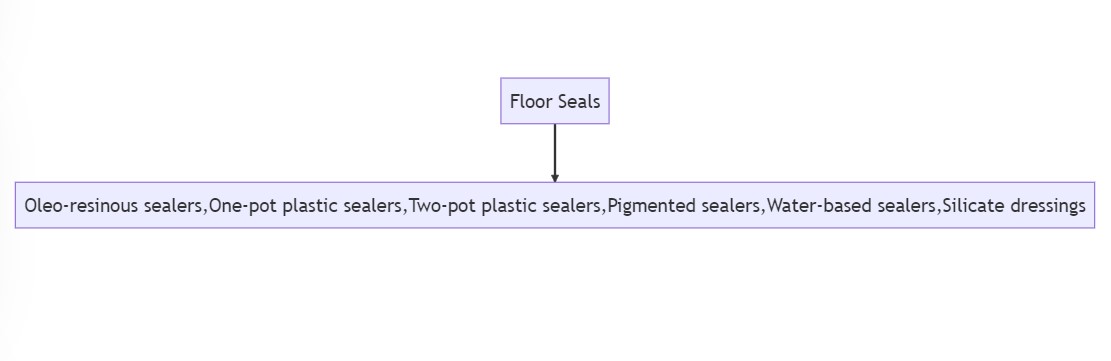
Oleo-resinous sealers
One-pot plastic sealers
- Urea-formaldehyde resin with an acid catalyst.
- Oil-modified polyurethane.
- Moisture-cured polyurethane.
Two-pot plastic sealers
This type of sealer is composed of a base such as urea. formaldehyde or polyurethane and an accelerator or hardener. The two components are kept separate until use, else a chemical reaction occurs between them and the mixture hardens in the can. Because of the separate components, the shelf life of these sealers is longer. The accelerator in itself has a shorter shelf life, however. The two components should be mixed in the recommended proportions, else the sealer will not harden and t will result in a patchy finish. This type of sealer should be used in a well-ventilated room as they smell strongly of solvent fumes. They may be used on wood, wood-composition, cork, and magnesite floors.
Pigmented sealers
- (a) One-pot synthetic rubber.
- (b) Two-pot polyurethane.