
Table of Contents
Q.1. What do you understand by the term Garde Manger? Give the breakdown of Larder’s work. Explain the liaison between larder and hot kitchen. (3+3+4=10)
The term Garde Manger originally identified a storage area. Preserved foods such as Hams, sausages, bacon, cheese, etc. were held in this area, cold foods for Banquets and Buffets are arranged here. Over the years this term evolved to mean more than just a storage area. It now also indicates a station in the professional kitchen, responsible for preparing Cold foods, Buffets, Decorative pieces, etc. and it’s Chefs who prepare them. Definition: The Larder is a department set aside for the storage of all perishable foods both raw and cooked and is also used for processing and preparation of all cold items served
the breakdown of Larder’s work is as follows:-
Butchery (including the fish mongery & ecaillage) the work of slaughtering animals and preparing them for other sections and restaurants takes place in the larder section. from cutting and cleaning of lamb, chicken, pork, veal to their processing takes place here.
Marinated Product preparation of Salads, Pickled Products, Brines / Cures – Smoked Products is also done in this section.
Cold Soups and Sauces are prepared here because it’s easy to create broth and stocks here and the same is used for making the soups and base sauces for the dishes served in the restaurant since it’s all done in bulk here to prepare dishes faster.
Appetizers and Hors d’oeuvres such as fruit starters or egg, fish, meat starters are made here to be served in lounges and restaurants. the cheese platter is also a common starter prepared here.
Forcemeat products are made hereafter processing and making forcemeats out of the cuts of different meat, some common preparations are Pâté, Galantine, Terrine, Sausage, Quenelle, etc.
Gelatin Products are made here because it’s quite convenient to extract gelation from the bones and joints of different animals and that gelatinous liquid can be used to make preparations such as Aspic, Mousse, Aspic jelly coating, Colle, Chaudfroid, etc.
Cold Fish and Meat are also treated and prepared here for eg Roasted, Poached, and grilled chicken and fishes
Pièce Montée also called Centerpiece are large decorative edible sculptures and designs which are used to increase the visual appeal of the buffets and parties. some centerpieces used for decoration are Ice-carving, Tallow/Butter Sculpture, Salt Dough, Vegetable & Fruit Carving.
Liaison between larder and the hot kitchen is important if confusion and wastage are to be avoided. Lack of liaison between the departments could result in duplication of work, or sometimes in certain processes not being carried out to the best advantage.
For Instance:
- Certain foods intended for cold service are best cooked in the Kitchen where there are greater facilities for carrying out the operation
- Pastry for pies or puddings, and various savories served from the Larder department, are best prepared by the Pastry staff, who will be more skillful in such work, and who are equipped with the necessary apparatus and tools for producing such items.
- Savory fillings as are required by the Pastry chef for such items as sausage rolls, patties, or pasties, ravioli, etc., will be prepared in the Larder and transferred to the Pastry department as and when required.
- Another important function of the Garde-Manger is to process and utilize the ‘leftover’ which is transferred from the Kitchen to the Larder at the conclusion of every meal.
- A number of garnishes or accompaniments to dishes served from kitchen departments are prepared by the Garde-Manger. Such items as stuffings, forcemeats, lardons or bacon rashers, are naturally provided by the Larder, as well as cold sauces for the accompaniment of hot dishes.
Or List major heavy equipment in the Larder department. Draw a neat diagram of the Larder department of a 5-star hotel. (4+6=10)
List major heavy equipment in the Larder department is as follows:
- Mincing machine and food processors
- The slicing machine
- Scales and weighing machines
- Electric grinding machine
- Salamander / grill / toaster
- Butcher’s blocks
- Other larder tools
- Serving spoons and ladles
- Sieves
- Colanders
- Conical strainers
- Meat presses
- Pie molds
- Whisks
- Egg slicers
- Steel basins
- Graters
The layout of the larder section:-
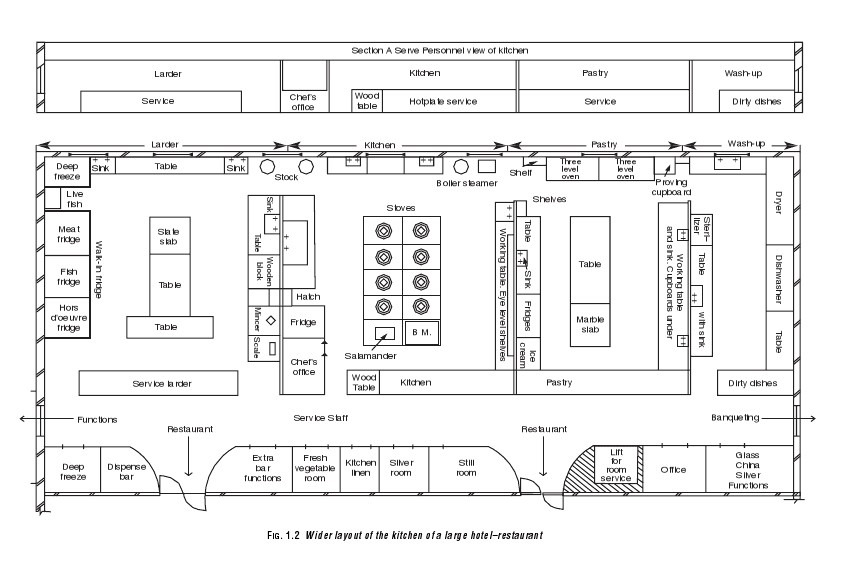
The larder of a 5-star operational kitchen will be segregated into the following section-
- Hors d’oeuvres and salad section
- Poultry and Butchery section
- The fish section.
- A general section with work tables.
- Cold rooms with deep freezer and walk-in facility.
- A weighing scale next to the entrance.
- Chef’s office.
Q.2. What do you understand by the term Forcemeat? What are the different components of forcemeat? (5+5=10)
The term Forcemeat or farce is used to describe the basic mixture that needs to be prepared in order to produce charcuterie products. The word farce comes from the Latin farce. A farce or forcemeat is a ground seasoned mixture of meat, game, poultry, fish, or vegetables, prepared as a dish on its own or used to stuff numerous other items such as eggs, meat, fish, and poultry, pastry shells and perhaps even pasta. Such dishes are prepared in the Garde Manger. Forcemeats are used in the preparation of various cold dishes such as pate, terrines, galantines, ballotines, quenelle, roulade, mousse, and mousseline. Traditional forcemeat /farce is made up of four parts:
The Meat
Consists of three elements:
The Dominant Meat (basic meat) which could include veal, game, poultry, rabbit, duck, or even fish. This will provide the dominant flavor and will also name the dish. e.g. chicken liver in a Chicken Liver Pate. These ingredients should be fresh and of prime quality. All bones, skin, sinews, and gristle must be removed and the flesh cut up into ½” pieces for grinding. The dominant meat normally accounts for 40% of the meat component.
- Lean Pork which contributes to the bulk as well as the flavor. This will be about 30% of the meat component. Nowadays, when preparing forcemeat using other varieties of meat, lean pork can be substituted with another subsidiary meat. For example, in a Lobster Mousse, the lean pork will be substituted with shrimp or some other cheap white fish. The important thing to remember is that the subsidiary meat should complement the dominant meat
- Pork fat which gives richness and smoothness to the product as well as for its binding qualities. This too will be 30% of the meat component. Again, other fats such as butter and cream can be substituted in order that the meat and fat compliment each other. In the Lobster mousse, the cream would be better suited as a fat instead of pork fat.
The Binding Agent
To lighten the farce and to give it a finer texture, binding agents are needed. These are typically used in the making of poultry, fish, and vegetable farce. The game, veal, and pork do have their own binding qualities, with the protein from the meat acting as binding agents.
Seasoning Flavoring and Garnish
Salt is an important part of the forcemeat. It helps to bring out the natural flavors of the other elements. 20 gm of salt/kilo of the mixture is a rough guideline to use. The salt must be evenly mixed to ensure equal distribution. Seasoning should not be extravagant to cover up for inferior quality ingredients. One mistake is to use excessive MSG for this purpose. Flavorings such as herbs and spices give character to the product.
The Additives
Many additives are included in the forcemeat. These include Nitrates and Nitrites of Sodium and Potassium, MSG, Sodium Erythorbate, BHT, and BHA, Salt Petre. These additives will enhance the color, increase shelf life, contribute to the taste and flavor, and prevent/delay the fat from going rancid.
Or Differentiate between Galantine and Ballotine. Describe the process of making chicken Galantine. (5+5=10)
Galantine:- This indicates a dish made with chicken or breast of veal. The chicken or veal is boned and stuffed, then rolled in a cloth and simmered in stock or braised until tender. The roll is then pressed and glazed and served cold. The term is now more loosely applied, and a galantine can be made with beef or game. The mixture is sometimes cooked in a mold.
Ballantine:- Meat, fish, or fowl that has been boned, stuffed, rolled, and tied in the shape of a bundle. It is then braised or roasted and is normally served hot but can be served cold. Often confused with galantine, which is poached and served cold.
Method of making chicken galantine is:-
- Preheat the oven to 160C.
- Bone chicken – your butcher will do this for you, just give him a little notice.
- Generously season the inside of the chicken with salt and pepper. Set aside.
- In a large bowl, combine the pork mince, chorizo, olives, paprika, parsley, basil, and garlic.
- Arrange the stuffing lengthways along the inside of the chicken.
- Roll the chicken around the stuffing. Fasten with a skewer and tie with butchers twine.
- Roast in your preheated oven for about a 1 hour or until the core temperature of chicken reaches 72C.
- Rest for 10-15mins before carving.
Q.3. Define the term Charcuterie. Classify sausages with examples. (3+7=10)
In French, the word characteristic is derived from charcuterie, meaning cooked meat. It usually centers around pork products, including some of the pride of French cuisines. Pate’s and terrines ranging from the simple pureed liver to textured real Pates or rustic country mixtures studded with hazelnuts or peppercorns and a selection of stuffed galantines and Ballantine’s coated with aspic. Ham, bacon, sausages and cured meats are the staple of charcuterie, found around the worldWide in innumerable guises. Traditionally, charcuterie consists only of completely or partially prepared pork dishes, but nowadays it also includes games or real and ham pies, as well as pork pies and pate en croute. Fish and vegetable terrines and mousselines as well as the famous pate de foie gras and even prepared salads are also included in the range.
Sausages can be classified as followed:-
Fresh sausages
Fresh meats (chiefly pork); uncured, comminuted, seasoned, and usually stuffed into casings; must be cooked fully before serving. examples: Fresh pork sausage, Bratwurst
Dry and semi-dry sausages
Cured meats; fermented air-dried, maybe smoked before drying; served cold. examples: Genoa salami, Pepperoni, Lebanon bologna.
Cooked sausages
Cured or uncured meats; comminuted, seasoned, stuffed into casings, cooked and sometimes smoked; usually served cold. Examples: Liver sausage, Summer sausage, Braunschweiger, Liver cheese.
Cooked, smoked sausages
Cured meats; comminuted, seasoned, stuffed into casings, smoked, and fully cooked; do not require further cooking, but some are heated for serving. Examples: Frankfurters, Bologna, Cotto salami.
Uncooked, smoked sausages
Fresh meats; cured or uncured, stuffed, smoked, but not cooked; must be fully cooked before serving examples: Smoked, country-style pork sausage, Mettwurst, Kielbasa.
Or With the help of a neat diagram identify different parts of Bacon Carcass and mention the best cooking methods for each cut. (7+3=10)
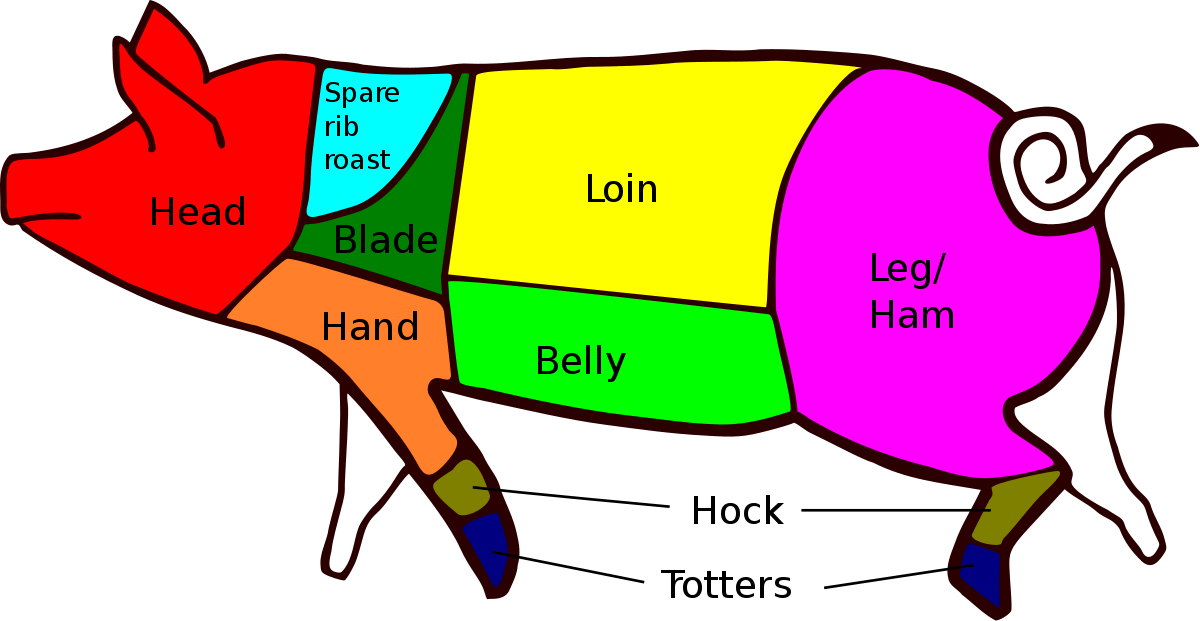
Head
This can be used to make brawn, stocks, and soups. After boiling the ears can be fried or baked and eaten separately, which are crunchy due to cartilage bones. It is considered a delicacy. Best cooking method: Roasting
Spare Rib
This is the shoulder and contains the shoulder blade. It can be boned out and rolled up as a roasting joint, or cured as “collar bacon”. Not to be confused with the rack of spare ribs from the front belly. Boston Butt, or Boston-style Shoulder, cut comes from this area, and may contain the shoulder blade. Best cooking method: Barbeque or baking in the oven.
Hand/Arm
This can be cured on the bone to make a ham, or used in sausages. Best cooking method: Slow roasting
Loin
This can be cured to give back bacon or Canadian-style bacon. The loin and belly can be cured together to give a side of bacon. The loin can also be divided up into roasts (blade loin roasts, center loin roasts, and sirloin roasts come from the front, center, or rear of the loin), back ribs (also called baby back ribs, or riblets), pork cutlets, and pork chops. A pork loin crown roast is arranged into a circle, either boneless or with rib bones protruding upward as points in a crown. Best cooking method: roasting and baking
Belly
The belly, although a fattier meat, can be used for steaks or diced stir-fry meat. Belly pork may be rolled for roasting or cut for streaky bacon. Best cooking method: slow roasting, frying.
Legs/Hams
Although any cut of pork can be cured, technically speaking only the back leg is entitled to be called a ham. Legs and shoulders, when used fresh, are usually cut bone-in for roasting, or leg steaks can be cut from the bone. Three common cuts of the leg include the rump (upper portion), center, and shank (lower portion). Best cooking method: steaming, roasting, smoking.
Trotters
Both the front and hind trotters can be cooked and eaten, as can the tail. Best cooking method: Braising
Q.4. How are Appetizers broadly classified? What are the different parts of the canapé? Write the importance of spreads used for making canapé. (4+3+3=10)
Classification Of Appetizers:
cocktails
consist of several bite-sized pieces of fish, shellfish, drinks and fruits served with tangy flavored sauce. They must be fresh in appearance and arranged attractively to have an eye appeal. Various cocktails are-Juices of orange, pineapple, grapefruit, or tomato served with cold salad dressings.
Hors D’ Oeuvres
are small portions of highly seasoned foods formerly used to precede a meal served either hot or cold. Simplicity should be the main criteria for making the hors d oeuvres. Although most hors d oeuvres are served cold, there are also hot ones.
Canape
a bite-sized or two bite-sized finger food consisting of three parts: a base, a spread or topping and garnish or garniture. They are savory titbits of food. They could be served hot or cold. The items should be dainty, petite, fresh, having an eye appeal, and color contrasts. There are no set recipes for making canapes. Individual or a combination of several different colored items are used on the small fancifully cut pieces of bread, toasted or fried, and biscuits, etc. The larger canapes are termed as ZAKUSKIS after the Chef Zakuski.
Relishes/crudites
they are pickled items and raw, crisp vegetables such as julienned carrots or celery sticks. relishes are generally placed before the guest in a slightly, deep, boat shape dish.
Petite Salad
they are small portions and they are usually displaying the characteristics found in the most salad.
Soups And Consommes
are included in the appetizer category because they are served in this course more than ever before.
Chips And Dips
savory dips are popular accompaniments to potato chips, crackers, and raw vegetables. proper consistency is important for many dip you prepare. it must not be so thick that it cannot be scooped up without breaking the chip or crackers, but it must be thick enough to stick to the items used as dippers.
These are tiny open-faced snacks, which are cut into a variety of shapes – round, rectangular, oval, triangle, or other shapes. The size and thickness will depend upon the nature of the ingredients used. A canapé will have three parts:
- The base – which would normally be bread – toasted or plain, white or brown. However, a variety of other base ingredients could also be used – puff pastry, flaky pastry, shortcrust, pizza dough, choux pastry, are examples of the variety that can be used. Sometimes, a spread would be applied to the base to prevent it from soaking up the moisture of the topping.
- The topping – almost anything could be used to top the base. However, it should be suitable and must complement the base. It should be fairly dry and must hold shape. A slice of cheese, hard-boiled egg, ham, salami, mushrooms, or chicken coated with a thick cream sauce, marinated mushrooms, and prawns could all be used as a topping. The list is limitless and can only be contained by the imagination.
- The garnish – this is done more to increase the visual appeal and the appearance than for any functional value. A slice of olive, a sprig of parsley, a dice of capsicum or even a green pea can all be used to increase the presentation of the platter of canapés
Importance of spreads used for making canapes are:-
- It also forms a protective layer on the bread and prevents it from getting soggy from the moisture in the filling.
- it adds to the taste of the canape and in the case of children, contributes to the nutritive value.
- It makes the canape more moist, soft, and palatable.
Or Classify herbs. Write the ideal uses of wine in cooking. (5+5=10)
Herbs are classified in many ways. Some of them are:
- According to the usage
- According to the active constituents
- According to the period of life
According to the usage:
the herbs are classified into 3 parts:
- Medicinal Herbs – Medicinal herbs have curative powers and are used in making medicines because of their healing properties.
- Culinary Herbs – Culinary herbs are probably the most used as cooking herbs because of their strong flavors like mint, parsley, basil.
- Ornamental Herbs – Ornamental herbs are used for decoration because they have brightly colored flowers and foliage like lavender, chives.
According to the active constituents:
the herbs are divided into five major categories:
- Aromatic Herbs – Aromatic Herbs, the name is a reflection of the pleasant odor that many of these herbs have. They are used extensively both therapeutically and as flavorings and perfumes.
- Astringent Herbs – Astringent Herbs have tannins, which have the ability to precipitate proteins, and this “tighten,” contracts, or tones living tissue, and helps to halt discharges.
- Bitter Herbs – Bitter Herbs are named because of the presence of phenols and phenolic glycosides, alkaloids, or saponins
- Mucilaginous Herbs – Mucilaginous herbs derive their properties from the polysaccharides they contain, which give these herbs a slippery, mild taste that is sweet in water.
- Nutritive Herbs – These herbs derive both their name and their classification from the nutritive value they provide to the diet. They are true foods and provide some medicinal effects as fiber, mucilage, and diuretic action.
According to the period of life:
these herbs also can be classified as :
- Annual herbs – These plants complete their life cycle in one year; start them from seed.
- Biennial herbs – These are plants that live two seasons and bloom in the second season only.
- Perennial herbs – They grow for more than one season and include sweet marjoram, parsley, mint, sage, thyme, and chives. Most can be started from young plants except for parsley.
The Uses Of Wine In Cooking:
- Marinades Both red and white wine are used as marinades for meat. One of the primary uses is for the flavor, but wines also help to tenderizer the meat and remove offensive flavors, if there are any.
- Sauces Wines are used for making sauces, both for savory items as well as desserts. Most of the stock-based sauces are a mixture of stock and wine reduced to a glaze and then thickened with soft butter or various thickening agents.
- Deglazing This is the most versatile method employed to retain the flavor of the sauce. Deglazing is the process where the liquid, such as wine and stock, is used for dissolving the remains of the cooked food in a pan.
- Flaming Wines and spirits are alcohol. Thus, upon igniting, these wines flare up and burn until the alcohol burned off. This principle is used for flaming various dishes to give a good visual appeal.
- Stocks Wines are commonly used for flavoring stocks. Apart from adding flavor, wines are also added for various other reasons, one of them being to make an acidic stock called court bouillon.
Q.5. Write short notes on: (4x 2 ½ =10)
(a) Ballotine
Meat, fish, or fowl that has been boned, stuffed, rolled, and tied in the shape of a bundle. It is then braised or roasted and is normally served hot but can be served cold. Often confused with galantine, which is poached and served cold.
(b) Gammon
Gammon is the hind leg of pork after it has been cured by dry-salting or brining. It may or may not be smoked. Like bacon, it needs to be cooked before it can be eaten. It may be sold on-the-bone or without bone, or as steaks or slices. It differs from a ham in that ham is cured after being cut from the carcass and the curing process for ham may be different.
(c) Truffle
A truffle is the fruiting body of a subterranean fungus, predominantly one of the many species of the genus Tuber. Truffles are ectomycorrhizal fungi, so they are usually found in close association with tree roots. Spore dispersal is accomplished through fungivores, animals that eat fungi. These fungi have significant ecological roles in nutrient cycling and drought tolerance.
(d) Salt dough
Salt dough is a modeling material made from a mixture of flour, salt, and water. It can be used to make ornaments and sculptures and can be dried in the oven or microwave. It can be sealed using varnish or polyurethane and can be painted with acrylic paint, or colored using food coloring, natural coloring, or paint mixed in with the flour or water.
Q.6. What are the different types of non-edible displays observed in hotels? List the special equipment required for Ice Carving. (6+4=10)
Different types of non-edible displays are as follows:-
Ice Carvings
The ice sculpture is the highlight of any buffet, the artistic touch, the focal point. Ice can be carved in any shape, size, or figure that fits the theme or occasion. For example, for Christmas, there could be a Santa Claus, for an anniversary, a heart.
Tallow work
When deciding on the selection of a pattern for a tallow display piece, it is essential that the display piece chosen to match the theme of the food design buffet. It is even more desirable, to select a pattern that may also fit into the décor theme of other buffets at a later date. Creating on eye-catching tallow piece is always time-consuming and should be planned well in advance.
Butter and margarine carvings
Very often in place of tallow, butter and margarine are used to produce centerpieces. Margarine is the preferred medium as it has a higher melting point and is easier to handle than butter. An outline of the sculpture is made out of suitable stiff material such as a wire piece, aluminum foil, and strips of wood.
Saltillage
Basic Salt Dough for Sculptures
- 1 cup of cold water
- 1 cup of corn starch
- 2 cups warm popcorn salt.
Salt dough is a modeling material made from a mixture of flour, salt, and water. It can be used to make ornaments and sculptures and can be dried in the oven or microwave. It can be sealed using varnish or polyurethane and can be painted with acrylic paint, or colored using food coloring, natural coloring, or paint mixed in with the flour or water.
Sugarcraft (Pastillage)
This could include:
- Pulled sugar
- Poured Sugar
- Blown Sugar
- Spun Sugar
Cooked sugar can be used in various forms to provide stunning works of art. They could adorn a dessert buffet.
Chocolate moldings
Tempered chocolate can be used to make figures which can be attractively arranged to be used as centerpieces during festive times like Christmas and Easter. They are also used to adorn the dessert buffet.
Fruit and vegetable carvings
Very attractive centerpieces can be made by carving various shapes out of fruits and vegetables. Large pumpkins, melons, and such vegetables can be used as containers or carved into objects such as boats and ships. The variety in the color of vegetables and fruits adds a lot to the eye appeal and the presentation of the centerpiece.
special types of equipment required for Ice Carving are as followed:
- Snow Sculpting Tools.
- Hand Saws.
- Chisels.
- Junichi Tools.
- Ice Tongs.
- Jigs and Compasses.
- Nail and Scratchy Boards.
Q.7. Explain the following terms: (10×1=10)
(a) Darne
A darne is a thick section cut from a substantial fish, such as salmon or tuna. The word is French (darne de saumon might be roughly translated as ‘salmon steak’), but it comes originally from Breton darn, which means ‘piece’.
(b) Parfait
a dessert made of rich cream, eggs, syrup, etc. frozen together and served in a tall, slender, short-stemmed glass
(c) Lorette
In France, a name for a woman who is supported by her lovers, and devotes herself to idleness, show, and pleasure; — so called from the church of Notre Dame de Lorette, in Paris, near which many of them resided.
(d) Albufera
Sauce Albuféra) is a small compound sauce. The base of the sauce uses the mother sauce (or leading sauce) velouté. Escoffier gives a recipe in Le Guide Culinaire which consists of a base of Suprême sauce to which is added meat glaze in order to lend the latter an ivory-white tint that characterizes it.
(e) Dame Blanche
Dame Blanche (French, “white lady”) is the name used in Belgium and the Netherlands for a sweet dessert consisting of vanilla ice cream with whipped cream, and warm molten chocolate.
(f) Portugaise
Cooked according to the Portuguese style (in savory dishes usually with tomatoes and frequently also onions and garlic).
(g) Mortadella
Mortadella is a large Italian sausage or luncheon meat made of finely hashed or ground heat-cured pork, which incorporates at least 15% small cubes of pork fat (principally the hard fat from the neck of the pig).
(h) Chorizo
Chorizo (from Portuguese) is a type of pork sausage. Traditionally, it uses natural casings made from intestines, a method used since Roman antiquity. chorizo is a fermented, cured, smoked sausage, which may be sliced and eaten without cooking, or added as an ingredient to add flavor to other dishes.
(i) Lindstrom
Lindström is a Swedish dish made from onion, potato, red beet, capers, and ground beef, which is made into patties and fried.
(j) Cardinale
Sauce Cardinale is a classic French Compound Sauce made from a Béchamel Sauce flavored with Fish Stock and Truffle Essence, seasoned with cayenne pepper and Finished with lobster butter.
Q.8. Differentiate between the following terms: (4×2 ½ =10)
(a) Roulade and Dodine
| Gratin | Mousseline |
|---|---|
| Partial cook some of the meats before grinding or pureeing the forcemeat. Livers, especially poultry, are commonly used and mixed with a panada. Eggs, cream, and panada are used as a binder. Gratin forcemeats are used as terrines or packed into crocks as a spreadable mixture. | Very light in texture, utilizing lean cuts of meat usually from veal, poultry, fish, or shellfish. The resulting texture comes from the addition of eggs and cream to this forcemeat. A forcemeat made with lean meat, fish or poultry, and emulsified with cream and egg whites (1-2 egg whites per lb./450 g of lean meat). Delicate forcemeat is suitable for lighter fish and seafood emulsions. Used for pates, terrines, quenelles or ravioli fillings |
(b) Pâté and Terrine
| Pâté | terrine |
|---|---|
| Pâté is a paste, pie or loaf consisting of a forcemeat that at least contains liver. Common additions include ground meat from pork, poultry, fish or beef, fat, vegetables, herbs, spices, and either wine or brandy (often cognac or Armagnac). Pâté can be served either hot or cold, but it is considered to develop its best flavors after a few days of chilling. | A terrine, in traditional French cuisine, is a loaf of forcemeat or aspic, similar to a pâté, that is cooked in a covered pottery mold (also called a terrine) in a bain-marie. Terrines are usually served cold or at room temperature. Most terrines contain a large amount of fat, although it is often not the main ingredient, and pork; and many terrines are made with typical game meat, such as pheasant and hare. |
(c) Mousse and Mousseline
| Mousse | Mousseline |
|---|---|
| A mousse is soft prepared food that incorporates air bubbles to give it a light and airy texture. It can range from light and fluffy to creamy and thick, depending on the preparation techniques. A mousse may be sweet or savory. Sweet mousses are typically made with whipped egg whites or whipped cream, and flavored with one or more of chocolate, coffee, caramel, puréed fruits, or different herbs and spices. Savory mousses are made from meat, fish, shellfish, foie gras, cheese, or vegetables. Hot mousses often get their light texture from the addition of beaten egg whites. It is sometimes stabilized with gelatin. | Mousseline may be used either for a sauce or for a type of fabric. Sauce Mousseline is also known as Sauce Chantilly, is produced by folding whipped cream into hollandaise sauce. Mousseline is also used for a very fine, semi-opaque fabric that is similar to muslin. It is a cotton fabric of plain weave. A very fine, semi-opaque fabric similar to muslin, typically made of silk, wool, or cotton. A soft, lightly sweet, or savory mousse. A hollandaise sauce that has been made frothy with whipped cream or egg white, served mainly with fish or asparagus. |
(d) Sandwich and Zakuski
| sandwich | zakuski |
|---|---|
| A sandwich is a food typically consisting of vegetables, sliced cheese or meat, placed on or between slices of bread, or more generally any dish wherein bread serves as a container or wrapper for another food type. … The sandwich is named after its supposed inventor, John Montagu, 4th Earl of Sandwich. | A zakuski is a Russian term for hot and cold hors d’oeuvres, snacks, appetizers, served before meals. Usually presented buffet style, it often consists of cured meats and fishes, various pickled vegetables such as beets, cucumbers, and garlic, mixed salads, hard cheeses, caviar, and bread. These appetizers are often present at parties or receptions, especially in Armenia and Russia. Usually, zakuski are the first food already laid on the table when guests are called to the dining room. Iced vodka or other alcoholic beverages is often served with the appetizers. |
Q.9. What is a casing? What are the different types of casing? What is the Progressive grinding method? (2+4+4=10)
Sausage casing, also known as sausage skin or simply casing, is the material that encloses the filling of a sausage. Natural casings are made from animal intestines or skin; artificial casings, introduced in the early 20th century, are made of collagen and cellulose.
Different types of casings used in sausage making are as follows:-
Natural casings
These are made from the intestines of animals such as hogs, pigs, wild boar, cattle, and sheep. The intestine is a very long organ and is ideal for a casing of the sausage. They should be refrigerated at all times. Natural casings are available in Australia, New Zealand, and South America where cattle are reared on a very large scale.
Collagen casings
These are edible and are not synthetic casings. They are made from the hide of cattle. Collagen is obtained from the corium layer that is situated just under the skin of the animal. The fat, flesh, and hair are removed from the hide and it is split into two layers by special equipment.
Fibrous cellulose casings
These are by-products of the food processing industry. Cellulose and fiber are extracted from the husk, skin, peels, pips, and seeds of the fruit and vegetables during the processing stage. These are processed further to make casings. These types of casings are also referred to as peel-able cellulose
Protein lined fibrous cellulose casings
A protein lining is often added to the inside of the above type of casing. These casings are ideal for the dried sausages. The protein lining causes the casing to shrink as the meat is cooked or dried so that it retains the shape of the sausage.
Progressive grinding method is used to mix the emulsion evenly, and to produce a smooth refined texture. The product is processed through a grinder 2-3 times starting with a large grind, then to a medium, and finally to a fine grind.
Q.10. Define Chaud Froid. Describe the process of making Chaud Froid sauce. Write atleast four uses of Chaud Froid sauce.
Chaud – Froid, translated literally means hot – cold. This name refers to the fact that the sauce is cooked and is applied hot, but then chilled and served cold. The high gelatin content of the sauce makes it possible to apply it to an item while still warm and flowing. As the sauce cools, it gels and adheres to the product. It gives a smooth, pristine surface and seals the product from the air.
The two primary methods of preparing Chaud – froid are:-
The Classical Method:
The classical method calls for the use of Béchamel or Veloute. This is reduced with a stock, suitable for the product that needs to be coated. This reduction is then fortified with a suitable aspic jelly and cream.
The Contemporary Method:
A modern variation of the sauce is prepared without a base of the roux. The result is a sauce, which has a less starchy mouth feel. The method is also faster to prepare.
four uses of Chaud Froid sauce are:-
- Protection of the item from the air while it sits on the buffet.
- The sauce acts as a background or a canvas on which to decorate. The chaud froid is an adornment itself.
- The sauce can complement the flavor of the coated item.
- Helps in preserving the flavor and moisture from the dishes.