
Table of Contents
Q.1. In a tabular form classify catering establishments. Explain restricted market catering in brief.
| Type of Catering Establishment | Description |
|---|---|
| Banquet Halls | A large venue typically used for weddings, corporate events, and other large-scale gatherings. Provides catering services, often in-house or through a preferred vendor list. |
| Event Planners | Companies or individuals who specialize in planning and executing events, including catering services. |
| Restaurants | Establishments that provide food and beverage services to the public. May also offer catering services for events and parties. |
| Food Trucks | Mobile kitchens that offer a variety of food options and can be hired for events and parties. |
| Catering Companies | Specialize in providing food and beverage services for events, parties, and other gatherings. May also provide equipment rental, staff, and event planning services. |
Restricted market catering refers to catering services that are provided to a specific group of people or within a specific context. For example, catering for a school cafeteria or a hospital would be considered restricted market catering. In these cases, the catering service is not open to the general public, but rather serves a specific group of people who have access to the establishment.
One key aspect of restricted market catering is that the menus are often tailored to the specific needs and preferences of the target group. For instance, a school cafeteria may offer meals that meet certain nutritional standards and cater to the tastes of children. Similarly, a hospital may offer meals that are appropriate for patients with specific dietary restrictions.
Another important aspect of restricted market catering is that it often involves long-term contracts or agreements. This allows the catering company to provide consistent service over an extended period of time and to build a strong relationship with the client. Additionally, because the target group is often large, catering companies that specialize in restricted market catering can benefit from economies of scale and may be able to offer more competitive pricing.
Examples of restricted market catering include:
- School cafeterias
- Hospital and healthcare facility food service
- Corporate cafeterias
- Military mess halls
- Correctional facility food service
In summary, restricted market catering refers to catering services that are provided to a specific group of people or within a specific context. These services often involve tailored menus, long-term contracts, and competitive pricing. Examples of restricted market catering include school cafeterias, hospital food service, and corporate cafeterias.
OR What do you understand by welfare catering? Give examples and explain any one in detail.
Welfare catering refers to catering services that are provided to institutions or organizations with a focus on promoting health, nutrition, and well-being. The primary goal of welfare catering is to provide nutritious, healthy, and well-balanced meals that meet the dietary needs of the target group. Welfare catering is often associated with organizations such as schools, hospitals, and nursing homes, where the well-being of the individuals being served is of paramount importance.
Here are some examples of welfare catering:
- School meal programs: In many countries, school meal programs are a key component of welfare catering. These programs provide free or subsidized meals to students, with a focus on promoting health and nutrition. School meal programs may also provide nutrition education and counseling to students and their families.
- Hospital and healthcare facility food service: Hospitals and healthcare facilities often provide food service to patients, staff, and visitors. These services may include inpatient meal service, cafeteria service, and catering for special events. The focus is on providing meals that meet the dietary needs of patients and promote their recovery.
- Elderly care facilities: Elderly care facilities such as nursing homes and assisted living facilities often provide food service to residents. The focus is on providing nutritious and well-balanced meals that meet the dietary needs of the elderly population.
- Workplace wellness programs: Some companies offer workplace wellness programs that include food service. These programs may provide healthy snacks, meals, or catering for company events with a focus on promoting employee health and well-being.
School meal programs are designed to provide healthy, nutritious meals to students who might not otherwise have access to them. These programs are typically operated by schools or local government agencies and are subsidized by the government or other funding sources.
School meal programs may offer breakfast, lunch, and/or snacks to students. The menus are designed to meet the nutritional needs of growing children, with an emphasis on fruits, vegetables, whole grains, and lean proteins. School meal programs may also offer vegetarian or vegan options, as well as meals that accommodate food allergies or intolerances.In addition to providing meals, school meal programs may also offer nutrition education and counseling to students and their families. This can help to promote healthy eating habits and improve overall health and well-being. Some school meal programs also incorporate local food systems and sustainable agriculture practices, which can help to support the local economy and promote environmental sustainability.
Overall, welfare catering plays an important role in promoting health, nutrition, and well-being in a variety of settings. Whether it’s providing meals to students, patients, or elderly residents, welfare catering helps to ensure that individuals have access to the nutritious food they need to thrive.
Q.2. List the hierarchy of a French and American fine dining restaurant.

OR
What are the duties and responsibilities of the senior captain?
The senior captain is a key member of the restaurant or catering team who is responsible for overseeing the dining experience for guests. Here are some of the key duties and responsibilities of a senior captain:
- Supervision of the Dining Room: The senior captain is responsible for supervising the dining room and ensuring that guests receive high-quality service. This includes managing the work of other servers and ensuring that they are meeting service standards. The senior captain may also be responsible for training new servers and ensuring that all staff adhere to the restaurant or catering establishment’s policies and procedures.
- Greeting and Seating Guests: One of the primary responsibilities of the senior captain is to greet guests as they arrive and assist with seating them. This involves being knowledgeable about the establishment’s layout and seating arrangements, as well as being able to accommodate special requests and preferences from guests.
- Taking Orders: The senior captain may be responsible for taking orders from guests, especially for large parties or events. This involves being knowledgeable about the establishment’s menu and specials, as well as being able to make recommendations to guests based on their preferences.
- Coordination with Kitchen Staff: The senior captain is responsible for coordinating with the kitchen staff to ensure that orders are prepared and served in a timely and efficient manner. This involves communicating any special requests or dietary restrictions from guests, as well as ensuring that all orders are accurate and complete before they are served to guests.
- Handling Guest Complaints: If a guest has a complaint or concern about their dining experience, the senior captain is responsible for handling the situation in a professional and courteous manner. This may involve listening to the guest’s concerns, offering a solution or compensation, and following up to ensure that the guest is satisfied with the resolution.
- Upselling and Promoting Specials: The senior captain may be responsible for upselling menu items and promoting specials to guests. This involves being knowledgeable about the establishment’s menu and specials, as well as being able to make recommendations to guests based on their preferences.
- Managing Reservations: The senior captain is responsible for managing reservations and ensuring that guests are seated in a timely and efficient manner. This involves being knowledgeable about the establishment’s reservation system and ensuring that guests are seated according to their preferences and special requests.
- Maintaining Cleanliness and Organization: The senior captain is responsible for maintaining a clean and organized dining room. This includes ensuring that tables are properly set, linens are clean, and silverware is polished. The senior captain may also be responsible for ensuring that the dining room is stocked with supplies and equipment, such as glassware, silverware, and condiments.
- Training and Development of Staff: The senior captain may be responsible for training and developing other members of the restaurant or catering team. This involves sharing knowledge and best practices with other staff members, as well as providing feedback and coaching to help them improve their skills and performance.
- Managing Guest Feedback: The senior captain is responsible for managing guest feedback and ensuring that it is communicated to the appropriate staff members. This may involve gathering feedback from guests, compiling it into a report, and presenting it to management for review.
Overall, the senior captain plays a crucial role in ensuring that guests receive high-quality service and have an enjoyable dining experience. By managing the dining room, coordinating with kitchen staff, handling guest complaints, and promoting specials, the senior captain helps to create a positive atmosphere that encourages guests to return.
Q.3. Explain different operating outlets in the F&B Service department of a large hotel.
The Food and Beverage (F&B) Service department of a large hotel can have several operating outlets that cater to different types of customers and occasions. Here are some of the different operating outlets commonly found in the F&B Service department of a large hotel:
- Restaurant: The restaurant is the main F&B outlet in a hotel and serves meals throughout the day. It can have a variety of dining options, such as a buffet, à la carte menu, and set menu. The restaurant can also have different themes and cuisines to cater to diverse customer preferences.
- Bar: The bar is another popular F&B outlet in a hotel that serves a variety of alcoholic and non-alcoholic beverages. It can also have a bar menu with snacks and light bites to complement the drinks. Some hotels also have specialty bars, such as a wine bar or a cocktail bar.
- Lounge: The lounge is a comfortable seating area where guests can relax and enjoy drinks, snacks, and light meals. It is usually located near the lobby and can be used as a waiting area for guests.
- Café: The café is a casual F&B outlet that serves coffee, tea, and light meals such as sandwiches, pastries, and cakes. It is usually open throughout the day and can be a popular spot for guests to socialize or work.
- Room Service: Room service is a convenient F&B option for guests who prefer to dine in their rooms. It can offer a limited menu of popular dishes from the restaurant and can be available 24/7.
- Banquet Hall: The banquet hall is a large event space that can be used for conferences, weddings, and other social events. It usually has a separate kitchen and F&B team to cater to large groups of people.
- Poolside Bar and Restaurant: The poolside bar and restaurant is a popular F&B outlet for guests who want to relax by the pool while enjoying drinks and meals. It can have a casual atmosphere and offer light bites and snacks.
- Specialty Restaurant: Some hotels have specialty restaurants that offer unique dining experiences and cuisines, such as a seafood restaurant, steakhouse, or sushi bar. These restaurants can be popular with hotel guests and also attract outside customers.
- In-Room Dining: In-room dining is a convenient F&B option for guests who prefer to dine in their rooms. It can offer a limited menu of popular dishes from the restaurant and can be available 24/7.
- Private Dining: Private dining is a special F&B option for guests who want to have a more intimate dining experience. It can be arranged in a private room or a secluded area of the restaurant and can include personalized menus and services.
Overall, the different operating outlets in the F&B Service department of a large hotel cater to a diverse range of customers and occasions. From the main restaurant to the specialty bars and private dining options, the F&B Service department plays a crucial role in providing high-quality F&B services to guests.
Q.4. What are the attributes of a good waiter? Explain any ten.
Being a waiter or server is not an easy job, as it requires a combination of different skills, qualities, and attributes to provide excellent service to customers. Here are ten attributes of a good waiter:
- Friendly and approachable: A good waiter should be friendly and approachable to make customers feel welcome and comfortable.
- Excellent communication skills: A good waiter should have excellent communication skills, including clear verbal and nonverbal communication, active listening, and the ability to convey complex information.
- Positive attitude: A good waiter should have a positive attitude and be able to handle difficult customers or situations with patience and professionalism.
- Attention to detail: A good waiter should have a keen eye for detail to ensure that orders are accurate and served correctly.
- Team player: A good waiter should be a team player and work well with colleagues to ensure that service is smooth and efficient.
- Knowledgeable about the menu: A good waiter should have good knowledge of the menu items, including ingredients, preparation methods, and allergen information, to help customers make informed decisions.
- Ability to multitask: A good waiter should be able to multitask, including taking orders, serving food and drinks, and handling cash and credit card payments, all while maintaining a high level of service.
- Time management: A good waiter should be able to manage their time effectively to ensure that service is not slow or rushed.
- Attention to hygiene and cleanliness: A good waiter should maintain high standards of hygiene and cleanliness to ensure that customers feel safe and comfortable.
- Professional appearance: A good waiter should have a professional appearance, including a clean uniform and well-groomed appearance, to create a positive impression on customers.
Overall, being a good waiter requires a combination of different skills, qualities, and attributes, including excellent communication skills, attention to detail, positive attitude, and ability to multitask. A good waiter should also be a team player, knowledgeable about the menu, and have a professional appearance, among other attributes. These qualities can help ensure that customers have an enjoyable dining experience and are likely to return in the future.
OR
Justify the significance of interdepartmental co-operation for F&B Service
Interdepartmental cooperation is crucial for the success of F&B service in any hotel or restaurant. Here are some of the reasons why interdepartmental cooperation is significant:
- Enhance customer experience: Interdepartmental cooperation allows different departments to work together to enhance the overall customer experience. For example, when the kitchen and service staff work together seamlessly, the customer receives a timely and delicious meal.
- Improved communication: Communication is critical for the smooth operation of any hotel or restaurant. Interdepartmental cooperation ensures that there is open communication between departments, which helps to identify and solve problems quickly.
- Increased efficiency: Interdepartmental cooperation helps to increase efficiency in the workplace. When departments work together, tasks are completed more quickly, and there is less downtime.
- Resource sharing: Different departments have different resources that can be shared to improve operations and reduce costs. For example, the housekeeping department can provide linens for the F&B service department, while the F&B service department can provide food and beverage for the housekeeping staff.
- Better decision making: When different departments work together, there is a collective effort to make better decisions that benefit the overall organization. Each department brings its expertise to the table, leading to informed decisions that can positively impact the business.
- Enhanced teamwork: Interdepartmental cooperation promotes teamwork, which is essential for the success of any business. When departments work together, they learn to rely on each other and collaborate to achieve common goals.
- Increased revenue: Interdepartmental cooperation can help to increase revenue by providing cross-selling opportunities. For example, the F&B service department can work with the marketing department to promote special dining events, which can attract more customers and increase revenue.
- Improved training: Interdepartmental cooperation can lead to improved training programs. When departments work together, they can identify training needs and develop training programs that meet the needs of the organization.
- Improved morale: When departments work together, employees feel more engaged and valued. This leads to improved morale and job satisfaction, which can lead to lower turnover rates.
- Enhanced reputation: Interdepartmental cooperation can help to enhance the reputation of the hotel or restaurant. When departments work together to provide excellent service, customers are more likely to have a positive experience and recommend the business to others.
Overall, interdepartmental cooperation is crucial for the success of F&B service in any hotel or restaurant. It helps to enhance customer experience, improve communication, increase efficiency, promote teamwork, and increase revenue. Interdepartmental cooperation can also lead to improved training, morale, and reputation, which can have a positive impact on the overall success of the organization.
Q.5. Classify non-alcoholic beverages. Explain different types of cocoa and malted beverages.
Non-alcoholic beverages can be classified into different categories based on their ingredients, flavor, and method of preparation. Here are some of the common categories of non-alcoholic beverages:
- Carbonated beverages: These are drinks that are infused with carbon dioxide to make them fizzy. Examples include soda, cola, tonic water, and sparkling water.
- Fruit juices: These are beverages made from the juice of fruits. Examples include orange juice, apple juice, and grapefruit juice.
- Tea: This is a beverage made by steeping tea leaves in hot water. Varieties of tea include black tea, green tea, and herbal tea.
- Coffee: This is a beverage made by brewing coffee beans. Varieties of coffee include espresso, cappuccino, and latte.
- Milk-based beverages: These are beverages that are made with milk or a milk substitute. Examples include milkshakes, smoothies, and hot chocolate.
Now let’s move on to the different types of cocoa and malted beverages:
- Hot chocolate: This is a sweetened cocoa powder-based beverage that is made with milk or water. It can be flavored with spices such as cinnamon or vanilla, and topped with whipped cream or marshmallows.
- Chocolate malt: This is a sweetened malted beverage made with malt powder, cocoa powder, and milk. It has a sweet and creamy flavor and is often served with a scoop of ice cream.
- Horlicks: This is a malted beverage that is made with malted barley, wheat flour, and milk. It is rich in vitamins and minerals and is often consumed as a bedtime drink.
- Ovaltine: This is a malted beverage that is made with malt extract, cocoa powder, and milk. It has a rich chocolate flavor and is often used as a flavoring for milkshakes and smoothies.
- Milo: This is a chocolate malted beverage that is popular in Australia, New Zealand, and Southeast Asia. It is made with malt extract, cocoa powder, and milk, and is often consumed as a hot or cold drink.
Overall, cocoa and malted beverages are a popular choice for those looking for a sweet and satisfying drink without alcohol. They come in a variety of flavors and are often consumed as a bedtime drink or as a treat for special occasions.
OR
Explain the manufacture of coffee. Write a short note on laced coffee.
Coffee is one of the most popular beverages in the world. It is made from the roasted seeds, or beans, of the Coffea plant. The process of manufacturing coffee involves several steps, including harvesting, processing, roasting, grinding, and brewing.
- Harvesting: Coffee cherries are picked by hand or machine when they are ripe, which can take several months. The cherries are sorted and then processed to remove the outer layer of the fruit.
- Processing: There are two main methods of processing coffee: the wet method and the dry method. In the wet method, the coffee cherries are pulped to remove the outer layer, and the beans are then fermented to remove the remaining fruit. In the dry method, the cherries are dried in the sun, and the outer layer is then removed by milling.
- Roasting: After processing, the coffee beans are roasted to bring out their flavor and aroma. The roasting process involves heating the beans to a high temperature, which causes them to turn brown and release oils. The length of the roasting process and the temperature used can affect the flavor of the coffee.
- Grinding: Once the beans are roasted, they are ground to the desired consistency. The grind size can affect the strength and flavor of the coffee, with finer grinds producing stronger coffee.
- Brewing: The ground coffee is then brewed with hot water to extract the flavor and aroma of the beans. There are several methods of brewing coffee, including drip brewing, French press, and espresso.
Laced coffee, also known as spiked coffee, is a type of coffee that is made with an added alcoholic beverage. The alcohol is typically added to the coffee after brewing, and can include liqueurs, brandy, or whiskey. Here are some popular types of laced coffee:
- Irish coffee: This is a popular cocktail made with hot coffee, Irish whiskey, sugar, and whipped cream. It is typically served in a glass mug.
- Baileys coffee: This is made with hot coffee and Baileys Irish Cream, which is a blend of Irish whiskey and cream.
- Brandy coffee: This is made with hot coffee and brandy, which is a distilled wine.
- Kahlua coffee: This is made with hot coffee and Kahlua, which is a coffee liqueur made with rum, sugar, and coffee beans.
Laced coffee is often consumed as a dessert or after-dinner drink, and can provide a warming and comforting beverage with a kick. However, it is important to consume laced coffee in moderation, as the added alcohol can increase the overall alcohol content of the beverage.
Q.6. Explain different steps involved in the manufacturing of Tea. What are the different types of tea?
Tea is one of the most popular beverages in the world, second only to water. The process of manufacturing tea involves several steps, including growing, harvesting, withering, rolling, oxidizing, and drying. Here are the steps involved in manufacturing tea:
- Growing: Tea is typically grown in tropical or subtropical regions, with the most common varieties being Camellia sinensis and Camellia assamica. The plants can grow up to 30 feet tall, but are typically pruned to waist height for ease of harvesting.
- Harvesting: The leaves of the tea plant are typically harvested by hand, although some modern methods use machines. The timing of the harvest can affect the quality of the tea, with the highest quality teas typically being harvested during the first flush, or first growth of the season.
- Withering: After harvesting, the tea leaves are spread out in a warm, dry room for several hours to wither. This process removes some of the moisture from the leaves and begins the process of oxidation.
- Rolling: Once the leaves have withered, they are rolled to break open the cell walls and release the natural juices. This also helps to shape the leaves into the desired form.
- Oxidizing: The rolling process begins the process of oxidation, which can take several hours or even days to complete. During oxidation, the natural enzymes in the tea leaves react with the oxygen in the air to create new flavors and aromas.
- Drying: After the desired level of oxidation has been achieved, the tea leaves are dried to stop the oxidation process. This can be done by sun-drying, oven-drying, or using specialized drying machines.
There are several types of tea, which are differentiated by the level of oxidation the leaves undergo during processing. Here are some of the most common types of tea:
- Black tea: This is the most common type of tea consumed in the western world. Black tea is fully oxidized, which gives it a strong flavor and dark color.
- Green tea: Green tea is minimally oxidized, which gives it a light, fresh flavor. Green tea is popular in many Asian countries and is known for its health benefits.
- Oolong tea: Oolong tea is partially oxidized, which gives it a complex flavor profile that is somewhere between green and black tea.
- White tea: White tea is the least processed of all teas, with the leaves only being withered and dried. This gives white tea a delicate, floral flavor.
- Herbal tea: Herbal teas are not technically tea, as they are not made from the Camellia sinensis plant. Instead, they are made from a variety of herbs and spices and can include ingredients such as chamomile, mint, or ginger.
In conclusion, the manufacturing process of tea involves several steps, including growing, harvesting, withering, rolling, oxidizing, and drying. The different types of tea are distinguished by the level of oxidation the leaves undergo during processing, and can include black tea, green tea, oolong tea, white tea, and herbal tea.
Q.7. Sketch the layout of a pantry. What are the salient features of a good pantry?
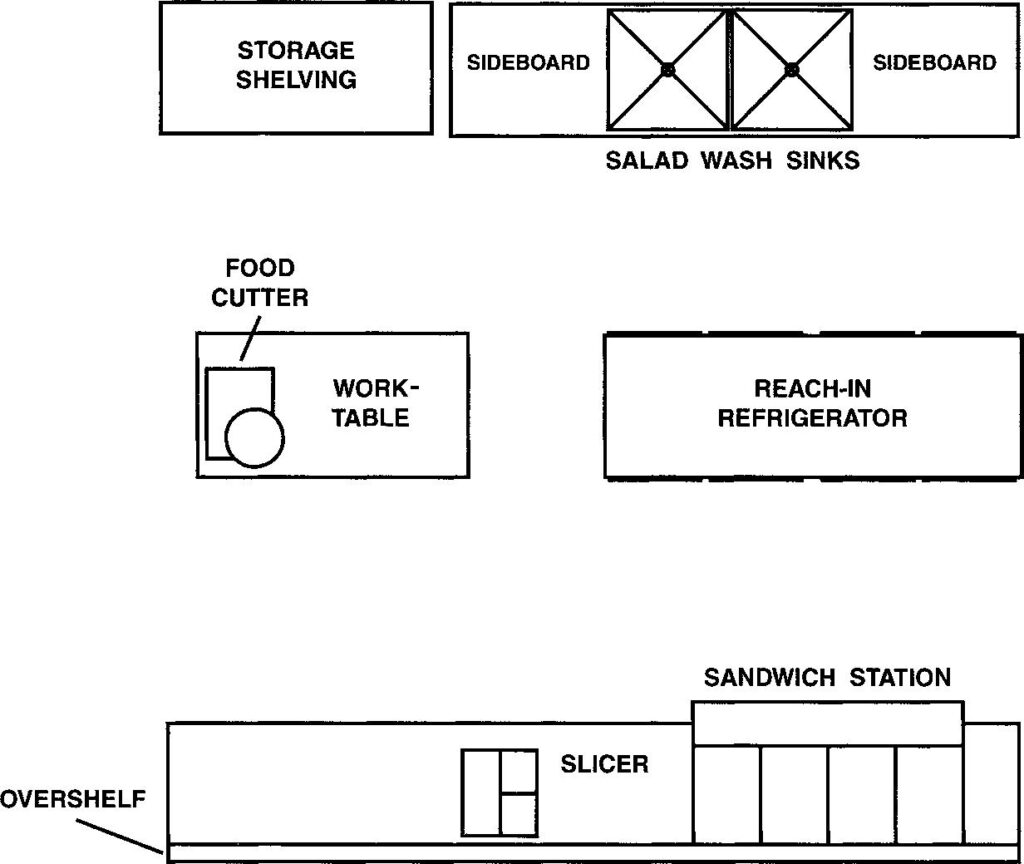
A pantry is an essential component of any kitchen, particularly in the hospitality industry. A good pantry should have the following salient features:
- Adequate storage space: A good pantry should have ample storage space to store all the necessary ingredients, utensils, and equipment needed for food preparation.
- Proper ventilation: The pantry should have proper ventilation to prevent the buildup of heat, smoke, and steam that can be produced during cooking.
- Easy accessibility: The pantry should be easily accessible to the kitchen staff, with well-defined pathways and clear labeling of all items.
- Proper lighting: Adequate lighting is crucial for proper visibility while preparing and storing food items in the pantry.
- Proper sanitation: The pantry should be kept clean and sanitized to prevent contamination of food items and to maintain hygiene.
- Good drainage system: A good pantry should have a good drainage system to prevent water from accumulating on the floor and to ensure proper sanitation.
- Proper organization: The pantry should be well-organized, with all items stored in a logical and easily accessible manner.
- Proper temperature control: The pantry should be equipped with temperature control devices such as refrigerators and freezers to ensure proper storage of perishable items.
- Adequate work surfaces: The pantry should have adequate work surfaces for preparing food, including countertops, cutting boards, and sinks.
- Proper waste management: The pantry should have proper waste management systems in place to ensure proper disposal of food waste and other garbage.
Overall, a good pantry should be well-equipped, organized, and maintained to ensure the smooth functioning of the kitchen and to provide high-quality food to customers.
Q.8. Write short notes on (any four):
(a) Cover
A cover in the hospitality industry refers to a place setting at a table. It typically includes a plate, silverware, glasses, and a napkin. The number of covers needed at a restaurant or event is determined by the number of guests expected.
(b) Mise-en-place
Mise-en-place is a French culinary term that means “everything in its place.” It refers to the preparation and organization of ingredients and tools before cooking. Mise-en-place is an essential part of the culinary process and helps to ensure efficiency and accuracy in the kitchen.
(c) A la carte
A la carte is a type of menu that offers individual dishes for separate prices. This is in contrast to a prix fixe menu, where a fixed price is charged for a set menu of multiple courses. A la carte menus are commonly found in restaurants, cafes, and bistros.
(d) Polivit
Polivit is a type of multivitamin supplement that is commonly used in the hospitality industry. It is often given to employees as a way to promote good health and prevent illness, particularly during busy seasons.
(e) Baize
Baize is a type of felt-like fabric that is often used to cover tables in the hospitality industry. It is durable, easy to clean, and provides a soft surface for table settings. Baize comes in a variety of colors and is often used in high-end restaurants and hotels.
(f) Dummy waiter
A dummy waiter is a type of serving cart that is used to transport dishes and other items from the kitchen to the dining room. Unlike a traditional serving cart, a dummy waiter does not have wheels or handles and is typically pushed by a server or waiter.
(g) Flatware
Flatware refers to the utensils used for eating, such as knives, forks, and spoons. Flatware can be made from a variety of materials, including metal, plastic, and wood, and can be designed in a variety of styles and patterns.
(h) Crockery
Crockery refers to the plates, bowls, and other dishes used for serving food in the hospitality industry. Crockery can be made from a variety of materials, including ceramic, porcelain, and glass, and can be designed in a variety of styles and patterns. The choice of crockery can greatly impact the presentation of food and the overall dining experience.
Q.9. Give the size / capacity of any ten of the following:
(a) Tea cup
Typically holds between 150-250 ml (5-8 oz) of liquid.
(b) Hi ball glass
Typically holds between 250-350 ml (8-12 oz) of liquid.
(c) Dinner plate
Typically has a diameter of 25-30 cm (10-12 inches).
(d) Round dining table
Typically seats between 4-8 people, with a diameter ranging from 90-150 cm (36-60 inches).
(e) Snifter
Typically holds between 150-300 ml (5-10 oz) of liquid.
(f) Beer goblet
Typically holds between 400-600 ml (14-20 oz) of liquid.
(g) Half plate
Typically has a diameter of 17-20 cm (6.5-8 inches).
(h) B&B plate
Typically has a diameter of 14-17 cm (5.5-6.5 inches).
(i) Height of the dining table
Typically ranges from 74-76 cm (29-30 inches).
(j) Serviette
Typically measures 40-50 cm (16-20 inches) square when unfolded.
(k) Parfait glass
Typically holds between 150-250 ml (5-8 oz) of liquid.
(l) Collins
Typically holds between 300-400 ml (10-14 oz) of liquid.
(m) Old fashioned
Typically holds between 180-300 ml (6-10 oz) of liquid.
(n) Martini glass
Typically holds between 150-250 ml (5-8 oz) of liquid.
Q.10. A List the French equivalent of any five:
(a) Spoon: Cuillère
(b) Knife: Couteau
(c) Carver: Trancheur
(d) Black coffee: Café noir
(e) Glass: Verre
(f) Plate: Assiette
(g) Lounge waiter: Garçon de salon
(h) Fork: Fourchette
(i) Floor waiter: Garçon de salle
(j) Barker: Annonceur
B Match the following:
(a) Coffee (i) Couverture
(b) Steward (ii) Café
(c) Plate (iii) Commis de rang
(d) Cover (iv) Assiette
(e) Milk (v) Lait
(f) Water (vi) L’eau
Coffee |
(ii) Café |
Steward |
(iii) Commis de rang |
Plate |
(iv) Assiette |
Cover |
(i) Couverture |
Milk |
(v) Lait |
Water |
(vi) L’eau |