
Table of Contents
Q.1. (a) Draw classification of catering establishments.

(b) Explain railway catering.
Railway Catering
In the mid 19th century railway began in India. With travel made easier, people were transported from one part of the country to another- subsequently requiring food and drink en route. At most of the larger stations, the refreshment rooms were established. The trains would halt for an appropriate time so the passengers could alight and obtain a meal. Third class passengers, unable to afford the luxury of eating in the refreshment room, could purchase food from the numerous vendors on station platform. At the turn of the century, most of the companies decided that catering was a major part of Railway travel. The expertise to run efficient catering operations of a mobile variety was not with regional railway bodies. In the early years of the new century it was decided to contract out the catering requirements to private companies or Hotels with a catering background so the traveler could be more professionally served during journeys.
Q.2. (a) Draw organisation chart of F&B department of a five star hotel.

(b) Write importance of co-ordination between F&B Service department and
kitchen.
- Receiving of food and beverage orders from service staff, preparing, preparing and handling over to them for service of food items to guest.
- Planning of menu items for different restaurants and banquet functions.
- Pricing of different menus.
- Planning of food festivals and promotional events.
- Food store management.
- Dispensing of wines used in cooking.
- Transfer of any flavouring agents or condiments to restaurant.
- To take the feedback from the guest on the quality of food being served to him.
- Receiving complaints from guests and handling them properly.
- Menu improvisation.
- Menu merchandising.
- Menu Engineering
Q.3. List and explain ten attributes of a waiter.
- Professional & Hygienic Appearance
The food & beverage service personnel are a point of interaction to the guests. A server must be very well groomed so as to project a positive image of the establishment. While working in F & B Service one has to handle food throughout the operation hours; hence the hygienic practices must be followed strictly to ensure the safety of food and to provide hygienic atmosphere and service to customers. - Menu Knowledge
A server must have full knowledge of the food and beverage that are being offered in the menu. Which of the menu items are spicy, less spicy or medium spiced; how a particular item is prepared etc. Proper menu knowledge helps in suggestive selling and up-selling. A server must be aware of the special items for the day/month in the menu. Apart from the knowledge about food preparation, the server must have thorough knowledge about the different service styles chosen as per the menu/occasion/establishment. - Sense of urgency
The food and beverage operations demand a high amount of hard work and multi-tasking abilities are a must. The maximum amount of business is done at the high turnover hours, and a server must have sense of urgency to execute the operations flawlessly. - Punctuality
Punctuality is all important. If the staff is continually late on duty it shows lack of interest in work and lack of respect for management and customers. - Personality and attitude towards customers
The staff must be tactful, courteous, good humored and even tempered. They must converse with the customer in a pleasing and well spoken manner and the ability to smile at the right time pays well. - Honesty and Loyalty
“Honesty is the Best Policy”, as it is said. An honest employee is the most important asset to the organization. The staff must be loyal to the organization and management they are working with. No worker should leave the organization without informing to the management and must not commit any act which goes against the image of the organization. - Memory
This is an essential asset to f & b service staff. A good server must be able to remember the regular guests’ names and their preferences; this helps in making good relations with the customers and hence helps in generating repeat business. - Ability to handle customer complaints
Customer concerns or complaints are a regular part of f & b service operations. One must be tactful enough to handle the complaints and should be able to satisfy the guests. A customer not satisfied is loss to the business and reputation of the establishment. - Sales Ability
Servers reflect the image of the establishment. They are salespeople and must therefore have a complete knowledge of all forms of food and drink and their correct service, and so be able to contribute to personal selling and merchandising. Suggestive selling and up-selling abilities are a must for f & b service personnel. - Contribution to the TEAM
This is the most important attribute as it contributes to each and every quality mentioned above. Together Everyone Achieves More, and a person with ability to perform in a team takes the organization’s achievements to a higher level.
OR
Explain duties and responsibilities of senior captain.
- Deputize in the absence of the Restaurant Manager and ensure the smooth functioning of the restaurant.
- Schedule weekly/fortnightly staff duty shifts with the approval of the Restaurant Manager ensuring that work exigencies are met and the staff is rotated fairly.
- Allot daily duties to subordinate staff to meet work exigencies ensuring equity of work.
- Conduct daily briefing using it as a vehicle for two-way communication, training and corrective action.
- Attend to guest complaints and ensure guest satisfaction through immediate action.
- Inspect the mise-en-scene and mise-en-place to ensure the smooth flow of operations.
- Ensure the maintenance and aesthetic upkeep of the restaurant in close coordination with engineering and housekeeping.
- Organize the training of staff for meeting the standards of service.
- Develop restaurant sales through upselling, guest contacts and ensuring good service.
- Ensure that the restaurant is free from work hazards.
- Supervise food service with a view to ensuring speed, quality of service and personalization
- Appraise staff performance and recommend rewards to the restaurant
- Control costs by applying food control principles.
- Serve wines and beverages according to international practice.
- Motivate staff through fair leadership.
- Prepare flambe items, if applicable to the restaurant, with showmanship and authenticity.
- Maintain and control the par stocks of cutlery, crockery, linen, supplies, and equipment.
- Assist the accounts department in stocktaking.
- Hand over lost and found properties to the Housekeeping as per rules.
- Supervises: Restaurant Captains, Hostess, Servers and Apprentices.
Q.4. Explain any two in details:
(a) Bar
Bar is an outlet of F&B Service where alcoholic and non-alcoholic beverages, tobacco and some accompanied food items are served. Bars can be of different types:-
- Public bar- Also known as cocktail bar, it has a bar counter and seating arrangements in the form of tables & chairs, as well as bar stools along the counter, for loaners. It is opened during lunch and dinner and is handled by a barman. The décor can be general or based on a particular theme and the lighting is generally dim.
- Dispense bar- It is a bar which serves beverages to the different F&B outlets like room service, coffee shop, restaurant etc. It is located behind the scene and the timing depends on the F&B outlets with which it is related.
- Temporary bar- It is a bar which is specially set for banquets etc. The commodities used in the bars are very expensive and a great deal of care and control of these areas has to be taken by the management. The hotel must have license for dispensing alcohol and a daily inventory must be taken of all alcoholic beverages. A bar has got three parts viz a viz Front bar, Back bar and Under bar
(b) Speciality restaurant
A catering establishment which offers a particular cuisine like Indian, Japanese or French etc, in a hotel. These restaurants in a hotel cater to the needs of the overseas tourists, in-house guests as well as a sizable number of local clientele.
The bill of fare or Menu must include internationally known and accepted dishes of the particular country or region. It may include a fusion with the local flavours of the city.
The prices should range from moderately expensive to reasonable to attract a wide spectrum of patrons. The ambience should be as per the tradition and culture of Culinary Region. It should exhibit the flavour and ethnicity of the region chosen. The timings of the restaurant are mostly from 3pm to 12pm.
A see through barbecue or Open kitchen which promotes impulsive buying or reflex purchasing, is in vogue.
The table laying of these restaurants is complex, covering up for at least three courses of meals.
The menu offered is mainly A la carte. However, to boost sales often the management decides to spread an economy buffet.
The management also organises special entertainment events like a live band performing, solo singers etc to create an enjoyable experience for the guests.
(c) Coffee shop
Coffee Shop is the main dining room of lodging properties. It is perhaps the largest restaurant in a hotel. Its multi-cuisine nature makes it possible to incorporate a variety of international dishes which are hit among food enthusiasts. The food served is nutritious, colorful and wholesome without being monotonous and complicated. It attracts people from all walks, i.e. hotel’s guests, local pleasure diners, shoe string budget individuals as well as package deal guests.
The coffee shop provides an A la Carte menu as well as an elaborate buffet for breakfast, lunch and diner. It is called a Coffee Shop since it is open 24*7 i.e. throughout the day.
Coffee shop requires elaborate service and a fine-dining table layout. The staff requirement is also very extensive since it involves non stop operations.
The opening and closing duties have to be done during the operation in front of the guests. Thus, all the work has to be carried out in a tactical way.
The service has to be prompt and the staff should be on toes and alert for any guests’ needs or requests. Since the table turnover or repeat customers on the same table is often very rapid, a large number of covers should be ready beforehand for replenishment. Also, the cutlery and crockery inventory should be fairly high. The equipments used should be reasonably priced, as chances of breakage and pilferage are more.
(d) Quick service restaurant
A fast food restaurant, also known as a quick service restaurant (QSR) within the industry, is a specific type of restaurant that serves fast food cuisine and has minimal table service. The food served in fast food restaurants is typically part of a “meat-sweet diet”, offered from a limited menu, cooked in bulk in advance and kept hot, finished and packaged to order, and usually available for take away, though seating may be provided. Fast food restaurants are typically part of a restaurant chain or franchise operation that provides standardized ingredients and/or partially prepared foods and supplies to each restaurant through controlled supply channels. The term “fast food” was recognized in a dictionary by Merriam–Webster in 1951.
Q.5. Draw layout of a pantry and explain in short ten essential equipment used.
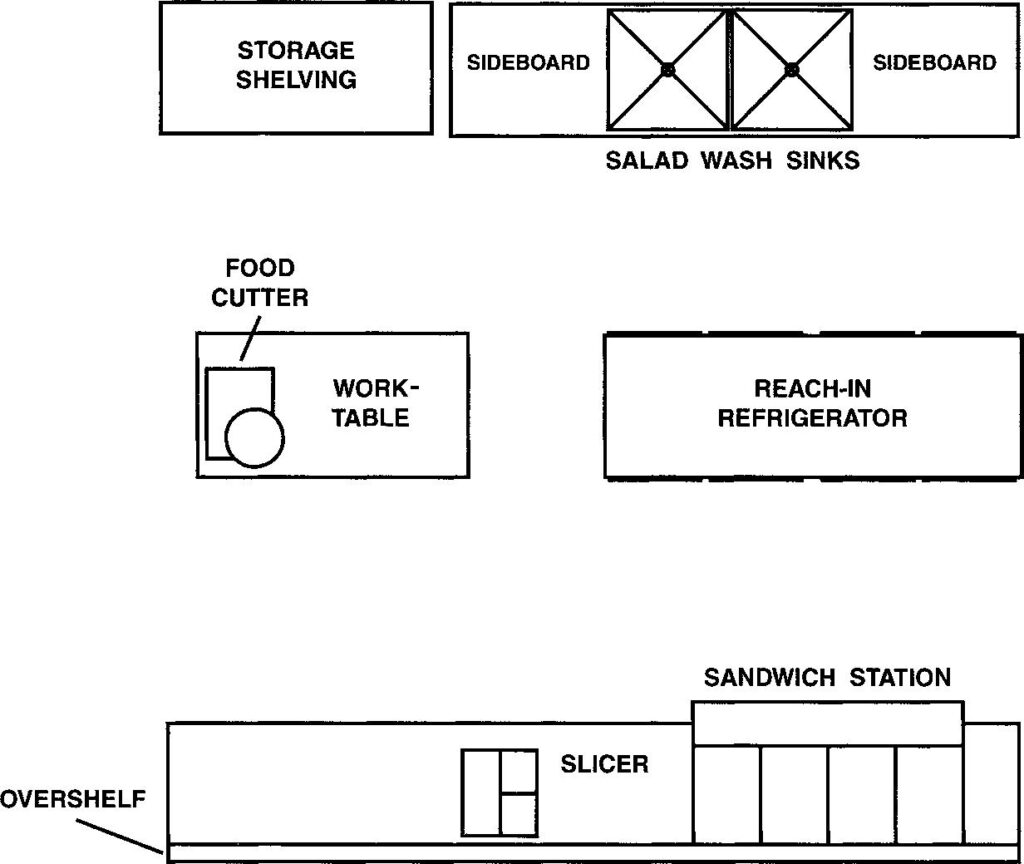
- Refrigerator
- Electric oven
- Toaster
- Coffee Brewing Machine
- Blender
- Electric food whisk
- Knives and chopping boards
- Hollowware like casserole, bowls, and dishes of various sizes
- Crockery
- Drinkware
- Cutlery
OR
Draw and explain, with the help of a chart, different types of non-alcoholic
beverages along with examples.
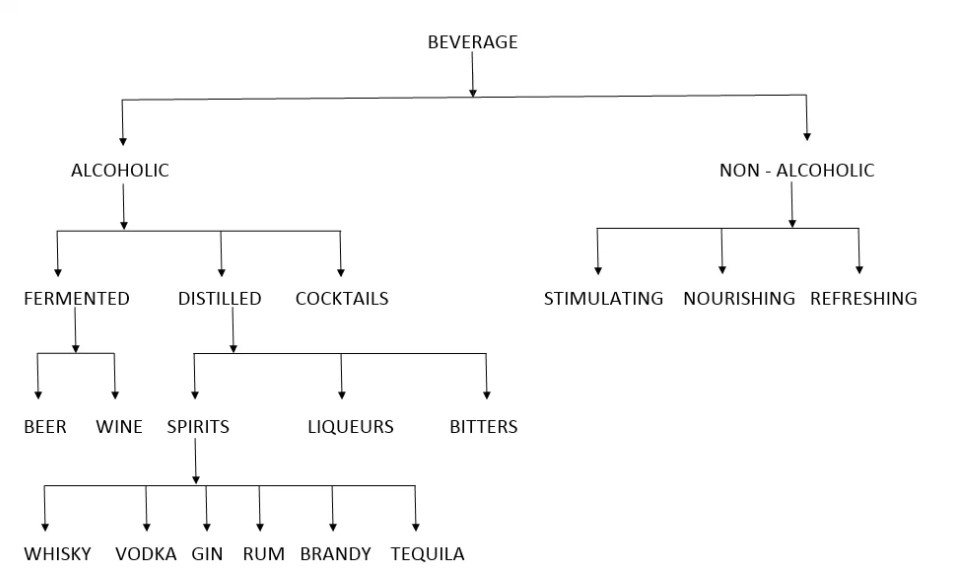
Stimulating drink/beverage:
These are consumed to stimulate our mental and physical activities. Eg. Tea and coffee
Refreshing drink/beverage:
These are drinks that are taken to make up for the fluid loss (due to perspiration) of our body. Eg. Nimbu Pani, water, syrups, soft drinks, tonic water, etc.
Nourishing drink/ beverage:
Beverage consumed to provide nutrients to the body. Ex. Milk-based products like a milkshake, chocolate drinks, juices, etc.
Q.6. Explain tea production process. List five international brands of tea.
tea production process
- Plucking– Two leaves and a bud are plucked from every shoot. A bush may be plucked 25-30 times in a year. The best tea is plucked during the flush season in India there are three flush periods, namely:
- 1st Flush: 15 days of March and April
- 2nd Flush: 10 days after the 15th of May
- 3rd Flush: Also known as the autumn flush occurs in October.
- Drying-Leaves are dried out on racks. There is up to 50% loss of moisture, which leads to withering.
- Rolling– The withered leaves are machines rolled to break cellular structure and release fermenting enzymes giving the leaves a red hue. Prior to the use of machines in 1887 the leaves were hand-rolled in Assam. There are two method of rolling:
- C.T.C – CUT TURN CURL – The two cylinders have grooves on them. When the leaves are pass through these cylinders the leaves not only get the
cut and torn but also get curled. The CTC reduces the fermentation time to 1/3. It is a best method but cannot be applied to Green tea and Oolong tea. - LEG CUT – The leaves are shredded into stripped therefore maximum tannin comes out and fermentation is very quick.
- C.T.C – CUT TURN CURL – The two cylinders have grooves on them. When the leaves are pass through these cylinders the leaves not only get the
- Fermentation– This is done at about 82 degrees Fahrenheit for about 3-4 hours. This is essentially done for black tea, and is what gives it its strength, taste and coppery hue.
- Firing– Firing is done to check fermentation by passing hot air through leaves at a carefully regulated temperature.
- Sorting– The leaves are sorted out as (a) broken or small leaves and as (b) Grades of the leaf.
- Grading– The leaves are graded for green tea as per quality and for black tea by size of leaf and leaf particle There are 4 main grades of BLACK TEA:
- Leaf Teas – Leaf tea generally yield more flavour than broken and small leaf tea. The Grading are:
- FLOWERY ORANGE PEKOE (F.O.P.)
- ORANGE PEKOE (O.P.)
- PEKOE (P.)
- PEKOE SUCHONG
- Broken and Small Leaf Tea– Consist of small leaves sieved from bulk intentionally cut after firing to smaller size.
- Fanning– Tea leaves are of very small size. The fanning’s and dust are used as tea dust.
- Leaf Teas – Leaf tea generally yield more flavour than broken and small leaf tea. The Grading are:
- Polishing and Dyeing – This process is practiced only in China. The tea leaves are polished using chalk and dyed using indigo.
International bands
- Twinings.
- Tazo.
- The Republic of Tea.
- Lipton.
- Yorkshire Tea.
OR
List the manufacturing process of coffee. Explain three methods of brewing coffee
manufacturing process of coffee
- Curing – It is process of soaking the berries into the water and washing it until all parchment & covering is removed then it is sun/ machine dried & milled.
- Polishing and Grading: Depends on the type, size, quality exports and local consumption. The best quality beans are called as ‘supremo’.
- Roasting – The degree of roasting differs with regard to the use of the coffee. This is done at 200-220 degree Celsius for 5 mins and to avoid overcooking the beans are sprayed with water or cooled air is passed over them. In the early days this was done over charcoal. During roasting the green beans change colour to brown due to caramelization of the sugars. The oils oozes out & provide aroma. During the process the weight of the beans reduce by 16% but the volume increases. Roasting depends upon the uses of coffee.
- LIGHT CITY ROAST: Cinnamon colour, thin flavour and is very popular in the west.
- CITY ROAST / BROWN / AMERICAN: Has a flat flavour and is popular in America.
- FULL CITY ROAST: Dark brown colour and a hearty flavour.
- BRAZILIAN ROAST: There is a trace of oil on the beans.
- FRENCH COFFEE: Burnt amber colour and is very close to Espresso roast.
- VIENNESE ROAST: The beans are roasted to between full city and French roast
- ITALIAN / ESPRESSO ROAST: Almost burnt or carbonized and yields the darkest and the heaviest of coffees.
- Grinding: Different coffees have different grinds. The beans are ground to bring out the aroma and flavour from the roasted beans. But grinding also makes the coffee lost its aroma faster than other wise and so it would be best if ground when required. The earliest method of grinding was to use the mortar and pestle and is believed to be the best way of bringing out the flavours. The Box coffee mill succeeded the mortar and pestle, which was similar to a pepper mill. The next in line was the Bladed electric mill in which various blades could be used for various grinds. The grinding electric mill was the next invention. The modern machines available today may be programmed to grind only a specific quantity of beans so that always a fresh grind may be made. The types of grind are:
- PULVERISED: Only used for Turkish coffee and is a large grind.
- VERY FINE: Used for filter coffee.
- FINE EXPRESSO: Specifically, for use in the expresso machine and is generally applied for the Expresso roast.
- MEDIUM: This grind is specifically for percolators, vacuum machines, coffee jugs, etc.
- COARSE: This is a finer grind than the other grinds. It yields a muddy coffee and the grinds should not be too fine.
methods of brewing coffee
- Jug coffee: this coffee was founded in france and the coffee and hot water was allowed to infuse. Also known as steeping or open pot brewing the coffee was served with cream.
- Plunger or cafetiere: this is a glass jug in a fancy stand and has a filter attached to the plunge. The coffee is added and topped with hot water. Let the coffee Infuse for the few minutes and then let the plunger depress. The infused coffee is served immediately.
- Cona coffee machine: invented by robert napier it works on the infusion method. Is also known as the vacuum coffee machine, it improves eye appeal and gives freshly brewed coffee.
Q.7. List factors to be kept in mind for selection of;
(a) Glassware
When shopping for glassware for your restaurant, there are several tips that you need to consider and have in mind. They include:
1. Select Durable Glassware : In a restaurant setting, you will often have cases of broken, chipped and cracked glassware. However, if you go for low quality glassware, you can expect to deal with such cases even more and it will cost you a lot of money in the long run. It is advisable that you procure from a reputable supplier.
2. Use Wide Selection Of Glasses : Red wine glasses are different from white wine glasses and the two are different from soda glasses. When shopping for glassware, it is important that you cover all bases keeping in mind the design of the restaurant.
3. Make Glassware Distinctive : To make your restaurant different from the others, you need to make it stand out and you can do it through simple things like buying unique glassware that is pleasing to the eye and one that makes a bold impression of an amazing establishment.
4. Avoid Bulky Glassware : When shopping, opt for glasses that are easy to hold and handle. If considering bigger glasses such as beer mugs, ensure that you buy the mugs with handles.
5. Choose Daily Use Glasses : While you may be tempted to invest in crystal or etched glasses, it is advisable that you go for glasses that can be used on a daily basis. However, if you want your restaurant to have that particular level of class, you can buy such glasses to be used to serve special drinks and beverages.
6. Type Of Stemware : There are two different types of stemware namely long and short stemware. Long stem are suited for formal dining while short stems are best for informal dining. Depending with the kind of restaurant you want to start, you will be able to discern which stemware to buy in large quantities than the other.
7. Sturdy And Dishwasher Safe : For daily use glasses, it is advisable that you go for glasses that are can be cleaned using the dishwasher. It helps save on time and reduces chipping, cracking and breakages.
8. Versatility
For a restaurant set up, it is best that you go for versatile glasses. When shopping, consider the smooth glasses as they tend to be more versatile than glasses with rough texture and patterns. Transparent glasses are also the best as you do not want the color of glasses to interfere with color of your drinks.
9. Handmade Or Machine Made Glasses : When shopping for glasses you ought to remember that some glasses are machine made while others are handmade. Both types have their pros and cons and you need to make the right decision when buying.
10. Cost : This sums up everything. Good glassware does not have to be very expensive but you should not forget that buying cheap glassware to save present expenses can mean more expenses in the future.
(b) Linen
Here are three things to consider when choosing your restaurant table linens:
- Color and Design : Color is one of the most important factors in choosing your restaurant linens because it speaks directly to your restaurant’s theme. Are you looking for bright linens to convey a more casual theme? Or do you need plain, neutral colors to highlight a more formal setting?
Colors are important because they help tell your customer what kind of dining experience they can expect from your establishment. You want your colors to match your restaurant’s ambiance and add to your customer’s experience, not distract from it. - Material : Restaurant linens come in a variety of materials. It’s important to select fabrics that suit your restaurant’s theme while keeping in mind their longevity and maintenance. There are different materials to choose from that each have a different look and feel.
If you’re looking for comfortable yet classy linens, you want them to last. Invest in linens that will last through multiple washes and uses to come. Make sure to choose linens that are made from high-quality materials that won’t wear and tear easily. - Maintenance : While you want your table linens to be as visually appealing as possible, it’s important to keep in mind that different linens require different levels of maintenance. Do you wash your linens in-house? Or do you utilize a professional laundry service?
If you aren’t using a laundry service, consider working with one. Getting your linens washed by professionals and delivered back to you on a timely schedule saves you not only time and money, but allows you to invest in the type of linens you think will best fit your restaurant without having to worry about maintaining them yourself.
Q.8. Write short notes on (any two):
(a) Vending machines
These are the machine in which packaged food items and beverage are kept for sale. All the items are seen through glass doors. The customers put the requisite money and press the button for dispensing items. The machine dispensed the item and it is collected from the base of the machine. Usually found in malls, airports, railway stations etc.
(b) Types of banquets
- Informal banqueting– in this no set plan of seating is followed. Apart from this no formality is expected from the guest side in terms of maintaining the protocols. The best examples are the marriage parties, birthday bash, launch parties etc.
- Semi-formal banqueting- in this a part of the function is formal whereas the rest can be informal in its own sense. For example in a company board meeting the top table can be arranged maintaining the protocols and ranking whereas the rest of the table could be at ease with no such arrangement.
- Formal banqueting– in this all degrees of formalities and protocols are maintained and therefore elaborate arrangements are required to be made. Normally formal banquets are witnessed in case of head of states hosting function in honor of Visiting dignitaries. These elaborate arrangements are in advance and everything is preplanned to the last details. Elaborate seating arrangements are made with predetermined and marked seat numbers. Seating plans may be given in advance to the guest along with the menu or may be send with the invitation. The actual plan is as per the ranking and during the final show one may find tent cards mentioning names of the guest placed in the particular seating position.
(c) Five names of cocoa beverages
- Traditional Hot Chocolate
- Dried Plum Cocoa
- Coconut Hot Cocoa
- Maple Cocoa
- Mexican Hot Cocoa
(d) Welfare catering
The provision of food and beverages to people to fulfil a social obligation, determined by a recognised authority, is known as
welfare catering. This grew out of the welfare state concept, prevalent in western countries. It includes catering in hospitals,
schools, colleges, the armed forces and prisons.
Welfare Catering is mainly about providing food at minimal costs. It does not serve the purpose of generating revenue. This kind of establishment does not promote a lucrative food menu. They mostly follow a Cyclic Menu that is good enough to fulfill the nutritional requirements of the customer.
Q.9. Match the following:
| (a) Restaurant Manager | (i) Couverture |
| (b) Spoon | (ii) Café |
| (c) Coffee | (iii) Commis de rang |
| (d) Soup | (iv) Napperon |
| (e) Fork | (v) Cuillere |
| (f) Steward | (vi) Tasse |
| (g) Plate | (vii) Assiette |
| (h) Napkin | (viii) Fourchette |
| (i) Cup | (ix) Gérant |
| (j) Cover | (x) Potage |
Solution
| (a) Restaurant Manager | (ix) Gérant |
| (b) Spoon | (v) Cuillere |
| (c) Coffee | (ii) Café |
| (d) Soup | (x) Potage |
| (e) Fork | (viii) Fourchette |
| (f) Steward | (iii) Commis de rang |
| (g) Plate | (vii) Assiette |
| (h) Napkin | (iv) Napperon |
| (i) Cup | (vi) Tasse |
| (j) Cover | (i) Couverture |
Q.10. Fill in the blanks:
(a) Height of chair from ground is 18 inches.
(b) Height of table from ground is 30inches.
(c) Size of a cover is 24 to 30 inches.
(d) The cutlery required for thick soup is large rounded soup spoon.
(e) EPNS stands for electroplated nickel silver.
(f) The diameter of a quarter plate is 6 inches.
(g) Capacity of a high ball glass is 8 to 12 oz.
(h) coffee shop is open 24 hours a day.
(i) Old age home falls under welfare catering.
(j) baize cloth linen protects the table surface.