
Table of Contents
Q.1. How marketing concept and marketing mix are integrated in service industry ? Substantiate your answer with suitable examples from hospitality industry. (20)
The marketing concept dictates that marketing decisions should be based upon customer needs and wants. Buyers purchase goods and services to satisfy their needs and wants. Thus when a buyer engages in a market transaction he perceives a bundle of benefits and satisfactions to be derived from that transaction. However he does not usually divide the market offering into its component parts.
From the sellers’ view point however the market offering can be divided into its component parts. The marketing mix is the convenient means of organizing all the variables controlled by the marketer that influence transactions in the marketplace. It is a ‘checklist approach’ where marketer’s attempt to list and organize the variables under their control which may be important in influencing transactions in the market place.
The formulation process of marketing mixes in services markets is much the same as in other types of markets typically this involves:
a. Separating the offering into its components or sub mixes;
b. Coordinating the sub mixes into the marketing mix.
The specific marketing mix adopted by a particular organization will of course vary according to circumstances (e.g. level of demand, range of service being offered). The marketing mix process then is a constant one of fashioning and reshaping the component elements in response to changing market circumstances and needs.
Inevitably there is much overlap and interaction between the various components of a marketing mix. Decisions cannot be made on one component of the mix without considering their impact upon the other components.
Also the precise elements and their importance within any marketing mix at any point in time will vary. The outline that follows therefore indicates some of the key areas to which marketing managers need to devote their attention in formulating their marketing mixes for services markets. It is illustrative not comprehensive. Service organizations will almost certainly need to adapt it in their strategy planning.
Marketing Mix
1. Product
The service product requires consideration of the range of services provided, the quality of services provided and the level of services provided. Attention will also need to be given to matters like the use of branding, warranties and after-sale service. The service product mix of such elements can vary considerably and may be seen in comparisons of service range between a small local building society and one of the largest in the country; or between a small hotel offering a limited menu range and a four star hotel offering a wide range of meals.
2. Price
Price considerations include levels of prices, discounts allowances and commissions, terms of payment and credit. Price may also pay a part in differentiating one service from another and therefore the customers perceptions of value obtained from a service and the interaction of price and quality are important considerations in many service price sub mixes.
3. Place
The location of the service providers and their accessibility are important factors in services marketing. Accessibility relates not just to physical accessibility but to other means of communication and contact. Thus the types of distribution channels used (e.g. travel agents) and their coverage is linked to the crucial issue of service accessibility.
4. Promotion
Promotion includes the various methods of communicating with markets whether through advertising, personal selling activities, sales promotion activities and other direct forms of publicity, and indirect forms of communication like public relations.
Expanded mix for services
Because services are usually produced and consumed simultaneously, customers are often present in the firm’s factory, interact directly with the firm’s personnel, and are actually part of the service production process. Also, because services are intangible customers will often be looking for any tangible cue to help them understand the nature of the service experience.
These facts have led services marketers to conclude that they can use additional variables to communicate with and satisfy their customers. For example, in the hotel industry the design and decor of the hotel as well as the appearance and attitudes of its employees will influence customer perceptions and experience.
5. People
All human actors who play a part in service delivery and thus influence the buyer’s perceptions: namely, the firm’s personnel, the customer, and other customers in the service environment. All of the human actors participating in the delivery of a service provide cues to the customer regarding the nature of the service itself. How these people are dressed, their personal appearance their attitudes and behaviors all influence the costumers perceptions of the service.
The service provider or contact person can be very important. In fact, for some services, such as consulting, counselling, teaching, and other professional relationship – based services, the provider is the services. In other cases the contact person may play what appears to be a relatively small part in service delivery, for instance, a telephone installer, an airline baggage handler, or an equipment delivery dispatcher. Yet research suggests that even these providers may be the focal point of service encounters that can prove critical for the organization.
6. Physical Evidence
The environment in which the service is delivered and where the firm and customer interact, and any tangible components that facilitate performance or communication of the service. The physical evidence of service includes all of the tangible representations of the services – such as brochures, letterhead, business cards, report formats, signage, and equipment. In some cases it includes the physical facility where the service is offered, for example, the retail bank branch facility.
In other cases, such as telecommunication services, the physical facility maybe irrelevant. In this case other tangibles such as billing statements and appearance of the repair truck may be important indicators of quality. Especially when consumers have little on which to judge the actual quality of service they will rely on these cues just as they rely on the cues provided by the people and the service process. Physical evidence cues provide excellent opportunities for the firm to send consistent and strong messages regarding the organization’s purpose, the intended market segments, and the nature of the service.
7. Process
The actual procedures, mechanism and flow of activities by which, the service is delivered the service delivery and operating systems. The actual delivery steps the customer experiences, or the operational flow of the service, will also provide customers with evidence on which to judge the service.
Some services are very complex, requiring the customer to follow a complicated and extensive series of actions to complete the process. Highly bureaucratized services frequently follow this pattern, and the logic of the steps involved often escapes the customer.
Another distinguishing characteristic of the process that can provide evidence to the customer is whether the service follows a production-line/standardized approach or whether the process is an empowered/customized one. None of these characteristics of the service is inherently better or worse than another.
Rather, the point is that these process characteristics are another form of evidence used by the consumer to judge service. For example, two successful airline companies, Southwest in the United States and Singapore Airlines, follow extremely different process models. Southwest is no-frills (no food, no assigned seats), no exceptions, low-priced airline that offers frequent, relatively short length domestic flights.
All of the evidence it provides is consistent with its vision and market position. Singapore Airlines, on the other hand, focuses on the business traveller and is concerned with meeting individual traveller needs. Thus, its process is highly customized to the individual, and employees are empowered to provide nonstandard service when needed. Both airlines have been very successful.
The three new marketing-mix elements (people, physical evidence, and process) are included in the marketing mix as separate elements because they are within the control of the firm and any or all of them may influence the customer’s initial decision to purchase a service, as well as the customer’s level of satisfaction and repurchase decisions.
Q.2. Discuss the concept of service and service marketing. What are the characteristics of Services? (20)
Services & Service Marketing
The term service is rather general in concept, and it includes a wide variety of services. There are the business and professional services such as advertising, marketing research, banking, insurance, computer-programming, legal and medical advice. Then there are services which are provided by professionals but consumed for reasons not of business, rather for leisure, recreation, entertainment and fulfilment of other psychological and emotional needs such as education, fine arts, etc.
Kotler offers one such definition: “A. service is any activity or benefit that one party can offer to another that is essentially intangible and does not result in the ownership of anything. Its production may or may not be tied to a physical product”.
Services can be described on the basis of type of process used in the delivery of the service. The three kinds of delivery processes that are applicable in case of service products are line operations, job shop operations and intermittent operations. Self-service restaurants and shops are examples of line operations.
The most important issue in the service product is understanding what benefits and satisfaction the consumer is seeking from the service. From the view-point of a restaurant’s manager, the restaurant simply provides food. But the customers coming to the restaurant may be seeking an `outing’, an atmosphere different from home, relaxation, entertainment or even status. The marketing of services can be a success only if there is a match between the service product from the consumer’s view-point and the supplier’s view-point.
W.J. Stanton views services as fulfilling certain wants and states that, “services are those separately identifiable, essentially intangible activities which provide want-satisfaction, and that are not necessarily tied to the sale of a product or another service.
To produce a service may or may not require the use of tangible goods. However, when such use is required, there is no transfer of title (permanent ownership) to these tangible goods”.
As in the case of a product, in the case of services also your starting point for understanding the marketing dynamics is the want satisfaction of the customers. It is important to correctly identify the particular want(s) which your service is fulfilling, since this will provide the clue for designing the most appropriate marketing strategy.
A restaurant provides satisfaction to its customers on the basis of type and quality of its food, its decor and environment and the behaviour of its staff and its location in a busy commercial-cum-office complex. For instance, `Class Touch’ was started as a restaurant serving exclusive Western and Chinese cuisine with expensive decor, a live band, beautifully liveried waiters and a high-price menu. The venture was a flop right from the start. On the advice of its marketing consultant, the restaurant changed over from serving elaborate, expensive meals to a `fast-food’ character providing quick, reasonably priced meals for consumption both within and outside the restaurant. Today this restaurant is a big success. It was the correct identification of the want-satisfaction which helped the restaurant become successful. Located in a predominantly office area, the restaurant’s major clientele was office going people.
During office lunch-break, people do not visit a restaurant for relaxation or status satisfaction. They have limited time at their disposal and want a quick clean meal at a reasonable price, with minimum frill and fancy. In this case, the restaurant was satisfying the basic hunger need, but was catering to a very specific class of customers (office-goers) with a special kind of constraint (that of time and money).
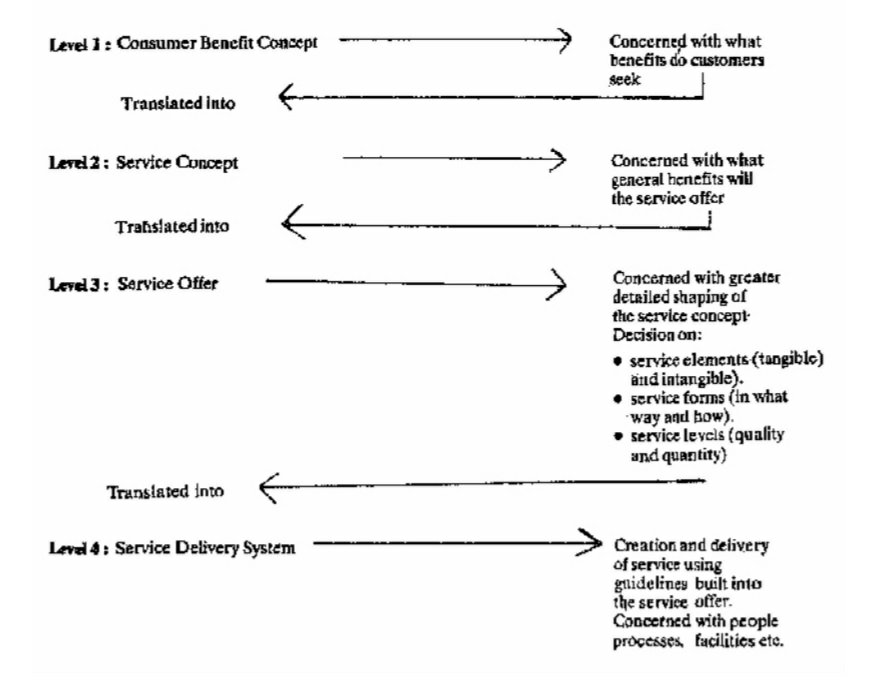
Conceptualisation of the service product
Service marketing refers to the application of a different set of tactics or strategies to anticipate the consumer’s need for an intangible product. And thus, meet their requirements accordingly, to create maximum value for them from their purchase.
The marketing of services is different from the marketing of products. While selling off services, convincing the consumers and pricing the intangible products is a challenging task.
For marketing of products, the four elements of marketing mix are product, price, distribution and promotion, which are used in a specific combination to arrive at the marketing strategy. In the case of services, there are three additional elements. These elements are people, physical evidence and process.
Characteristics of Services
Services have a number of unique characteristics that make them so different from products. Some of the most commonly accepted characteristics are:
1. Intangibility
When you buy a cake of soap, you can see, feel, touch, smell and use to check its effectiveness in cleaning. But when you pay fees for a term in college, you are paying for the benefit of deriving knowledge and education which is delivered to you by teachers. In contrast to the soap where you can immediately check its benefits, there is no way you, can do so in case of the teachers who are providing you the benefits.
Teaching is an intangible service. When you travel by aeroplane, the benefit which you are deriving is a service (transportation) but it has some tangible aspects such as the particular plane in which you fly (Boeing, Avro, Concorde, and the food and drink which is served). In this case the service has both a tangible and intangible aspect as compared to teaching which has no tangible aspect at all. This continuum highlights the fact that most services are in reality a combination of product and service having both tangible and intangible aspects. There are only a few truly pure tangible products or pure intangible services.
The distinguishing feature of a service is that its intangible aspect is dominant J. Bateson has described the intangible characteristics of services which make them distinct from products. These intangible features are:
• Service cannot be touched
• Precise standardisation is not possible
• There is no ownership transfer
• Service cannot be patented
• Production and consumption are inseparable
• There are no inventories of the service.
2. Inseparability
In most cases service cannot be separated from the person or firm providing it. Service is provided by a person who possesses a particular skill (singer), by using equipment to handle a tangible product (dry cleaning) or by allowing access to or use of physical infrastructure (hotel, train). A plumber has to be physically present to provide the service, the beautician has to be available to perform the massage. This is in direct contrast to products which can be produced in the factory today, stocked for the next two, three or more months and sold when an order is procured.
3. Heterogeneity
The human element is very much involved in providing and rendering services and this makes standardisation a very difficult task to achieve. The doctor who gave you his complete attention in your last visit may behave a little differently the next time.
The new bank clerk who cashes your cheques may not be as efficient as the previous one and you have to spend more time for the same activity. This is despite the fact that rules and procedures have been laid down to reduce the role of the human element and ensure maximum efficiency. Airlines, restaurants, banks, hotels have a large number of standardised procedures. You have to reserve a room in a hotel and this is a straight forward procedure for which all the steps are clearly defined. Human contact is minimal in the computerised reservation systems, but when you go to the hotel there will be a person at the reception to hand over the key of your room. The way this person interacts with you will be an important factor in your overall assessment of the service provided by the hotel. The rooms, the food, the facilities may be all perfect, but it is the people interacting with you who make all the difference between a favourable and unfavourable perception of the hotel.
4. Perishability
Services cannot be stored and are perishable. A car mechanic who has no cars to repair today, or spare berths on a train, unsold seats in a cinema hall represent service capacity which is lost forever. Apart from the fact that a service not fully utilised represents a total-loss, the other dimension of this perishability aspect is that most services may face a fluctuating demand. There is a peak demand time for buses in morning and evening (office hours), certain train routes are always more heavily booked than others. This fluctuating demand pattern aggravates the perishability characteristic of services.
5. Ownership
When you buy a product you become its owner-be it a pencil, book, shirt, refrigerator or car. In the case of service, you may pay for its use but you never own it. By buying a ticket you can see the evening film show in the local cinema theatre; by paying wages you can hire the services of a chauffer who will drive your car; by paying the required charges you can have a marketing research firm survey into the reasons for your products’ poor sales performance, etc. In case of service, the payment is not for purchase, but only for the use or access to or for hire of items or facilities.
A service is purchased for the benefits it provides. If we closely examine the reasons why products are purchased, we find that they are bought not because of their physical, tangible features but because they provide certain intangible benefits and satisfactions.
Q.3. Write short notes on: (10×2=20)
a. Bases for market segmentation
1. Benefit segmentation
In benefit segmentation you segment the market on the basis of what people say or the benefits they seek from the product.
Yankelovich applied benefits segmentation to the purchase of watches. He found that buyers bought for lowest price (23%), durability and general product quality (46%), and as symbols of some important occasion (31%).
One of the most successful benefit segmentations was reported by Russell Haley who coined the phrase benefit segmentation. According to him the oral hygiene (toothpaste) market can be divided into four distinct benefit segments depending on which of the following is sought:
• Flavour and product appearance
• Brightness of teeth
• Decay prevention
• Low price
2. Demographic basis
Instead of focusing on the differences in benefits sought, we might divide people in the market on the basis of demographic variables such as .age, sex, family size, income, occupation, education, location, religion, race and nationality. Demographic variables are the most popular bases for distinguishing customer groups.
3. Social class
Demographic variables can be combined to form social classes. Social class is defined in terms of a number of demographic variables varying from a single indicator like occupation to the use of a combination of factors like occupation, source of income, type of home or residential area. Social class has a strong influence on the person’s preferences in regard to clothing, home furnishings, leisure activities,’ reading habits, and so on,
4. Family life cycle
Another basis for segmentation that draws on demographic factors is family life cycle, where each stage in the cycle is a combination of age, marital status and age of children. A household with a young family tends to have different wants from an older married couple whose family is grown up. One family life cycle is:
• Young single people, not living at home
• Young married, no children
• Young married, youngest child under six
• Young married, youngest child six or over
• Older married, with dependent children
• Older married, no children living at home
• Older, single
5. Psychographic basis
We can also segment the market on the basis of life style or mode of living. This helps us to understand what those who are in the market do. Some of the products where life style approach has been used for segmenting the market are cars, women’s clothing, cigarettes, cosmetics, alcoholic beverages and furniture. Volkswagen, for example, has designed life style automobiles: a car for `the good citizen’ emphasizing economy, safety and ecology; and a car for the `car freak’ emphasizing handling, manoeuvrability, and spottiness.
6. Usage Rate
Usage rate is one of them and is sometimes used as a dependent variable with demographic or personality variables used as its predictors or independent variables.
The aim is to identify the `heavy users’ so as to focus directly on their wants and to appeal to them directly. Soft drinks and cigarettes are two important products where this approach is used. To explain, it is the younger group which falls in the category of heavy users so far as the soft drinks market is concerned. The main attempt of the companies selling this product is to focus on this group and to appeal to them directly.
7. Brand Loyalty
Another basis is brand-loyalty, with companies making direct appeal to the loyal user. Some important examples are the toothpaste market, the beer market, and the cigarette market. Companies selling in a brand-loyal market have a hard time gaining more market share. Similarly, companies that enter a brand-loyal market have a hard time getting in.
b. Principles of Designing an Organisation
Organisation refers to any system, body or group of people, comprising various sub-systems or parts which are inter-related and or inter-dependent on each other. An organisation may be informal or formal. An informal organisation has no specific objective to achieve. A formal organisation has a specific objectives to achieve and that is the very reason for the organisation’s existence. Objectives may relate to making profit or there may be no consideration of profit whatsoever. Thus, when we refer to an organisation it can mean a firm or company involved in business, a non-business organisation such as university, hospital, a social organisation such as club, charitable trust, or a government agency. respective of the nature of an organisation, the principles involved in its design are the same. These are:
1. Specialisation
The division of labour on the basis of which a particular type (or set) of activity is differentiated from another. Jobs are assigned to individuals on the basis of their specialisation.
2. Departmentalisation
The integration of differentiated (or specialised) activities and grouping of individuals into departments, divisions etc.
3. Standardisation
The existence of procedures and systems, which help integrate the entire organisation.
4. Formalisation
The extent to which all procedures, systems and policies are written, so that the organisation becomes independent of the person(s) who founded it and acquires a life-span substantially longer than any one individual.
5. Centralisation
The level at which authority for decision-making is concentrated. It involves designing formal reporting relationships and information systems, leading to hierarchical levels and spans of control.
6. Evaluation
Providing systems for appraisal and compensation.
7. Structure
The total configuration or arrangement of individuals, departments, reporting ‘ relationships, information flows, span of control, all of which give the organisation its specific ‘shape’.
Given these basic principles, you have many kinds of organisation structures to choose from. In making the choice, you must evaluate the alternative structures on the basis of:
• Facilitating achievement of objectives and accomplishment of tasks,
• Managerial control, and
• Cost
Q.4. Elaborate the factors influencing Consumer Behaviour. How a consumer’s purchase decisions are affected by his/her personal characteristics? (20)
Consumer behaviour is affected by a host of variables, ranging from personal motivations, needs, attitudes and values, personality characteristics, socio-economic and cultural background, age, sex, professional status to social influences of various kinds exerted by family, friends, colleagues and society as a whole. The combinations of these various factors produce a different impact on each one of us as manifested in our different behaviour as consumers. You may think that the best way of utilising your annual saving is to have a holiday, but your wife thinks it is wisest to invest in a house, while your colleague considers buying shares as the best way of spending savings. Thus you would find that each person has his or her own standards of judgments and distinct behaviour in every aspect of his role as a consumer. But at the same time, underlying the individual differences are similarities which help explain behaviour of specific types or groups of people. It is these similarities which make it possible for us to classify and analyse the behaviour of individual consumers.
Psychological factors such as individual consumer needs and motivations, perceptions, attitudes, the learning process and personality characteristics are the similarities which operate across different types of people and influence their behaviour. Amongst the social influences affecting behaviour, we can classify the influences of family, friends, leaders and the social class to which the ‘consumer belong.
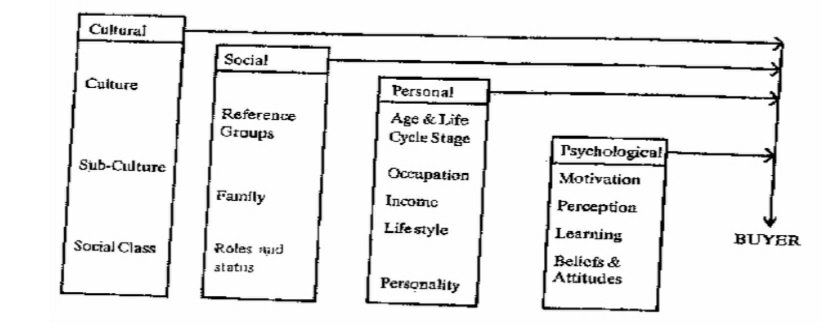
Factors influencing consumer behaviour
There are four categories of factors that influence consumer behavior
1. Personal factors
An individual’s interests and opinions that can be influenced by demographics (age, gender, culture, etc.).
2. Psychological factors
An individual’s response to a marketing message will depend on their perceptions and attitudes.
3. Social factors
Family, friends, education level, social media, income, they all influence consumers’ behavior.
4. Psychological factors
Psychological factors such as individual consumer needs and motivations, perceptions, attitudes, the learning process and personality characteristics are the similarities which operate across different types of people and influence their behaviour.
Personal factors that affect consumer behaviour
A consumer’s purchase decisions are also affected by his personal characteristics such as age, sex, stage in family life-cycle, education, occupation, income, life-style, his overall personality and overall self-concept.
1. Demographic factors and life-cycle stage
The first factor influencing a buyer’s decision is his age. The need for different products and services changes with age. Babies and children have special needs for products such as milk powder, baby foods and toys. Young adults need clothes, recreational and educational facilities, transportation and a host of other age and fashion related consumption needs.
There are certain physiological differences between men and women which result in their having different consumption needs. Women need specialised medical facilities for pregnancy and delivery. Their requirement of clothes and cosmetics is different from that of men. Each gender thus has its own need for specific products and services. Consumption behaviour is also influenced by the specific stage of the family life cycle.
2. Education and Occupation
Education widens a person’s horizons, refines his tastes and makes his outlook more cosmopolitan. An educated person, as compared to somebody less educated, is more likely to consume educational facilities, books,- magazines and other knowledge oriented products and services. For instance, in India, we find that educated families are more inclined towards adopting family planning than families which have no educational background.
The occupation also shapes the consumption needs. People following specialised occupations such as photography, music, dance, carpentry, etc. need special tools and equipment. But, apart from this specific need, the status and role of a person within an organisation affects his consumption behaviour. Chief executives would buy three-piece suits of the best fabric., hand made leather briefcase and use services of airlines and five star hotels. A junior manager or blue collar worker in the same organisation may also buy a three-piece suit but he compromises on quality.
3. Income
The income which a person earns is an extremely important influence on his consumption behaviour. He may aspire to buy certain goods and services but his income may become a constraint. Income in this context really refers to the income available for spending (i.e. income after tax, provident fund and other statutory deductions). The person’s attitude towards spending versus saving and his borrowing power are also important influencing factors. Small size packaging in sachets for products such as tea, shampoo, toothpaste are meant for the lower income customers who cannot afford a one time large outlay of money on such products.
Products which are considered luxuries are more income sensitive than products which fall in the category of necessities. If you are marketing a luxury product you must keep a close watch on income and saving trends to avoid ‘decrease in sales resulting from recession. To avoid sales decline you may need to re-position the product, change the marketing mix or both.
4. Personality
Personality is sum total of an individual’s psychological traits, characteristics, motives, habits, attitudes, beliefs and outlooks. Personality is the very essence of individual differences. In consumer behaviour, personality is defined as those inner psychological characteristics that both determine and reflect how a person responds to his environmental stimuli. Personality is enduring and ensures that a person’s responses are consistent over time.
5. Life-Style
Life-styles are defined as patterns in which people live, as expressed by the manner in which they spend money and time on various activities and interests. Life-style is a function of our motivations, learning, attitudes, beliefs and opinion, social class, demographic factors, personality etc. While reading this unit, you are playing the role of a student. But at the same time you also have your career, family and social roles to play. The manner in which you blend these different roles reflects your life-style.
Q.5. Write an essay on “Indian Consumer Environment“. (20)
India is a vast country populated by more than 121 crore people. Its unique feature is its diversity of religions, languages, social customs, regional characteristics, which is both a boon and a bane for the marketer: boon because there is tremendous scope for a wide variety of products and services to be successfully marketed and a bane because the marketer often need to adapt his marketing strategy to suit different tastes and values.
Despite 73 years of independence. India is still dominated by villages and almost 70 per cent of population is located in the rural areas. But these rural areas are today enjoying the fruits of the Green Revolution and the purchasing power of the rural population is increasingly demanding attention from the marketer who had so far concentrated only in urban areas. No doubt the urban areas with their concentration of numbers and market potential are the priority target markets, but a firm which wants to ensure its future survival must start making inroads into the rural market as well.
Characteristics of the Indian Consumer Market
1. Demographic Characteristics
The starting point for understanding the nature and dynamics of any market is its size in terms of number of consumers. For a marketer, the sheer number of consumers in India spells magic. India is a country populated by more than 121 crore people (2011 census) and it is expected that by 2021 it will touch a figure of 135 crore of the population. Almost 72 per cent live in villages and only 28 per cent in towns the total population comprises the 51.7 per cent males and 48.3 per cent females. About 74 per cent of the people in the country are capable of reading and writing and only 26 per cent work to support the remaining majority. All these characteristics have important implications for a marketer and provide him important clues on what products he can offer in the market and the type of marketing mix required for them.
For instance, the clothes that men and women wear, with some exceptions, are dissimilar, and as a marketing manager selling sarees and/or pants you should know the total size of the market.
More than 34 per cent of our country’s population in 2011 comprised of children upto 14 years of age. On the one hand this represents the vast potential market for children products. On the other, it must be remembered that this age segment is not capable of making purchase decision independently. The consumer segment between 15-59 years age group comprises 66 per cent of the population has the capability to make purchase decision independently both in terms mental competence and purchasing power.
2. Income and Consumption Characteristics
It is not enough to merely know that there is a very large number of potential customers, it is equally critical to find out whether or not they have the ability to purchase. This is reflected by the figures of income.
The average consumer was spending about 48 per cent of his disposable income on food 13 per cent on transport and communications 5 per cent on clothing and footwear and 11 per cent on rent, fuel & power.
Food rent, fuel power and transport are almost fixed expenses, since they are the necessities of life and it is very difficult to really reduce expenditure on them. Thus the discretionary income available after paying for the basic necessities is a very small amount. If you are marketing a product or service, which is not a necessity item, you are in the consumers’ low priority and the consumer has a small amount to spend and to tap this requires a really effective marketing strategy.
3. Geographical Characteristics
India is a geographically vast country spread over 32,08,825 square kilometres and administratively divided into 28 states and 8 union territories. As per 2011 census, its 121 crore people live in 1,392 towns and 6.27 lakh villages.
It is important to know not only the number of consumers but also where they are located & their distribution among rural & urban area. It also shows the number of administration districts that each state is divided into. Each district has its headquarter and the town in which it is located is invariably an important nerve centre. The district headquarter would be a good choice to set up a distribution point.
4. Socio – Culture Characteristics
All our decisions of purchase and consumption are strongly influenced by the society in which we live-its social customs, traditions and values the social class to which we belong and the religion we practise.
It is these socio-cultural characteristics which account for differences in patterns of purchase and consumption in different regions societies and countries.
India is a secular country inhabited by people of many different religions. Of course the dominant religion is Hinduism and 79.8 per cent of Indians are Hindus. Of the remaining 20 per cent population 14.2 per cent is Muslim while Christians, Sikhs, Buddhists and Jains make up the remaining 6 per cent.
Each religion prescribes its own code of conduct regarding what food to eat, what clothes to wear and the type of behaviour that is to be indulged in. These religious norms exert a strong influence on consumer’s purchase and consumption behaviour.
For instance, Hindus do not eat beef and also a fairly large percentage of them are even vegetarians.
Each religion has its own important festivals which are celebrated with traditional gaiety. At the time of these festivals, most people spend money on buying new clothes, sweets and a host of gift items for their friends and relatives. For the marketer, these festivals represent sales peaks. it is a good time for introducing new products or even existing products in new, festive gift packaging.
5. Market Potential
A comprehensive countrywide survey titled “Indian Marketing Demographics” has been conducted by National Council for Applied Economic Research (NCAER) on country’s market for consumer products. The study reveals that:
a. The rural markets are already large, and they are growing fast.
b. People are graduating from the lowest to the higher income groups.
c. There is a sizeable population of those who by Indian standards, could be said to be the “very rich”.
d. There has been a surge in the purchase of consumer products by households, and the ownership of consumer durables.
e. This surge is not confined to people with high level of income. Even those who appear to be poor, in the lowest levels of income purchase and use such products.
f. Most of the purchases are made from the income of the households. Hire purchase and loans account for around ten per cent of ownership of durables, and gifts for a mean of around five per cent, with wrist watches being the most common gift, around ten percent.
g. Second-hand Products bought and owned by households are primarily two, wheelers and cars – 25 per cent.
Q.6. What are the brand strategy options open to a firm? Discuss their relative strengths and weaknesses. (20)
Branding consists of a set of complex branding decisions. Major brand strategy decisions involve brand positioning, brand name selection, brand sponsorship and brand development.
Before going into the four branding decisions, also called brand strategy decisions, we should clarify what a brand actually is. A brand is a company’s promise to deliver a specific set of features, benefits, services and experiences consistently to buyers. However, a brand should rather be understood as a set of perceptions a consumer has about the products of a particular firm. Therefore, all branding decisions focus on the consumer.
1. Brand Positioning – Branding Decisions
A brand must be positioned clearly in target customers’ minds. Brand positioning can be done at any of three levels:
• On product attributes
• On benefits
• On beliefs and values
At the lowest level, marketers can position a brand on product attributes. Marketing for a car brand may focus on attributes such as large engines, fancy colours and sportive design. However, attributes are generally the least desirable level for brand positioning. The reason is that competitors can easily copy these attributes, taking away the uniqueness of the brand. Also, customers are not interested in attributes as such. Rather, they are interested in what these attributes will do for them. That leads us to the next level benefits.
A brand can be better positioned on basis of a desirable benefit. The car brand could go beyond the technical product attributes and promote the resulting benefits for the customer: quick transportation, lifestyle and so further.
Yet, the strongest brands go beyond product attributes and benefits. They are positioned on beliefs and values. Successful brands engage customers on a deep, emotional level. Examples include brands such as Mini and Aston Martin. These brands rely less on products’ tangible attributes, but more on creating passion, surprise and excitement surrounding the brand. They have become “cool” brands.
Brand positioning lays the foundation for the three other branding decisions. Therefore, brand positioning should also involve establishing a mission for the brand and a vision of what the brand should be and do. The brand’s promise must be simple and honest.
2. Brand Name Selection – Branding Decisions
When talking about branding decisions, the brand name decision may be the most obvious one. The name of the brand is maybe what you think of first when imagining a brand – it is the base of the brand. Therefore, the brand name selection belongs to the most important branding decisions. However, it is also quite a difficult task.
We have to start with a careful review of the product and its benefits, the target market and proposed marketing strategies. Having that in mind, we have to find a brand name matching these things. Naming a brand is part science, part art, and certainly a measure of instinct.
Although finding the right name for a brand can be a challenging task, there are some guidelines to make it easier. Desirable qualities for a brand name include:
• It should suggest something about a product’s benefits and qualities. Think of the wadding polish “Nevr Dull”. The brand name indicates the benefit of using this product: the treated metal will never be dull.
• It should be easy to pronounce, recognise, and remember. iPod and Nike are certainly better than “Troglodyte Homonculus” – a clothing brand.
• The brand name should be distinctive, so that consumers don’t confuse it with other brands. Rolex and Bugatti are good examples.
• It should also be extendable. Think of Amazon.com, which began as an online bookseller but chose a name that would allow expansion into other categories. If Amazon.com had chosen a different name, such as books.com, it could not have extended its business that easily.
• The brand name should translate easily into foreign languages. The Ford Pinto line had some struggles in Brazil, seeing as it translated into “tiny male genitals”. Or the Mitsubishi Pajero, which means in Spanish “man who plays with himself and enjoys it a bit too much”. More famous: Coca-Cola reads in Chinese as “female horse stuffed with wax”.
• It should be capable of registration and legal protection. In other words, it must not infringe on existing brand names.
Worthy of note is the fact that brand name preferences are changing continuously. After a decade of choosing quirky names (such as Yahoo!, Google) or fictional names, today’s style is to build brands around names that carry real meaning. For instance, names such as Blackboard, a school software, make sense. However, with more and more brand names and trademark applications, available new names can be hard to find.
Choosing a brand name is not enough. It also needs to be protected. Many firms attempt to build a brand name that will eventually become identified with a product category. Examples for these names include Kleenex, Tip-ex and Jeep. However, their success can also quickly threaten the company’s rights to the name. Once a trademark becomes part of the normal language (called “genericization”), it is not protected anymore. For that reason many originally protected brand names, such as aspirin, Walkman (by Sony) and many other names are not protected anymore.
3. Brand Sponsorship – Branding Decisions
Branding decisions go beyond deciding upon brand positioning and brand name. The third of our four branding decisions is the brand sponsorship. A manufacturer has four brand sponsorship options.
A product may be launched as a manufacturer’s brand. This is also called national brand. Examples include Kellogg selling its output under the own brand name (Kellog’s Frosties, for instance) or Sony (Sony Bravia HDTV).
The manufacturer could also sell to resellers who give the product a private brand. This is also called a store brand, a distributor brand or an own-label. Recent tougher economic times have created a real store-brand boom. As consumers become more price-conscious, they also become less brand-conscious, and are willing to choose private brands instead of established and often more expensive manufacturer’s brands.
Also, manufacturers can choose licensed brands. Instead of spending millions to create own brand names, some companies license names or symbols previously created by other manufacturers. This can also involve names of well-known celebrities or characters from popular movies and books. For a fee, they can provide an instant and proven brand name. For example, sellers of children’s products often attach character names to clothing, toys and so on. These licensed character names include Disney, Star Wars, Hello Kitty and many more.
Finally, two companies can join forces and co-brand a product. Co-branding is the practice of using the established brand names of two different companies on the same product. This can offer many advantages, such as the fact that the combined brands create broader consumer appeal and larger brand equity. For instance, Nestlé uses co-branding for its Nespresso coffee machines, which carry the brand names of well-known kitchen equipment manufacturers such as Krups, DeLonghi and Siemens.
4. Brand Development – Branding Decisions
Branding decisions finally include brand development. For developing brands, a company has four choices: line extensions, brand extensions, multibrands or new brands.
Line extension refers to extending an existing brand name to new forms, sizes, colours, ingredients or flavours of an existing product category. This is a low-cost, low-risk way to introduce new products. However, there are the risks that the brand name becomes overextended and loses its specific meaning. This may confuse consumers. An example for line extension is when Coca-Cola introduces a new flavour, such as diet cola with vanilla, under the existing brand name.
Brand extension also assumes an existing brand name, but combines it with a new product category. Thus, an existing brand name is extended to a new product category. This gives the new product instant recognition and faster acceptance and can save substantial advertising costs for establishing a new brand. However, the risk that the extension may confuse the image of the main brand should be kept in mind. Also, if the extension fails, it may harm consumer attitudes toward other products carrying the same brand name. For this reason, a brand extension such as Heinz pet food cannot survive. But other brand extensions work well. For instance, Kellog’s has extended its Special K healthy breakfast cereal brand into a complete line of cereals plus a line of biscuits, snacks and nutrition bars.
Multibrands means marketing many different brands in a given product category. P&G (Procter & Gamble) and Unilever are the best examples for this. In the USA, P&G sells six brands of laundry detergent, five brands of shampoo and four brands of dishwashing detergent. Why? Multibranding offers a way to establish distinct features that appeal to different customer segments. Thereby, the company can capture a larger market share. However, each brand might obtain only a very small market share and none may be very profitable.
New brands are needed when the power of existing brand names is waning. Also, a new brand name is appropriate when the company enters a new product category for which none of its current brand names are appropriate.
These four branding strategy are all interrelated. In order to build strong brands, brand positioning, brand name, brand sponsorship and brand development have to be in line with each other.
Q.7. Write short notes on: (10×2=20)
a. The Promotion Mix
In our daily life we all are exposed to various tools of promotion aiming at communicating one thing or the other to us. To illustrate, while at home welcome across advertisements when reading a newspaper, watching TV, listening to radio or even examining the water, electricity or telephone, bills. On our way to the office similar communications face us on bus panels, roadside hoardings, neon sighs, posters and banners etc. And, while at a retail shop these take the shape of traffic builders, product displays, streamers, hangers, bins etc. All sharing information relating to a specific product of a company.
Listed above are just a few types of the various promotion tools available to a marketer. Before proceeding further, let us take a look at the definitions of the four major methods of promotion. These are: advertising, personal selling, sales promotion and publicity. The committee on Definitions of the American Marketing
Association defined these components as under:
• Advertising
Any paid form of non-personal presentation and promotion of ideas, goods, or services by an identified sponsor. It includes the use of such media as magazines, newspapers, outdoor posters, direct mail novelties, radio, television, bus posters, catalogues, directories, programmes and circulars.
• Personal selling
Oral presentation in a conversation with one or more prospective purchasers for the purpose of making sales.
• Sales promotion
Those marketing activities–other than personal selling, advertising, and publicity-that stimulate consumer purchasing and dealer effectiveness such as displays, shows and exhibitions, demonstrations, coupons, contests, and other non-routine selling efforts. These are usually short-term activities.
• Publicity
Non-personal stimulation of demand for a product, service or business unit by generating commercially significant news about it in published media or obtaining favourable presentation of it on radio, television or stage. Unlike advertising, this form of promotion is not paid for by the sponsor.
Packaging, public relations and role of other elements of marketing mix in promotion
Although definitions vary about the number of components that constitute promotion, , marketing practice brings out that almost all marketing activities influence the promotion function. Notably, packaging performs the promotion function in addition to providing protection to the product. By incorporating creativity in its design, a package can add the `pick-me-up’ appeal to the product and also help to communicate its features, uses and benefits more effectively. The promotion aspect of packaging is witnessing a hit of revolution in India now a days with the introduction of innovative, packages in, the field of consumer goods. For example, package design of Pepsi and edible oils etc.
Public relation, likewise, performs an important role in promotion insofar as it helps to create a favourable image of the firm and allows the public to experience better satisfaction in dealing with the firm.
High and consistent product quality, provision of superior customer service, price promotions as a way of increasing short-term sales and compatibility between the character of distribution outlets and the product are the other ways which contribute to the promotion function of this firm.
Major determinants of the promotion mix
1. Type of Available budget, and
2. Company policy.
b. Role of Communication in marketing
In the absence of effective communication, small-business processes can fall apart. Strong communication skills are particularly necessary for business functions, especially in those areas where employees create messages that are shared with a target market. In marketing, business communication is vital for creating effective campaigns, resonating with target audiences and persuading people to make a purchase.
1. Understanding the Role of Communication in Business
It’s no secret that communication is an essential part of every successful organization. However, it’s important to note that communication plays specific roles in each department in your company. In the marketing department, business communication is used to:
• Inform employees about the benefits of the product and teach them the talking points to use when dealing with customers;
• Persuade prospects and customers to make a purchase through tailored messaging that resonates with their needs;
• Motivate team members to hit campaign deadlines to capitalize on market trends; and
• Improve internal marketing processes to increase productivity and efficiency within the department.
To improve business communication within their marketing department, managers need to identify any barriers to effective communication, such as improper communication channels, varying cultural norms and perceptual differences. Once the barriers have been dealt with, businesses can ensure that the proper infrastructure and systems are in place so employees can communicate effectively with each other and with their customers.
2. Creating Successful Strategies
Internal communication between employees is critical to developing effective marketing strategies. It’s vital for team members to be able to express their ideas to each other while brainstorming campaign strategies to reach the target market. If an employee has an innovative idea but is unable to express its benefits to colleagues, it’s unlikely the idea will come to fruition.
Employers need to provide communication training or guidance to assist employees in better expressing their ideas as part of developing marketing strategies for the business. By identifying the team’s communication weaknesses, it’s possible to discern where they can use help in improving their communication processes. For example, if employees have trouble getting a word in at brainstorming meetings because everyone keeps talking over one another, they may need a workshop on effectively running and participating in meetings.
3. Understanding Audience Needs
A critical role of communication in service marketing and product marketing is identifying the target audience. Employees need to have strong research and questioning skills in ]that enable them to determine who their target audience is for a particular campaign and what their characteristics are. Many companies perform detailed market research with focus groups to determine what their audience wants. Being able to ask the right questions and articulate the prospects’ answers into viable data is a necessary communication skill for marketers.
4. Developing Engaging Messaging
Effective marketers need to be able to develop messaging that resonates with their target audience. As a result, having strong written communication skills is a vital part of the role. Effective business communication enables marketers to define product benefits, respond to customer objections and persuade prospects to take the next step, resulting in more sales for the business. The marketing department has to ensure that the target audience receives the messages they put out as intended.
Also, marketers need to be able to tailor the message for the medium they are using. The messaging for an email campaign may not be as effective over the phone. As a result, it’s essential to understand which communication channel to use for each kind of message.
5. Using a Brand Voice
For many successful brands, the way they communicate is of the utmost importance. The sentence structure, tone, word choice and emotions in the content all contribute to the voice of the brand. To maintain the voice, it’s critical that all business communication, internal and external, be in the same brand voice. This kind of consistency provides prospects, customers and internal stakeholders with a streamlined user experience.
Communication skills play a big role in developing and maintaining a brand voice. Employees need to be able to discuss specific elements of the voice with one another so they can establish what they want it to sound like. They also need tools and systems to document the characteristics of the brand voice and disseminate it to other employees.
6. Improving Marketing Processes
The role of communication in business is to share ideas and improve efficiency within the organization. Similarly, in marketing, communication is used to improve internal company processes. Whether your business has a marketing department with one employee or a dozen, it’s wise to have documented processes and guidelines that help people do their jobs more effectively. Repeatable processes ensure that employees don’t miss any important steps and reduce the chance of errors.
Communication is used to develop marketing processes for creating design briefs, content strategies and marketing plans. It’s also a vital skill when providing feedback on images, copy and campaigns. Having processes to manage all of the activities ensures that employees have the structure they need to stay on track.
7. Reducing Group Conflict
Internal conflict is bound to occur when there is a group of people working closely together on the same projects. With different personalities and communication styles, ideas can be miscommunicated, which leads to conflict. Being able to resolve that conflict without managerial interference is vital to the success of the organization. Business communication plays a large role in conflict resolution. It can help employees share their ideas more clearly, empathize with their coworkers and come to a compromise or agreement.
8. Sharing Innovative Campaign Ideas
Creative and engaging ideas are the foundation of a successful marketing campaign. Marketers must be able to think of innovative ways to grab their prospects’ attention long enough to persuade them to make a purchase. Being able to brainstorm a range of ideas, share them with colleagues, incorporate feedback and articulate everything into a campaign brief requires strong business communication skills.
9. Developing Solutions to Challenges
In marketing, employees may run into challenges such as small budgets, limited human resources and poor traction on campaigns. When such challenges emerge, it’s necessary to be able to pivot strategies to meet the business’s goals. Effective business communication can help employees develop solutions to the obstacles they face.
For example, if a marketer is tasked with developing a campaign on a shoestring budget, they may need to request more funds from management. Before they do this, they need to be able to prove that the company will see a return on their investment. As a result, they need to be able to write a proposal to the management team, ask for a larger budget and present their proposal with answers to any questions.
10. Boosting Team Engagement
Business communication plays a major role in the way employees socialize at work. While much of their interaction at work is professional, employees also develop friendships with the people they spend several hours with each day. This helps them to learn about each other more comprehensively, which can improve their relationships at work.
It’s important for employers to provide their team with the infrastructure to get to know one another. Employees can improve their communication skills while socializing in the lunchroom or playing a game of table tennis or foosball in the lobby. Having dinner or lunch outside of work also enables employees to learn more about their colleagues. Through this socialization, employees become more familiar with how their colleagues communicate, which can allow them to work more effectively on marketing projects.
Q.8. Explain how media planning is done for service industry. Describe the parameters used for measuring advertising effectiveness. (20)
Media Planning
Media planning includes decisions relating to (i) which media should be used, and (ii) when and how often should advertisements be placed in the selected media. The basic purpose of media planning is to optimise the communication reach to the relevant audience within the available budget.
Media planning is the series of decisions involved in delivering the promotional message to the prospective consumers. It is the process of directing the advertising message to the target audience by using the appropriate channel at the proper time and place.
The media plan marks on the best way to get the advertiser’s message to the market. Generally, the goal of the media plan is to find that combination of media that allows the marketer to communicate the message in the most effective manner to the largest number of potential customers at the lowest cost.
Media planning assists in controlling wasteful advertising. It ensures die optimum-utilisation of resources spent on advertising. In media plan, media objectives are decided keeping in view the advertising objectives of the organisation. Media plan specifies media strategies. Media strategy means plans of action designed to attain media objectives.
Steps involved in the Media Planning Process
Following are the steps which are involved in media planning are:
Step 1. Market Analysis
Every media plan begins with the market analysis of environmental analysis. Complete review of internal and external factors is required to be done.
At this stage media planners try to identify answers of the following questions:
i. Identification of the Target Audience:
Which is the audience for our product? This happens to be the most important consideration in the media decisions. We first examine our market plans and advertising plans. These provide us details about the audience for our product.
Detailed studies of our audience can be made. We can describe our audience in terms of age, religion, sex, education – these are demographic characteristics. We can describe it in terms of their income and occupation.
The target audience can be classified in terms of age, sex, income, occupation and other variables. The classification of target audience helps media planner to understand the media consumption habit, and accordingly choose the most appropriate media or media mix. Different customers differ with regard to age, income, education level, personality, attitude etc. If target audience or customers are educated and young, print media and T.V., can be selected. If number of target customers is more, then mass-media like, T.V., Newspapers will be suitable.
ii. Study of Factors Affecting Media Planning:
There are various factors which affect media planning.
While making media planning, the media-planner must consider these factors which are described as follows:
a. Internal Factors – Internal factors are those factors which are directly related to company like size of company, advertising budget, size of organization, distribution strategy of organization, potential market area etc. Advertising budget is very important factor, while selecting media planning. If size of ad-budget is more, then costly media like T.V. can be selected. If size of ad budget is small, the cheap media will be selected.
b. External Factors – External factors includes media coverage, media image, media adopted by competitors etc. while selecting the media, the advertiser must consider the media selected by competitors and leaders of that industry. Along with cost of various media should be compared.
iii. Identifying the Geographical Area:
Total geographical area of target market is identified. Those areas, where the sale of the company’s product is more, are identified. For low potential market area, smaller advertising budget is allocated. The geographical area also includes whether advertising should be done at local level or national level or international level.
Step 2. Message Distribution
The first step in the setting up of objectives was the definition of the target audience. The next step is the distribution of message to this audience. The number of messages and the frequency of their appearance matter a lot.
We have to decide whether a single message is sufficient or there should be several repetitions of the same. These lead us to the concepts of reach and frequency, which are to be balanced.
The overall constraint on both these concepts is the advertising budget. We also have to calculate the total message weight of the campaign.
Step 3. Selecting Suitable Media
For selecting appropriate media, different media are compared on the basis of cost per reader, cost per viewer, media-image, etc. While selecting media, the advertiser should ensure that media matches with features of target audience. The selected media should match with message-requirements, e.g. If message involves demonstration, then media with audio visual effects will be selected. While selecting suitable media, availability of media should also be kept in mind. It is possible that a particular media suits our requirements, but it is already booked, so some other media will have to be selected.
Step 4. Selecting Optimum Media-Mix
If the advertiser feels that no single media is sufficient in itself in achieving advertising objectives then different media can be used in combination and their optimum mix is decided by the advertiser. By combining different media, advertiser can increase coverage and improve the chances of achieving advertising goals. Overall ad-budget also influences the ration of different elements of media mix.
Step 5. Selecting Suitable Media Vehicle within Each Selected Media
After selecting media, appropriate media vehicles are to be selected. For example, after deciding that advertising is to be done through newspaper, it is decided that in which newspaper it is be done-whether through Indian Express, Tribune, or Hindustan Times, etc.
If it is decided that advertising is to be done through magazine, then out of various magazines, appropriate magazine/magazines are selected. If advertising is to be done through television, then it is decided that at which T.V. channel or in which T.V. programme advertisement is to be given. Suitable media vehicles are selected to attain media objectives.
Step 6. Media Scheduling
In media scheduling, decisions regarding date or time when these advertisements are to be shown are taken. In media-scheduling, time-gap in two advertisements is also decided. Purpose of media-scheduling is to issue advertisements at appropriate time with appropriate frequency so that target audience can be contacted at minimum advertising cost.
It helps to control wasteful advertising expenses. If advertisement is related to product to be used by school/college going children, then it is better to show the advertisement in the evening time in T.V. programmes. If the product is of seasonal nature, then ad should be shown more frequently in the season period and less frequently in the off season period.
Step 7. Executing Advertising Programme
After selecting media and deciding its schedule, advertising department is given the task of designing suitable advertising copy and executing it in the selected media. Some companies assign this task of designing advertising to professional advertising agencies.
Step 8. Follow-Up and Evaluation
After implementing advertising programme, advertiser evaluates its effectiveness to know whether media objectives have been achieved, whether media-plan has contributed in achieving overall advertising-objectives. Answers to these questions help the advertiser to know success or failure of media strategy. If our media strategy is not effective, then corrective actions will be taken for future media planning, so that in future, better media-plans can be made.
Parameters used for measuring advertising effectiveness
Measuring advertising effectiveness is one of those areas of advertising about which nothing can be said for sure. Advertising communications have a time lag between buyer’s awareness and action. But, if the lag happens to be longer and/or the competitor happens to be more aggressive the decay or forgetting effect of the advertisement may set in soon. It is, thus, very difficult to define the appropriate advertising level and which advertisement will produce how much effect.
The advertising effectiveness, therefore, is measured by examining the following:
• Communication effectiveness of the advertising campaign and
• Sales-effect of advertising efforts.
Measuring Communication Effectiveness
The effectiveness of advertising, therefore, depends on why and how the communications are made. The communication effectiveness of an advertising campaign can be measured both before and after its release. The three major methods used for pretesting advertisements are :
• Asking consumers of specialists to rate or rank alternative advertisements in terms of elements such as attractiveness, liking, and interest of the theme, slogan and illustration used in the advertisement copy. This method of pretesting is called ‘Direct Ratings’ method.
• Checking the extent of recall of both the overall advertisement as well as its content. This, is done by first making available, to select consumers, a set of advertisements. This type of pretesting can be done both by providing aid/lead to the consumer to recall, or can be unaided. The purpose is to ascertain the extent of recall of the alternative advertisements, and the reasons that make an advertisement stand out. This method is called Portfolio Test method.
• The third method makes use of equipment and gadgets to measure consumer’s physiological reactions like pupil dilation, heart beat, etc, on seeing an advertisement. These tests popularly call as `Laboratory tests help in the measurement of attractiveness of the advertisement to a consumer.
Measuring Sales Effectiveness
Sales being the result of both advertising as well as other elements of the marketing mix, it is very difficult to isolate and relate advertising to sales. However, it can be done to some degree of accuracy by:
• Measuring sales that take place in response to mail order offers in select sales territories
• Counting of inquiry coupons received and relating them to the sales effected out of them
• Conducting experiments by varying advertising efforts is isolated sales territories and comparing sales results, or
• Establishing historical relationship between advertising expenditure, media used and sales over a sufficiently long duration.
Q.9. Explain the nature and role of personal selling and sales promotion. Substantiate your answer with suitable examples from travel and tourism industry. (20)
Personal Selling
Personal selling is an act of convincing the prospects to buy a given product or service. It is the most effective and costly promotional method. It is effective because there is face to face conversation between the buyer and seller and seller can change its promotional techniques according to the needs of situation. It is basically the science and art of understanding human desires and showing the ways through which these desires could be fulfilled.
According to American Marketing Association, “Personal selling is the oral presentation in a conversation with one or more prospective purchasers for the purpose of making sale; it is the ability to persuade the people to buy goods and services at a profit to the seller and benefit to the buyer”.
Personal selling is a different form of promotion, involving two way face-to-face communications between the salesmen and the prospect. The result of such interaction depends upon how deep each has gone into one another and reached the height of the common understanding. Basically the essence of personal selling is the interpretation of products and services benefits and features to the buyer and persuading the buyer to buy these products and services.
Some important points
1. It is a Part of promotion mix
Personal selling is part of promotion mix, or the communication mix in the company’s marketing program. Other elements being sales promotion, advertising, public relations etc.
2. It is a Two-Way Communication
It is the best tool for two-way communication. Salesman can provide necessary information to customer about company’s offer, and also can collect information from customer. The ultimate aim is to persuade the customer.
3. It involves presentation and Persuasion
The salesman through his knowledge tries to present his product to the prospective buyer and tries to persuade the prospective buyer with the help of various skills and techniques.
4. It is a Flexible tool
Personal selling is more flexible than other promotional tools. Salespersons ca see their customer’s reaction to a particular sales approach and make adjustment according to the situation.
5. It’s a creative tool
Personal selling is creative in nature. The salesperson tries to create needs. Make the customer aware of hose needs and try to persuade him to buy the product. The salesman does not sell but he creates in the other man the urge to buy.
6. Development of long-term Relationship
Personal selling results in the development of personal relationship between the sales person and the possible buyer. Such a relationship has an important place in sales.
7. Receipt of Additional Information
Normally, before introducing its product, a company is aware of the preferences of the probable buyers. Nevertheless, during the course of personal selling, when the sales person is in direct contact with the buyers he/she gathers additional information regarding their tastes and likings.
8. Quick solution of Queries
The prospective buyer can make inquiries regarding the product. Salesman answers these queries quickly and removes any doubts in the mind of the buyer.
9. Customer Confidence
By systematic sales talk and presentation, a capable salesman can remove all doubts, quarries, objections and misunderstandings, and can win customer’s confidence. It increases customers’ faith in company and its offers.
10. Improves company’s goodwill/ Image
Note that salesmanship can remove bad image or misunderstanding by highlighting company’s achievements and offers. The detailed explanation about company and its products removes all doubts and misunderstandings. It helps in restoring company image and reputation in market.
11. Service Element
Personal selling is not getting rid of a thing or cheating the customers for short term goal. Rather it is necessarily an act of assisting the customers to buy wisely. Today, it has become a symbol for honesty and dependability. A product tangible component when attached to intangible component of service adds value and helps in personal selling.
Sales Promotion
The word promotion, originates from the Latin word ‘Promovere.’ The meaning is “to move forward” or to push forward or to advance an idea. The aim of production is sales. Sales and promotion are two different words and Sales Promotion is the combination of these two words. Sales promotion increases the sales.
Sales promotion methods aim to capture the market and increase the sales volume. It is an important instrument in marketing to lubricate the marketing efforts. Now-a-days sales promotion is a necessary tool to boost sales. Sales promotion becomes a fashion and luxury.
In the broader sense it is not an expenditure; it is an investment, as it pays rich returns. It aims in creating demand. It is right to say that sales promotion moves the product. A manufacturer must make the customers to know the product and he must influence them to buy that product.
Sales promotion is one among the three pillars of promotional mix. The other two pillars are personal selling and advertising. Sales promotion is the connecting link between personal selling and advertising. Sales promotion is an important and specialized function of marketing.
Sales promotion is the art of persuasion of potential clients to buy a product. It is intended as a short-term tactic to enhance sales. It is a rare method to build long-term customer loyalty. When preparing for a sales promotion, the following factors should be taken into account by the business.
Scope of Sales Promotion in Marketing
Sales promotion is a powerful tool for behavioural targeting as it integrates into the buying behaviour of a specific target. Swaying customers away from competitors is achieved by offering sales promotion incentives.
• Sales promotions act as a direct inducement that gives extra product value to the distributors, sales force and the ultimate consumers.
• Behavioural targeting is the mainstay of sales promotion marketing and managers should acquire knowledge on this by undergoing specialized sales and marketing courses.
• It gives an immediate incentive to make a buying decision and acts as an expediting tool in the selling process and enhances the sales volume.
It helps in achieving the following purposes:
1. The basic purpose of promotion is to disseminate information to the potential customers.
2. Sellers use incentive-type promotions to attract new customers, to reward loyal customers and to increase the repurchase rates of occasional users.
3. To encourage the customers to try a new product. An interesting example: the Brooke Bond Tea of India used to distribute free tea to every household during 1930’s, in order to promote tea drinking habits among the people of Chennai.
4. Sales promotions yield faster responses in sales than advertising.
5. Sales promotion is considered as a special selling effort to accelerate sales.
6. Brand switchers are primarily looking for low price, good value and premiums. Sales promotions are likely to turn them into loyal brand users.
7. It helps to defeat competitors’ promotional activities.
Q.10. What is “Alternative channels of distribution” ?Substantiate your answer with suitable example from hospitality industry. (20)
Channels of distribution can be grouped under two major headings:
1. Direct Selling by manufacturer
2. Indirect Selling through middlemen.
For direct selling, the first option involves supplying the product to the customer using your own salesmen and arranging your own deliveries. The second option is using the medium of post office. You obtain orders from your customers who respond by mail or telephone to your advertisements or to letters mailed directly to their houses. You deliver your products to them through mail or through some other carrier. The next alternative is to establish your own retail stores. Bata Ltd., for example, has established its own retail stores throughout the country. This practice has also been adopted on a smaller scale by a number of textile mills who have their own retail shops like Calico Mills, Raymonds, DCM etc., has franchised a number of retailers to sell their products to the consumers.
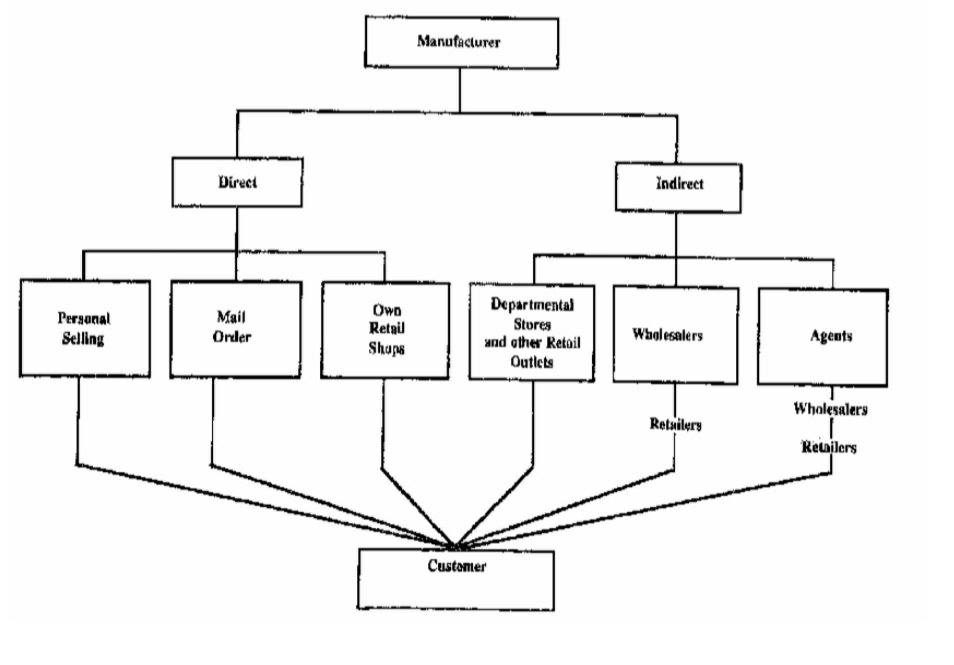
Alternative channel of distribution
But in most cases, manufacturers have to take the help of a variety of agencies or middlemen to reach their ultimate customers. These agencies are called by various names which generally follow the services they perform. They are generally classified as(i) functional middlemen or (ii) merchant middlemen. The functional middlemen are those intermediaries who perform various marketing functions without having title to goods. More important of ‘ them are mercantile agents like brokers and commission agents. On the other hand, merchant middlemen obtain title to the goods with a view to selling them at a profit. They take the risk involved in marketing and work not for a certain percentage of commission but for a margin of profit. More important of them are wholesalers and retailers.
A. Mercantile Agents
1. Brokers
They take neither possession nor acquire ownership of the goods but only serve to bring the buyers and sellers together. They negotiate purchase and sale of goods on behalf of other parties. Their task is over as soon as the buyer and the seller come to terms in respect of the purchase or sale of the goods. The broker works for a certain percentage of commission on the business transacted by him on behalf of his principal.
2. Commission Agents
They also sell goods on behalf of the sellers. But they differ from brokers in that they not only negotiate the sale of goods but also take possession of the goods and make arrangements for the transfer of title to the goods. The commission agent has to perform the functions of warehousing, grading, packing or sampling in addition to assembling and dispersion. For their services, the commission agents get a certain percentage of commission on sales. If the commission agent is authorised to sell on credit and agrees to bear the risk of bad debts for some additional commission, he is known as a del credere agent.
B. Merchant Middlemen
1. Wholesalers
Wholesalers are those merchants who act as intermediaries between the primary producers, manufacturers or importers, on one side, and retailers or industrial consumers on the other. They buy goods and commodities in large quantities with a view to selling them to retailers in smaller quantities. They assemble merchandise from many sources, warehouse and regroup the goods for convenient buying by retailers. Thus wholesalers make it possible for the manufacturer to sell to a large number of retailers to whom the merchandise cannot be easily sold directly from the factory.
2. Retailers
A retailer is defined as “a middleman who sells mainly to the ultimate consumer. He may sell to institutions but most of his sales are made to industrial or household consumers. He usually sells in small lots”.
The retailer is the last link and the most important intermediary in the chain of distribution. Mass production in the present day set-up is geared to the requirements of the ultimate consumer. Retailers are directly and intimately in touch with the ultimate consumers and thus occupy a strategic position in the whole chain of distribution.
Type of Retailers
There is a wide variety of retail trading establishments. They vary from hawkers and peddlers to big departmental stores. Hawkers and peddlers move from door-to-door in residential localities to sell their goods. Pavement shops usually arrange their wares at busy street corners or pavements of busy streets. Some traders sell their wares at weekly markets which are very common in rural India, and are not uncommon in urban centres.
3. Department Stores
A department store is a large-scale retail institution comprising a number of departments, each department specialising in a separate line of products. All these departments are under one roof and one unified control. Department stores offer the widest possible choice of products. The consumer can find all what he needs in one store rather than move around from shop to shop. These stores are located in central places in big cities so that they are easily accessible to customers.
4. Cooperative Stores
Consumers sometimes join together to form cooperative societies to sell goods on retail basis. The basic purpose is to eliminate middlemen and obtain their requirements at a lower price. The capital is subscribed by the members through the purchase of shares of small denominations. Cooperative stores purchase their requirements in bulk. from manufacturers or wholesalers. This enables the cooperative stores to sell their products at somewhat lower prices than the ordinary retailers.
5. Multiple Shops or Chain Stores
The multiple shop system denotes an organisation which controls a number of stores under one common ownership and management. The various stores are located in various cities and in various localities of bigger cities. Multiple shops refer to a group of retail stores dealing in similar types of goods. The basic idea behind the establishment of the multiple shops is to approach the customer in his vicinity unlike department stores which seek to attract customers to a central location. These shops could be operated by manufacturers or by wholesalers with the basic objective of eliminating retailers. Bata Shoes and Usha Sewing Machines are the two examples of products for which multiple shops have been opened by manufacturers in India.
Some textile mills also have some shops of their own in bigger cities. If wholesalers decide to operate multiple shops, they indulge in centralised buying with decentralised selling.