
Table of Contents
Q.1. Discuss the various responsibilities of a manager towards customers. (20)
The manager must always remember that the customer comes first. The starting point for the business firm is an understanding of the needs of the customer, and the firm’s foremost responsibility is towards the customer.
A firm’s responsibility towards its customer is in terms of ensuring that the desired quality of product at a reasonable price is made easily available to the customers. Product quality is of the utmost concern and covers dimensions of product design, materials used in production, safety, purity, hygiene and aesthetic appeal. The quality of spices is measured in terms of its purity, fragrance, freshness, cleanliness and colour. In case of a car the quality refers to its fuel-efficiency, maximum speed at which it can run, reliability and trouble-free working of the engine, efficiency of its brakes, sturdiness of the body, comfortable sitting space, commodious boot for keeping luggage, fitted-in air conditioner, stereo system, foam seat covers, etc. The list is endless. This is because quality means different things to different people.
In India durability is a very important ingredient of quality. The longer the product works or lasts, the better is its quality in our perception. In contrast, people in the developed countries discard even a perfectly functioning product in favour of a new one as soon as it is possible.
In attempting to provide the best quality product the manager must always remember that quality is perceived in relation to the price of the product. Your company may spend a fortune in producing the best quality product, but if it is priced significantly higher than the accepted price you will not be able to find any buyers for your product. Price is always determined in relation to your cost of production and what the customer thinks is good value for money.
It is the responsibility of the manager to provide the right match between quality and price. This relationship of quality and price is very important. Japan’s economic recovery and rise to the position of world’s number one position in electronics and automobiles is the result of its winning combination of best quality which competitors can’t match and at prices which competitors can’t beat.
Products manufactured by reputed companies carry stickers saying checked for quality control’, `tested’, ‘O.K.’. Over a period of title the customer starts associating certain level or connotation of quality with particular companies and their brand names. If, however, your products do not enjoy this kind of quality association, you can have the quality ascertained by government bodies such as the Indian Standards Institution which puts its ISI mark of approval on your product after testing for adherence to minimum quality standards. Getting such certifications will go a long way in building the customers’ confidence in your products.
Having ensured the desired quality of your product, and fixed a reasonable price for it, your next responsibility is to ensure that your product is easily and conveniently available to your customers. Unless you happen to be marketing a product in which your company enjoys a monopoly and no substitute is easily available, persistent non-availability of your product will lead your customers to switch over to the best available substitute. As a manager you are also responsible for ensuring that the dealers or retailers through whom you sell your product provide the correct information about the product to the customers, charge the correct price, sell the correct weight or amount (if your product is sold loose) and provide the proper after sales support. A dealer who cheats on any one of these accounts is spoiling the image of your product and company and you should discard such dealers immediately.
Often firms, in their anxiety to make a success of a new product, make very tall claims about the potential benefits of their product. Such a promotional effort may create a short-term effect but can never provide a long-term stability. In India, there is a tendency on the part of many firms to bolster the image of their products by making claims far from the truth primarily because many customers are not in a position to challenge such claims either through a voluntary or legal framework. In the absence of pressure from consumers, it becomes the responsibility of the manager to promote the products only on the basis of real and not imaginary benefits.
Finally, there are always; some product or service concepts the consumption of which is viewed to be unethical. For instance a private medical clinic promoting the concept of determining the sex of a foetus, knowing fully well that there is a distinct preference for a male child in most families, is certainly promoting an unethical service.
Therefore, in terms of responsibility towards customer, the management of a firm should always, aim at marketing, the right product, at the right price and of the right quality.
Q.2. What do you understand by controlling in management? Mention the basic steps involved in designing a control process. (20)
Controlling
Planning and controlling go hand in hand. There can be no control without a plan and plans cannot be successfully implemented in the absence of controls. Controls provide means of checking the progress of the plans and correcting any deviations that may occur along the way.
As each worker enters the factory premises in the morning, his or her time of arrival is electronically ( or manually) punched on his or her card and every evening the departure time is similarly recorded. This simple control process is effective in checking the time spent by each worker in the factory and at the end of the month for calculating his or her wages and overtime. The mere act of recording makes each worker conscious of late arrival and acts as a self-check on his or her timing. In contrast to this simple control, the annual budget for the subsidiary of a multi-location company requires a far more sophisticated process for controlling its many diverse activities.
The type of control required will vary according to the factors that are to be controlled, and the critical importance of the factors to the organisation’s success. The more critical the factor the more complex is the control mechanism needed to check its progress. Finance is a very critical area of management and most companies devise elaborate and sophisticated financial controls.
A control is meaningful only when there is clear cut responsibility for activities and results. It is meaningless to have a control process which simply points out deviations but cannot pinpoint the area inwhich they occurred and who is responsible for taking the corrective measures.
Controls may be used to measure physical quantities (such as volume of output, number of man hours, number of units of raw material consumed per machine, etc.), monetary results ( value of sale, capital expenditure, return on investment, earnings per share, etc. ) or to evaluate intangibles such as employees loyalty, morale, and commitment to work. Obviously, the third kind of controls are the most difficult to design and implement. No quantitative measure can be used, but only a qualitative, descriptive evaluation is possible.
Steps in controlling
There are three basic steps involved in designing a control process :
a. Establishment of standards
Controls are established on the basis of plans and so the first step is to have clear plans which in turn become the standards for controlling. The sales forecast plan which sets sales targets itself becomes the standard against which actual sale is measured. However, an effective control process focuses only on the critical variables rather than controlling all the variables. It also indicates the permissible range of deviation from the expected target. Only when the actual performance is outside this range, does it become a matter of concern for the manager to find out why this has happened and take corrective action. Similarly, the marketing manager at the head office is interested in the sales figures achieved by each branch and not in the performance of individual salesperson.
b. Measurement of performance
Having set standards it is necessary to devise a system for measuring the performance of individuals, departments or the company against these standards. In some cases quantitative goals can be set, such as number of units to be sold by each salesperson., number of units to be produced per machine, or the profit to be generated by each branch office.
However, evaluating performance in case of managers at the top level or those operating in areas such as personnel, public relations, and administration is far more difficult. The work output cannot be translated into quantifiable terms. Only a qualitative appraisal is possible.
c. Correcting deviations
The ultimate objective of the control process is to pinpoint the occurrence outside the permissible range of action to allow management to take corrective action. For example the maximum number of rejects per machine per day is fixed. When the number of rejects increases beyond this acceptable level, it is time for the production supervisor to investigate and take suitable steps to correct the situation.
The successful control process hinges on the all important concept of feedback. This refers to the information on the critical control variable of the operation or activity which, when fed back to the manager, triggers off corrective action.
Q.3. Define organisational culture. Discuss the dimensions of organisational culture. (20)
Organisational Culture
Every organisation has some characteristics which are common with any other organisation. At the same time, each organisation has its unique set of characteristics and properties. This psychological structure of organisation and its sub-units is usually referred to as Organisational Culture.
For a layman, culture is a commonly experienced phenomenon and many words like, climate, atmosphere, environment and milieu are often used interchangeably to describe it. In fact, most of the studies which have tried to measure an organization’s “Culture” have operationalised it in terms of “Organisation Climate”. A couple of formal definitions of organisation climate are given below:
1. “Organisational climate is a relatively enduring quality of the internal environment that is experienced by the members, influences their behaviour, and can be described in terms of values of a particular set of characteristics of the organisation” (Renato Tagiuri, 1968).
2. “Organisational climate is the set of characteristics that describe an organisation and that
a. Distinguish one organisation from other organisations
b. are relatively enduring over time and
c. influence the behaviour of the people in the organisation” (Forehand & Gilmer 1964).
Compare these two definitions of “Organisational Climate” with a definition of “Organisational Culture” as given by Stephen P. Robbins (1986): “Organisational culture is a relatively uniform perception held of the organisation, it has common characteristics, it is descriptive, it can distinguish one organisation from another and it integrates individual, group and organisation system variables.”
Dimensions of Organisational Culture
Some of these common dimensions are-
1. Individual Autonomy
This refers to the individual’s freedom to exercise his or her responsibility. In other words, individual autonomy is the degree to which employees are free to manage themselves; to have considerable decision making power; and not to be continually accountable to higher management.
2. Position Structure
This refers to the extent of direct supervision, formalization and centralisation in an organisation. In other words, position structure is the degree to which objectives of the job and methods for accomplishing it are established and communicated to the individuals by supervisors.
3. Reward Orientation
This refers to the degree to which an organisation rewards individuals for hard work or achievement. An organisation which orients people to perform better and rewards them for doing so, will have an OC characterised by high reward orientation.
4. Consideration, Warmth and Support
This refers to the extent of stimulation and support received by an individual from other organisational members. In other words, if there is a sense of team spirit among the members of an organisation, the OC is likely to be perceived as considerate, warm and supportive.
5. Conflict
This refer to the extent of conflict present between individuals and the willingness to be honest and open about interpersonal differences.
6. Progressiveness and Development
This aspect refers to the degree to which organisation conditions foster the development of the employees, allow scope for growth and application of new ideas and methods.
7. Risk Taking
The degree of which an individual feels free to try out new ideas and otherwise take risks without fears of reprisal, ridicule or other forms of punishment, indicate the risk-taking dimension of OC. This dimension is akin to “ cautious” verses “venturesome” quality of an organisation.
8. Control
This dimension refers to the degree to which control over the behaviour of organisational members is formalised. In a highly bureaucratic organisation, control systems are well defined. In a low-control organisation, most of the controls are self-regulated, i.e. individuals monitor their own behaviour. You can think of these dimensions as “tightness” versus “looseness” of an organisation.
These eight dimensions account for most of the research findings, but they do not account for all that we intuitively feel to be present in the “Climate” or “Culture” of an organisation.
Q.4. Write short notes on any two of the following: (10×2=20)
a. Managerial obsolescence
Managers and executives, after 20 to 25 years of work experience, often find themselves having reached a plateau where, on the one hand, the prospect of enhanced status, increased pay and perks are no longer motivators enough to work hard; and on the other, they find they are unable to relate to the latest managerial knowledge and skills and feel totally lost. In both cases, these managers cease to be productive and become a drag on the organisation in terms of their heavy cost and inability to make meaningful contribution. This is the problem of managerial obsolescence, that is when managers become unproductive, or out of date, or both. In the situation where lack of motivation seems to be the cause, the solution lies in redesigning their job content to make it more meaningful. For example, an aerospace company designates its senior engineering managers as consultants to its groups of young engineers, thus providing the right outlet for their rich experience.
Training programmes aim to provide or improve knowledge and skills which can help the manager improve his or her performance on the job. Many companies regularly sponsor their senior managers to attend such training programmes. Other companies invite experts to their own company premises to conduct these programmes and workshops. Training programmes, refresher courses, and basic courses in functional areas are the solution for managers facing knowledge obsolescence.
These training programmes are not restricted to senior managers alone. In fact, younger managers can also benefit from these programmes, especially those which provide knowledge of other functional areas such as production for non-production managers. Also beneficial for the young managers are workshops aimed at training them for the top level management posts.
b. Managerial Ethos
Ethos refers to the habitual character and values of individuals, groups, races, etc. Managerial ethos is concerned with the character and values of managers as a professional group. Contemporary managers hold some specific values which affect work and some of these are autonomy, equity, security, and opportunity.
1. Autonomy
These managers tend to allow enough latitude to individual employees as long as the use of this freedom does not violate the basic norms of the organization. In the last two decades, some management practices have been innovated which are in keeping with this value of autonomy.
2. Equity
Equity refers to justice in rewarding performance. Modern managers strongly feel that a person must get a reward proportionate to his input.
Security(providing security both economically and emotionally): Keeping a person on his toes by making him feel insecure is slowly but steadily getting discredited as a management philosophy. Even the societies which have practiced “hire and fire” policy are unmistakably shifting towards providing security of the job.
3. Opportunity
Providing enough career advancement opportunities to employees is yet another contemporary managerial value.
Besides these four values which affect a manager’s work, the manager may have a strong “Work Value”. Work Value refers to the worth a person ascribes to the opportunity of work. If you have a “strong” work value you are going to identify the worth or value of work to you in more ways than one.
4. Security (providing security both economically and emotionally)
Keeping a person on his toes by making him feel insecure is slowly but steadily getting discredited as a management philosophy. Even the societies which have practiced “hire and fire” policy are unmistakably shifting towards providing security of job.
Managerial Ethos Characteristics
Apart from these values, the managerial ethos requires the below characteristics as well.
1. Action goal orientation
Persons with a high sense of adequacy have clear goals about their future and are directed by these goals. They are action oriented to reach their clear goals
Pro-action/Pro-active: Proactive people do things on their own without having to be told by anyone. Such an initiative taking behavior leads to a high level of activity and experimentation.
2. Internal resources
Managers with a high sense of adequacy are aware of their internal strengths and are guided by these strengths. They are aware of their weaknesses but this awareness does not deter them from acting positively or to look for opportunities for continuous self-improvement. They are open to feedback and ready to learn from experience.
3. Problem-solving attitude
A superior ethos requires that managers view themselves as problem solvers, rather than problem-avoiders. These managers have a positive orientation to problem situations and do not want to run away from problems. They tend to approach problem situations with optimism because they have an internal locus of control, i.e., a strong belief that they can change the environment through their own efforts.
4. Pro-action
Proactive people do things on their own without having to be told by any one. Such initiative taking behaviour leads to a high level of activity and experimentation. As contrasted to these people are reactive persons or conformists who spend most of their lives in doing things that others expect them to do. Reactive people are outer-directed, whereas proactive ones are inner-directed. A superior managerial ethos requires more of pro-action than reaction.
c. Conflict avoidance strategy
a. Ignoring the Conflict
This strategy is represented by the absence of action. Managers, often avoid dealing with dysfunctional aspects of conflict. Unfortunately, when you avoid searching for the causes of the conflict, the situation usually continues or becomes worse over time. Although ignoring the conflict generally is ineffective for resolving important policy issues, there are some circumstances in which it is at least a reasonable way of dealing with problems. One such circumstance in which ignoring the conflict is a reasonable strategy is when the issue seems to be symptomatic of other, more basic conflicts. For example, two groups may experience conflict over the amount and quality of office space. Such conflicts often reflect more important issues about relative power and status. Resolving the office space problem would not address the key issues, and attention could be directed more fruitfully to the more basic concerns.
b. Imposing a Solution
This strategy consists of forcing the conflicting parties to accept a solution devised by a higher-level manager. Imposing a solution does not allow much conflict to surface, nor does it leave room for the participants to air their grievances, so it also generally is an ineffective conflict-resolution strategy. Any peace that it does achieve is likely to be short-lived. Because the underlying issues are not addressed, the conflict reappears in other guises and in other situations.
Forcing a solution can, however, be appropriate when quick, decisive action is needed. For instance, when there is conflict over investment decisions, and delays can be very costly, forcing a solution may be the best strategy available to top management. Likewise, it may be necessary when unpopular decisions must be made and there is very little chance that the parties involved could ever reach agreement (Thomas, 1977). An example of this is when an organisation must cut back on the funding of programmes. It is unreasonable to expect that any department would agree to cut its staff and expenses for the greater good, yet some hard unpleasant decisions ultimately must be made.
Q.5. What do you understand by Management by Objectives(MBO) ? Discuss the benefits and limitations of MBO. (20)
MBO
Management By Objectives (MBO) is a tool by which managers can improve their performance and increase their effectiveness. The term MBO was coined by Peter Drucker more than 35 years ago. Drucker used the term in a very broad sense to connote not just a specific tool, but rather an approach or philosophy of management. In the United States, the name most associated with MBO is that of George Odiorne. He stresses on the superior-subordinate relationship and propounds MBO as a “guide for operating the unit and assessing the contribution of each of its members”. John Humble of U.K. visualises MBO as a “system which integrates the company’s need to achieve its goals with the managers need to contribute and develop himself” and consequently places greater emphasis on corporate planning.
MBO can be defined as an approach which uses objectives as a focal point to improve managerial performance and managerial effectiveness, both at the individual and at the organisational level. These objectives serve to guide, direct, review and measure performance. However, MBO should not be thought of as merely a tool for performance appraisal. It is a far more comprehensive mechanism and provides a framework for organisational and managerial decisions.
In the MBO approach while the objectives provide the focal point, the emphasis is on improving the performance and providing better results. This is because MBO is concerned with achieving the objectives as well as the process by which they are achieved. The objectives will necessarily vary with the managerial level at which they are set. Objectives at the level of the managing director will be different from those of a branch manager or the production manager. However, all these objectives are derived from the organisation’s overall objectives and in turn are linked to the corporate plan. The fact that MBO allows for distant, intangible organisational objectives to be converted into achievable, personalised objectives (for each level of management ) is the reason for its success and popularity.
The key concepts in MBO are :
• emphasis on results rather than activities,
• objectives for specific managerial positions,
• participatory or joint objective setting,
• identification of key result areas, and
• establishment of periodic review system.
Benefits –
The benefits accruing from MBO can be discussed in terms of the specific benefits to the subordinate, the superior and the organisation:
1. Benefits to subordinates
Includes greater role clarity, measurement of performance and increased job satisfaction. When specific objectives have been agreed upon, the subordinate knows exactly what he or she has to achieve and can plan various activities towards this end. Role and goal clarity ensure that there is no wastage of scarce organisational resources, on the one hand, and single minded dedication to achievement of objectives on the other.
MBO implies regular feedback and measurement of performance against objectives. This serves as a great motivating factor for people to put in their best effort to achieve the objectives. It also helps to weed out the non-performer and identify the real contributors.
Clear, specific objectives and unbiased feedback about performance contribute to increased job satisfaction as compared to a situation where a person does not know what is expected of him or her and how, if at all the performance will be judged. Job satisfaction emanates from the feelings of having done a job well to the best of your capability as well as public recognition and approval for it. The former is possible only when there are specific objectives while the latter can occur only if there is a system of review and reward. A worker or manager who derives satisfaction from his or her job will work harder in order to improve the performance while a dissatisfied, discontented manager will make a negative contribution. Thus MBO can serve to bring about a change and put people on the self-propelling cycle of role clarity, increased job satisfaction and increased productivity.
2. Benefits to Superiors
The benefits accruing to the subordinate will, of course, also accrue to the superiors. But besides these, the other specific benefits for superiors are that MBO motivates subordinates, strengthens superior-subordinate relationship, and provides an objective appraisal method.
MBO is based on the concept of participation and this leads to greater motivation. Setting objectives implies that both the superior and the subordinate have to sit across the table and openly discuss their respective roles, work, obstacles, and competencies. Such candid discussion always leads to increased mutual trust and confidence in each other and provides an enduring bond to the relationship.
One of the biggest advantages of MBO is that it provides an objective basis for reviewing performance on the basis of achievements rather than personality traits. Reviewing a person on the basis of personality not only puts him or her on the defensive but serves no purpose from the organisation’s point of view. The only thing that matters is results. People are retained by organisations to produce results and not because they are sociable, soft spoken, introverted or possess any other such personality characteristic which has no bearing on their competence or capability.
3. Benefits to the organisation
MBO focuses on managerial effectiveness as a central value in the entire organisation. And this emphasis permeates down to the lowest level, influencing each manager and worker. This shows up in all the decisions which each manager makes and the overall performance of the organisation is improved. Secondly, MBO with its focus on objectives improves concentration and co-ordination of managerial effort. There is maximum utilisation of resources and conflicting pulls in opposite directions are avoided. Thirdly, the periodic review in MBO helps identify advancement potential of workers and managers. It also helps in identifying who are under-utilised or not making the full contribution. Lastly, MBO creates many centres of accountability as against one centralised accountability point. It is not only the managing director or proprietor who is accountable for producing the desired results but each manager is responsible for achieving the agreed upon objectives. Thus, MBO leads to greater decentralisation in terms of setting and achieving objectives.
Limitations
In practical implementation you could sometimes encounter one or more of the following limitations of MBO:
1. Problems in joint objectives setting among unequals
MBO implies a process of point to point or consultative objective setting between the superior and the subordinate. But this very relationship, based upon status, may prove to be a hindrance in free and frank open communication between the two, and stall the process of setting goals in an objective manner.
2. Problems of MBO being effective at the lowest level
Theoretically, MBO is supposed to percolate throughout the organisation right down to the lowest level since the manager as well as the worker at each level have set their own agreed upon objectives. However, in reality, the workers or managers at the lower levels often do not have the full freedom to set their own objectives. This is because MBO operates from top to down, starting with the corporate objectives. Thus, the process of objective setting implies that the objectives at the lower level have already been locked in and managers down the line have to match their own objectives with those of the level above them only.
If the process of objectives setting is reversed to overcome this limitation, and objectives are first set at the lowest level, it would mean that the entire organisation is being guided by people who have less experience, less education, less knowledge and awareness.
3. It is difficult to implement in a situation of change
MBO assumes a stable environment in which the objectives once set will hold good till they are achieved. In reality, however, many unforeseen changes may occur which may render the objective impossible to achieve, or irrelevant, or invalid. In a situation where sudden changes occur frequently MBO is difficult to implement.
4. There have been cases where MBO has totally failed.
The most commonly encountered reasons for the failure of MBO are:
• Lack of top management support and commitment,
• Lack of or inadequate planning and preparation,
• Lack of information and education,
• Very short time horizon,
• Overemphasis on appraisal,
• Poor understanding of the role of MBO, and
• Lack of clear cut policy towards MBO.
Q.6. Mention the elements of an organisation structure. Differentiate between formal and informal organisation structure. (20)
Organisation structure refers to the formal, established pattern of relationships amongst the various parts of a firm or any organisation. The fact that these relationships are formal implies that they are deliberately specified and adopted and do not evolve on their own. Of course, it may sometimes happen that given an unusual situation, new working relationships may evolve and may later be adopted as representing the formal structure.
The second key word in our definition of structure is ‘established’. Only when relationships are clearly spelled out and accepted by everyone, can they be considered as constituting a structure. However, this does not mean that once established, there can be no change in these relationships. Changes may be necessary with passage of time and change of circumstances, but frequent and erratic changes are to be avoided. A structure can be based on relationships only if they exhibit a certain degree of durability and stability.
The elements of an organisation structure are
1. The network of formal relationships and duties, i.e. the organisation chart plus the job descriptions,
2. The manner in which various tasks and activities are assigned to different people and departments (differentiation),
3. The manner in which the separate activities and tasks are coordinated (integration),
4. The power, status, and hierarchical relationships within the organisation (authority system),
5. The planned and formalised policies, procedures and controls that guide the activities and relationships (administrative system), and
6. The flow of information and communication network.
Differences Between Formal and Informal Organization
1. Origin
A formal organisation is created to fulfil some objectives. Hence, a formal organisation is basically goal-oriented. It is built around the general principles or organisation and the members of formal organisation are fully aware of these principles. Informal organisation, on the other hand, develops automatically and spontaneously. In other words, formal organisations are deliberately created whereas informal organisations are spontaneously formed.
2. Structure
A formal organisation has a definite and specially designed structure reflected in organisation chart rendering a pictorial representation of the authority relationships. The authority structure is rigid and defined. Informal organisations are structure less groups. These are initiated by the workers themselves to serve the needs of workers.
3. Purpose
Formal organisations are created to achieve goals defined by management. Normally, profit maximisation or wealth maximisation are the fundamental objectives of a formal organisation. On the other hand, the basic aim of an informal organisation is to satisfy the individual goals of members. Social satisfaction is the fundamental objective of an informal organisation.
4. Control
In formal organisations, control points are established to constrain behaviour, restrain the members from going off the prescribed track. Thus, there exist a rigid system of rules and regulations which all the members are supposed to follow. Informal organisations are not tied to a rigid system of rules and regulations. However, every informal group outlines specific norms which the entire members are not supposed to violate in order to continue their membership.
5. Influence process
In formal organisations, authority is equated with influence. The person at the top becomes the most influential person. People enjoying authority become powerful in the minds of subordinates. In a sharp contrast, influence in informal organisation is attached to the individual person. Informal group attaches more value to that man who is able to satisfy the needs of the group members.
6. Communication
There is a formal, official channel of communication in formal organisation. Communication is largely a one-way traffic here. The informal organisation designs its own channel of communication (known as grapevine”) for both organisational and social communication process. The grapevine tends to outstrips formal channels on speed.
7. Size
Formal organisations can balloon to gigantic, unmanageable proportions depending on their success in capturing the market. In a sharp contrast, informal organisations tend to be small and manageable, and beyond a particular point members do not join groups. That is say, if the group membership is large; members join some other group (or form some other group).
Q.7. Discuss in brief the barriers to effective communication. Give relevant examples. (20)
Barriers To Effective Communication
The process of communication has multiple barriers. The intended communique will often be disturbed and distorted leading to a condition of misunderstanding and failure of communication. The Barriers to effective communication could be of many types like linguistic, psychological, emotional, physical, and cultural etc. We will see all of these types in detail below.
1. Linguistic Barriers
The language barrier is one of the main barriers that limit effective communication. Language is the most commonly employed tool of communication. The fact that each major region has its own language is one of the Barriers to effective communication. Sometimes even a thick dialect may render the communication ineffective.
As per some estimates, the dialects of every two regions changes within a few kilometers. Even in the same workplace, different employees will have different linguistic skills. As a result, the communication channels that span across the organization would be affected by this.
Thus keeping this barrier in mind, different considerations have to be made for different employees. Some of them are very proficient in a certain language and others will be ok with these languages.
2. Psychological Barriers
There are various mental and psychological issues that may be barriers to effective communication. Some people have stage fear, speech disorders, phobia, depression etc. All of these conditions are very difficult to manage sometimes and will most certainly limit the ease of communication.
3. Emotional Barriers
The emotional IQ of a person determines the ease and comfort with which they can communicate. A person who is emotionally mature will be able to communicate effectively. On the other hand, people who let their emotions take over will face certain difficulties.
A perfect mixture of emotions and facts is necessary for effective communication. Emotions like anger, frustration, humour, can blur the decision-making capacities of a person and thus limit the effectiveness of their communication.
4. Physical Barriers to Communication
They are the most obvious barriers to effective communication. These barriers are mostly easily removable in principle at least. They include barriers like noise, closed doors, faulty equipment used for communication, closed cabins, etc. Sometimes, in a large office, the physical separation between various employees combined with faulty equipment may result in severe barriers to effective communication.
5. Cultural Barriers of Communication
As the world is getting more and more globalized, any large office may have people from several parts of the world. Different cultures have a different meaning for several basic values of society. Dressing, Religions or lack of them, food, drinks, pets, and the general behaviour will change drastically from one culture to another.
Hence it is a must that we must take these different cultures into account while communication. This is what we call being culturally appropriate. In many multinational companies, special courses are offered at the orientation stages that let people know about other cultures and how to be courteous and tolerant of others.
6. Organisational Structure Barriers
As we saw there are many methods of communication at an organizational level. Each of these methods has its own problems and constraints that may become barriers to effective communication. Most of these barriers arise because of misinformation or lack of appropriate transparency available to the employees.
7. Attitude Barriers
Certain people like to be left alone. They are the introverts or just people who are not very social. Others like to be social or sometimes extra clingy! Both these cases could become a barrier to communication. Some people have attitude issues, like huge ego and inconsiderate behaviours.
These employees can cause severe strains in the communication channels that they are present in. Certain personality traits like shyness, anger, social anxiety may be removable through courses and proper training. However, problems like egocentric behaviour and selfishness may not be correctable.
8. Perception Barriers
Different people perceive the same things differently. This is a fact which we must consider during the communication process. Knowledge of the perception levels of the audience is crucial to effective communication. All the messages or communique must be easy and clear. There shouldn’t be any room for a diversified interpretational set.
9. Physiological Barriers
Certain disorders or diseases or other limitations could also prevent effective communication between the various channels of an organization. The shrillness of voice, dyslexia, etc are some examples of physiological barriers to effective communication. However, these are not crucial because they can easily be compensated and removed.
10. Technological Barriers & Socio-religious Barriers
Other barriers include the technological barriers. The technology is developing fast and as a result, it becomes difficult to keep up with the newest developments. Hence sometimes the technological advance may become a barrier. In addition to this, the cost of technology is sometimes very high.
Most of the organizations will not be able to afford a decent tech for the purpose of communication. Hence, this becomes a very crucial barrier. Other barriers are socio-religious barriers. In a patriarchal society, a woman or a transgender may face many difficulties and barriers while communicating.
Q.8. Define MIS. How can an effective MIS be designed for hospitality sector? (20)
MIS
Management Information System (MIS) refers to that system by which information is collected processed and presented to management to help it in making better decisions.
A manager makes decisions all the time and anything that helps improve the decision-making will obviously lead to better results. As we discussed in the previous section, the systems concept implies an input, a process, and an output. In case of MIS, data is the input which is processed to provide output in the form of information reports, summaries, etc. To be really useful the output must aid the manager’s decision-making process. If it does not do so, it is not a management information system, but just an information system.
An effective MIS should be:
a. Timely: A market research report, pointing out the unacceptability of milk sold in plastic containers in retail stores, presented to the manager after he has already launched his product in the market is of little use. Information is useful only when it is within the time limits of the decision.
b. Accurate: If the information presented is inaccurate, the manager who takes a decision based on this will invariably end up making a mistake. However, it is not possible to have hundred per cent accurate information. But the way to overcome this is to indicate the expected range of deviation or the level of inaccuracy. Thus the manager acting on the basis of this information knows the risk he or she is taking.
c. Relevant: Volumes of reports (however excellent they may be) on the export potential of cashew nut to a manufacturer of sports goods are of no value simply because it is outside his or her area of interest and activities. The manager, himself or herself, can make an important contribution in ensuring that the information received is relevant to his decision-making. To do so he or she must provide an answer to the question “What do I need to know?”
A manager’s requirement of information depends on the level of management at which one is operating. In any organisation there are three broad levels of management i.e., top, middle and operating management. It is the type of decisions made by one level that distinguishes it from the others.
Designing MIS
While designing the MIS, the different types of information required by different managers must be kept in mind. The manager at the top needs more information about the environment. Regarding the internal operations of the company, the top manager is only concerned with the results as reflected in profits, sales volume, turnover, etc. Moreover, these results should be presented in a summary rather than detailed format.
The middle level manager is interested in finding out why the results were not as per the expected plan, knowing about the deviations of the critical variables and taking corrective action. The operating manager’s concern is with details, like the number of hours each machine operated, number of units produced per hour, etc. Most of the internal organisational information is generated at this level but as it moves upward it is reduced to a summary highlighting only the critical performance variables.
In designing an effective MIS, the manager must understand the nature and flow of information.
Information regarding government policy, legislation, competition, etc. is generated in the environment but is collected and used within the organisation. Similarly, the firm or an organisation may send out information to the environment in the form of annual reports, company balance sheets, press-releases.
Besides this, the company managers and employees are also information carriers. Within an organisation, information may flow from operating level towards top management level ( bottom to top) and from top to bottom. Reports, summaries and feedback about impact of decisions flow from bottom to top and decisions, instructions flow from top to bottom. Information also flows sideways from one manager to another at the same managerial level.
Q.9. What do you understand by planning framework ? Differentiate between strategic and operational planning. (20)
Planning Framework
Planning rests on premises about the expected environmental conditions.
Such premises are classified into two categories:
a. External, i.e. Business Environment
Business Environment refers to the totality of economic, political, social, cultural and technological conditions that affect the formulation of plans of any organisation. Since the environment is primarily looked upon from the point of view of its impact on the demand for the product or services offered by the organisation, changes in the environment may have favourable or unfavourable consequences for the organisation. A rise in per capita income may signify more disposable income and indicate more purchasing power in the hands of consumers. On the other hand, political instability has an undesirable impact on the plans of a business enterprise.
The Government policies of regulation and control as also of taxation, and providing or withdrawing incentives, etc., all affect the future planning by a business enterprise. What can be produced or sold by a business may be subject to Government controls. The difficulty in business planning arises because it is impossible to forecast the character and effect of such controls. Again in an industry where technological changes are many and rapid, planning on the basis of old technology will spell doom for the enterprise. In order to succeed, managers today are expected to keep themselves abreast of technological changes taking place in the industry and plan the industry on that basis.
b. Internal premises
It can be several, e.g. , capital investment made; approved sales forecasts; values and beliefs of top management and the policies adopted, and the given organisational structure, etc.
For developing a plan framework, the following aspects should be taken account of:
1. Capital Investment
Business enterprises today need large capital investment and an investment once made in fixed assets tends to have long-run influence on its future plan as the investment made cannot be recouped except through use.
While developing plans, you should first assess carefully your own resources and commitments made, and adjust the plans in such a manner that the existing resources are more productively utilised.
2. Sales Forecasts
These are a projection of expected sales over a period of time and provide a framework on which plans of most enterprises are based. Since sales give rise to revenues which sustain the enterprise, business enterprises tend to attach a great deal of importance to the framing of such forecasts. A forecast of rising sales over a long-term would indicate the need for the expansion of the facilities.
On the other hand, a decline should alert the management to look into the causes of decline and initiate corrective actions.
Generally speaking, making a sales forecast is a two- step process:
1. Make industry- wise demand forecast.
2. Make sales forecast for a specific company.
For example, if you are in tourism business packaging tours, first estimate the total demand for tour packages in the tourist generating markets and then estimate your market share and the demand for the tours you are packaging or intend to package.
There are several methods of making demand forecasts and sales projections which you will study elsewhere.
It will be interesting for you to know that some of the most interesting and important contributions in management science are associated with the planning function.
3. Values and Policies of Top Management
The plans formulated and action taken by managers in an organisation are immensely affected by the values attached to alternative courses of action and policies pursued in each case. Value defines what is ‘good’ and what is ‘not good’. A top management holding a ‘good’ belief is not likely to plan for something, which it regards as ‘not good’. A case in point is an eco-friendly hotel devoted to the propagation of environment conservation. It has been the basic policy of the top management of that hotel not to use any thing which is not eco-friendly. Hence, howsoever, cost effective the products may be, if they are not eco-friendly they would never be considered as an alternative source to be used in the hotel.
4. Organisational Structure
Plans are implemented through an organisational structure which consists of people arranged in a hierarchy, each one responsible for the performance of a specific task in coordination with others.
Quite often it may be found that a particular drawn up plan cannot be satisfactorily implemented simply because the structure is such that while on the one hand there is duplication of effort, on the other hand, there is nobody to look after another part of the job.
In almost every kind of large-scale enterprise, examples can be found where well-conceived strategic plans were thwarted by an organisational structure that delayed the execution of the plans or gave priority to wrong set of considerations. While drawing up a plan, you should give attention to the needs of the organisation not only in terms of the number and kind of personnel required but also to the change in the organisational structure required for the effective implementation of the plan.
Difference between Strategic and Operational Planning
Strategic Planning
Strategic Planning, also known as long-range planning, has two important elements:
1. First it covers a longer period of time which may extend from five to twenty or more years. A capital intensive industry, e.g., a public utility service, or a company dealing in international markets must necessarily plan for a longer period.
2. Strategic planning also takes into consideration the totality of activities of the enterprise. In other words, it refers to planning for the total enterprise over a longer duration. Planning for a duration of fifteen, twenty or more years is also known as perspective planning.
Operational Planning
Operational Planning, tactical planning or short-range planning usually extends over a period of one year and is more detailed. While strategic plans indicate the activities to be undertaken or goals to be achieved in general terms, and are an instrument of planning and control in the hands of top management, operational plans are prepared in more specific terms. These plans are directly concerned with operations and deal with the various functional areas of the enterprise like production, marketing, finance, research and development, etc. They guide lower levels of managers in their day to day activities and serve as a yardstick for measuring their performance.
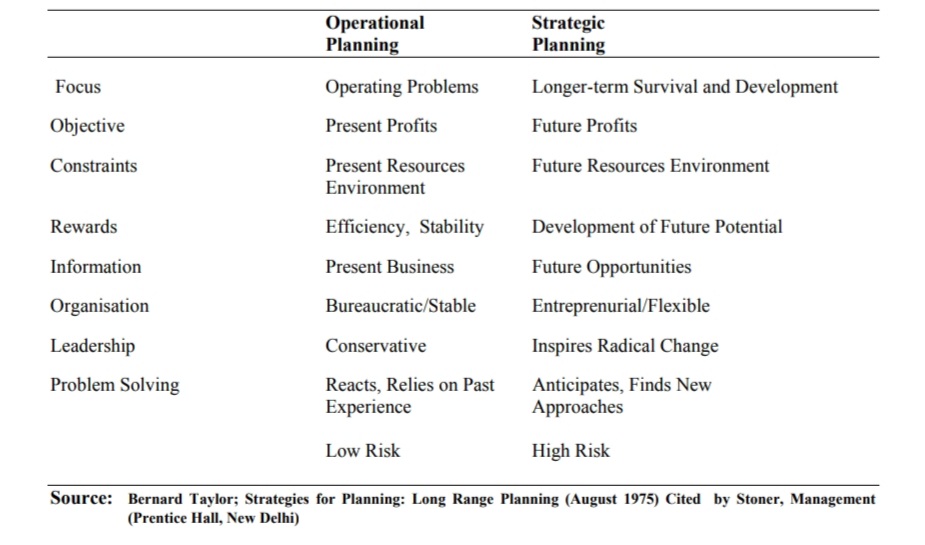
Distinction between Operational and Strategic Planning
Q.10. Explain the determinants of interpersonal behaviour. What is its relevance in hospitality trade ? (20)
Determinants of Interpersonal Behaviour
1. Self-Concept
Each person has an attitude towards himself or herself and this attitude comprises the self or self-concept i.e. What am I ? .The self-concept has three aspects – beliefs, feelings and behaviours:
• The belief component represents the content of the self. This is illustrated by such thoughts as “I am intelligent, sincere, overweight” etc.
• The feeling component about one’s self is reflected in feelings of self-worth or in general as ‘I’m O.K.’ or ‘I’m not O.K.
• Finally, the behavioural component is the tendency to act towards one’s self in a self-deprecating or self-enhancing manner.
The self-concept is a reflection of all your past experiences with other persons and includes characteristics which distinguish you from others. Once your self-concept is established and specific patterns of behaviour are adopted, it tends to resist change. This resistance to change also gives you a degree of stability that prevents you from regarding yourself as worthless at one moment and worthy at the next. As your activities are organised and integrated in relation to your self-concept, you can expect to develop a relatively consistent life-style. Also, you achieve a stable interpersonal environment by maintaining a consistent relationship between your self-concept and your beliefs about how others behave and feel towards you with regard to your self-concept.
2. Interpersonal Needs
What do you want from me ? People need people, but for what ? Schutz (Interpersonal Underworld 1966) maintains that there are three interpersonal needs- inclusion, control and affection that cause one to establish and maintain relations with others. These needs are defined as follows:
a. Inclusion- the need for interaction and association.
b. Control- the need for control and power.
c. Affection- the need for love and affection.
However, individuals differ in the strength of their interpersonal needs. For each interpersonal need, there are two behavioural aspects – expressed and wanted. Expressed behaviour is the behaviour that we initiate towards others, whereas wanted behaviour is the behaviour we want or prefer from others towards us.
Compatibility is the property of a relationship between two or more persons that leads to the mutual satisfaction of interpersonal needs and harmonious coexistence. If what is wanted and what is expressed is equal for both interacting persons, mutual needs are satisfied. For example, those who wish to dominate and control activities, work well with those who want to be controlled or directed. However, if both parties want to dominate, some degree of conflict may be expected.
When you compare these interpersonal needs with self-concept, you will find that the need for inclusion is to feel that the self is significant and worthwhile; for control, the need is to feel one’s self as a competent and responsible person; for affection, the need is to feel that self is a lovable person.
3. Interpersonal Orientations
How do you influence me? Individuals vary greatly in how they relate to and influence others. Three basic types of persons have been identified-the tough battler, the friendly helper, and the objective thinker.
Many people are more oriented to one style then another and feel more comfortable with its associated behaviours. While one’s style is related to his or her personal needs and self-concept, a style can be overdone and distorted. Each style reflects a behaviour that, in varying degrees, is ineffective in some situations.
The Tough Battler would relate better to others, if he or she was more sensitive to others, could accept his or her own inevitable dependence on others, and recognise that some situations will not yield to pressure.
The Friendly Helper would be more satisfied if he or she could stand up for his or her own interests and face conflict.
Like-wise, the Objective Thinker could relate to others more effectively, if he or she was more aware and accepting of his or her own feeling and those of others. One does not have to assume that his or her behaviour is fixed or impossible to control.
4. Interpersonal Attraction
Why do we like each other? You are not passive in your interpersonal interactions with others but seek to structure these relationships. You will choose to interact with others with whom you can most readily establish a harmonious relationship. For example, if you regard yourself as very intelligent, you will interact with others who respect your intelligence or allow you to use it. By choosing such persons as friends, an important and durable source of harmonious interactions is created. So, remember: people interact more frequently with those who are perceived as confirming their self-concept to the greatest extent.
The greater the importance and common consequences of an “object” for two people, the greater the attraction between both persons. An “object” may refer to any focus of perception− including physical objects, symbols, the other person’s self-concept or to one’s own self-concept.
Relevance in Hospitality Trade
Interpersonal relationship refers to a strong association among individuals working together in the same organization. Employees working together ought to share a special bond for them to deliver their level best. It is essential for individuals to be honest with each other for a healthy interpersonal relationship and eventually positive ambience at the workplace.
• An individual spends around eight to nine hours in his organization and it is practically not possible for him to work all alone. Human beings are not machines who can work at a stretch. We need people to talk to and share our feelings. Imagine yourself working in an organization with no friends around!!!!!!!!We are social animals and we need friends around. An individual working in isolation is more prone to stress and anxiety. They hardly enjoy their work and attend office just for the sake of it. Individuals working alone find their job monotonous. It is essential to have trustworthy fellow workers around with whom one can share all his secrets without the fear of them getting leaked. We must have friends at the workplace who can give us honest feedback.
• A single brain alone can’t take all decisions alone. We need people to discuss various issues, evaluate pros and cons and reach to solutions benefiting not only the employees but also the organization on the whole. Employees can brainstorm together and reach to better ideas and strategies. Strategies must be discussed on an open platform where every individual has the liberty to express his/her views. Employees must be called for meetings at least once in a week to promote open communication. Interaction on a regular basis is important for healthy relationship.
• Interpersonal relationship has a direct effect on the organization culture. Misunderstandings and confusions lead to negativity at the workplace. Conflicts lead you nowhere and in turn spoil the work environment.
• We need people around who can appreciate our hard work and motivate us from time to time. It is essential to have some trustworthy co workers at the workplace who not only appreciate us when we do some good work but also tell us our mistakes. A pat on the back goes a long way in extracting the best out of individuals. One needs to have people at the workplace who are more like mentors than mere colleagues.
• It always pays to have individuals around who really care for us. We need colleagues to fall back on at the times of crisis. If you do not talk to anyone at the workplace, no one would come to your help when you actually need them.
• An individual needs to get along with fellow workers to complete assignments within the stipulated time frame. An Individual working all alone is overburdened and never finishes tasks within deadlines. Support of fellow workers is important. You just can’t do everything on your own. Roles and responsibilities must be delegated as per specialization, educational qualification and interests of employees. An individual needs help of his fellow workers to complete assignments on time and for better results