
Table of Contents
Q.1. What do you mean by Small Scale Industries? Also discuss the characteristics and problems of Small Scale Industries (SSIs) in India. (20)
Small scale industries are those industries in which the manufacturing, production and rendering of services are done on a small or micro scale. These industries make a one-time investment in machinery, plants, and industries, but it does not exceed Rs 1 Crore.
The small scale industries are generally comprised of those industries which manufacture, produce and render services with the help of small machines and less manpower. These enterprises must fall under the guidelines, set by the Government of India.
The SSI’s are the lifeline of the economy, especially in developing countries like India. These industries are generally labour-intensive, and hence they play an important role in the creation of employment. SSI’s are a crucial sector of the economy both from a financial and social point of view, as they help with the per capita income and resource utilisation in the economy.
Examples of Small Scale Industries
• Bakeries
• School stationeries
• Water bottles
• Leather belt
• Small toys
• Paper Bags
• Photography
• Beauty parlours
Characteristics of SSI
1. Ownership
SSI ’s generally are under single ownership. So it can either be a sole proprietorship or sometimes a partnership.
2. Management
Generally both the management and the control is with the owner/owners. Hence the owner is actively involved in the day-to-day activities of the business.
3. Labor Intensive
SSI’s dependence on technology is pretty limited. Hence they tend to use labour and manpower for their production activities.
4. Flexibility
SSI’s are more adaptable to their changing business environment. So in case of amendments or unexpected developments, they are flexible enough to adapt and carry on, unlike large industries.
5. Limited Reach
Small scale industries have a restricted zone of operations. Hence, they can meet their local and regional demand.
6. Resources utilisation
They use local and readily available resources which helps the economy fully utilise natural resources with minimum wastage.
Major problems faced by the small scale industries
1. Finance
Finance is one of the most important problem confronting small scale industries Finance is the life blood of an organisation and no organisation can function properly in the absence of adequate funds. The scarcity of capital and inadequate availability of credit facilities are the major causes of this problem.
2. Raw Material
Small scale industries normally tap local sources for meeting raw material requirements. These units have to face numerous problems like availability of inadequate quantity, poor quality and even supply of raw material is not on regular basis. All these factors adversely affect the functioning of these units.
3. Idle Capacity
There is under utilisation of installed capacity to the extent of 40 to 50 percent in case of small scale industries. Various causes of this under-utilisation are shortage of raw material problem associated with funds and even availability of power. Small scale units are not fully equipped to overcome all these problems as is the case with the rivals in the large scale sector.
4. Technology
Small scale entrepreneurs are not fully exposed to the latest technology. Moreover, they lack requisite resources to update or modernise their plant and machinery Due to obsolete methods of production, they are confronted with the problems of less production in inferior quality and that too at higher cost. They are in no position to compete with their better equipped rivals operating modem large scale units.
5. Marketing
These small scale units are also exposed to marketing problems. They are not in a position to get first hand information about the market i.e. about the competition, taste, liking, disliking of the consumers and prevalent fashion.
6. Infrastructure
Infrastructure aspects adversely affect the functioning of small scale units. There is inadequate availability of transportation, communication, power and other facilities in the backward areas. Entrepreneurs are faced with the problem of getting power connections and even when they are lucky enough to get these they are exposed to unscheduled long power cuts.
7. Under Utilisation of Capacity
Most of the small-scale units are working below full potentials or there is gross underutilization of capacities. Large scale units are working for 24 hours a day i.e. in three shifts of 8 hours each and are thus making best possible use of their machinery and equipments.
8. Project Planning
Another important problem faced by small scale entrepreneurs is poor project planning. These entrepreneurs do not attach much significance to viability studies i.e. both technical and economical and plunge into entrepreneurial activity out of mere enthusiasm and excitement.
9. Skilled Manpower
A small scale unit located in a remote backward area may not have problem with respect to unskilled workers, but skilled workers are not available there. The reason is Firstly, skilled workers may be reluctant to work in these areas and secondly, the enterprise may not afford to pay the wages and other facilities demanded by these workers.
10. Managerial
Managerial inadequacies pose another serious problem for small scale units. Modern business demands vision, knowledge, skill, aptitude and whole hearted devotion. Competence of the entrepreneur is vital for the success of any venture. An entrepreneur is a pivot around whom the entire enterprise revolves.
The small scale entrepreneurs have to encounter numerous problems relating to overdependence on institutional agencies for funds and consultancy services, lack of credit-worthiness, education, training, lower profitability and host of marketing and other problems. The Government of India has initiated various schemes aimed at improving the overall functioning of these units.
Q.2. Explain the role of various central and state government bodies and other autonomous bodies in assisting the implementation of small scale industry and small scale business. (20)
The support system for SSI in India is quite comprehensive. Many of these agencies belong to the Central Government, while the rest belong to the state governments.
The small scale industry sector output contributes almost 40% of the gross industrial value-added, 45% of the total exports from India (direct as well as indirect exports) and is the second largest employer of human resources after agriculture. The development of small scale sector has therefore been assigned an important role in India’s national plans.
In order to protect, support, and promote small enterprises as also to help them become self-supporting, a number of protective and promotional measures have been undertaken by the government.
A. Central Government Agencies
1. MSME Board
Micro, Small, and Medium Enterprises Board (MSME Board, formerly known as Small Scale Industries Board, SSI Board) is reconstituted every two years and is headed by the minister-in-charge of Ministry of Micro, Small, and Medium Enterprises in the Government of India.
2. MSME Development Organization (MSMEDO)
MSME Development Organization functions through a network of MSME development institutes (formerly known as Small Industries Service Institutes), Branch MSME development institutes, regional testing centres (RTCs), field testing Stations (FTSs), and autonomous bodies.
3. MSME Development Institutes
The main functions of these institutions are as follows:
a. Assistance/consultancy to prospective entrepreneurs
b. Assistance/consultancy rendered to existing units
c. Preparation of state industrial profiles
d. Preparation/up gradation of district industrial potential surveys
e. Project profiles
4. MSME Technology Development Centers
Functions:
The functions of these technology development centres are:
a. Research and development in areas of dense industry clusters
b. Product design and innovation
c. Product and process improvement and development of improved packaging techniques
d. Common facility centre
e. Manpower development/training
5. MSME Testing Centers and MSME Testing Stations
MSME testing centers (formerly known as regional testing centers) provide testing and calibration facilities to industries in general and small scale industries in particular for raw materials, semi-finished and finished products manufactured by them.
Major functions of MSME testing centers and MSME testing stations are:
a. Provide testing facilities for quality upgradation
b. Training/consultancy in testing, quality control and quality management
c. Process quality control systems, etc.
d. Product specific testing facilities are provided by MSME testing stations.
B. State Government Agencies
All the state governments have their own state-specific policies for the promotion and development of the small, cottage, medium and large scale industries.
1. Commissioner/Director of Industries:
In each state, the commissioner/director of industries implements the state government policies and directives for promoting industrial development. The central policies for the SSI sector serve as guidelines for framing state-level policies as well as the package of incentives. The commissioner/director of industries also oversees the activities of their field offices, viz. district industries centers at the district level which are mostly engaged in extension activities, apart from administrative and regulatory work.
2. District Industries Centers
The District Industries Centers (DICs) Programme was initiated in May 1978, as a centrally sponsored scheme, with the objective of developing the small, tiny and cottage sector industries in the country and to generate greater employment opportunities especially among rural and backward areas.
Functions:
The extension services provided by the DICs include:
a. Dissemination of information
b. Supply of machinery and equipment
c. Provision of raw materials and quality inputs
d. Arrangements for credit facilities
e. Marketing
3. State Financial Corporations
The State Financial Corporations (SFCs) are state-level financial institutions, operating as regional development banks and playing a crucial role in the development of small and medium enterprises in the states concerned in tandem with national priorities.
Functions:
The major functions of SFCs are:
a. SFCs provide financial assistance by way of term loans, direct subscription to equity/debentures, guarantees, discounting of bills of exchange and seed capital.
b. The SFCs operate a number of schemes of refinance arid equity type assistance on behalf of IDBI/SIDBI in addition to special schemes for artisans and special target groups such as SC/ST, women, ex-servicemen, physically handicapped, etc.
d. SFCs have also started offering facilities such as equipment leasing and have entered the field of consultancy, merchant banking, debenture trusteeship, and capital-related services.
e. They also provide financial assistance for small road transport operators, hotels, tourism-related activities, hospitals, nursing homes, etc.
4. SIDCs/SIICs
State Industrial Development Corporations / State Industrial Investment Corporations (SIDCs / SECs) were set up under the Companies Act, 1956 as wholly-owned undertakings of the state governments to act as catalysts for industrial development in their respective states.
Set up primarily for providing assistance to medium and large scale industries, SIDCs/SIICs also extend assistance to the small scale sector by way of term loans, subscription to equity, and promotional services.
5. State Small Industries Development Corporations
State Small Industries Development Corporations (SSIDCs) were established under the Companies Act, 1956 as state government undertakings to cater to the needs of the small, tiny, and village industries in the respective states/union territories.
Functions:
Being operationally flexible, SSIDCs undertake a variety of activities for the benefit of the SSI sector such as:
a. Procurement and distribution of scarce raw materials
b. Supply of machinery to SSI units on a hire-purchase basis
c. Providing assistance for the marketing of products
d. Construction of industrial estates, provision of allied infrastructure facilities and their maintenance
e. Extending seed capital assistance on behalf of the State Government
Q.3. Analyse the role of SWOT analysis in the identification of a business opportunity. Explain with help of examples from the hospitality industry. (20)
One of most widely used strategic planning tools is a SWOT (Strengths, Weaknesses, Opportunities, and Threats) analysis. Most companies use it in one form or another. SWOT analysis is often used as basic guide for strategic planning.
The worth of SWOT analysis is often dependent on the objective insight of those management individuals who conduct the SWOT analysis. If management (or consultant management) is able to provide objective, relevant information for the analysis, the results are extremely useful for the company.
The term SWOT is the acronym made up of four words viz., Strengths, Weaknesses, Opportunities and Threats. The first two variables are internal to an organisation whereas the last two are external. SWOT stands for strengths, weaknesses, opportunities and threats. The first two are internal to an organisation whereas the last two are external.
The value of SWOT analysis cannot be overemphasised. It is rightly said “winners recognise their limitations but focus on their strengths; losers recognise their strength but focus on their limitations.” Positive thinking is strength whereas negative thinking is a weakness.
Every individual can make a list of his positive points (strength) and negative points (weakness). A weakness can be converted into strength by recognising it and by making an effort in that direction. Similarly, it is very important to be aware of the opportunities that come to us at various points of time and possible threats that also come from the other persons.
Importance:
SWOT analysis is not only concerned with making only four lists but it is much more than that.
The following points highlight its importance:
1. SWOT Analysis brings to light whether the business is healthy or sick.
2. An undertaking comes to know of both internal as well as external factors affecting its success or failure.
3. It helps in the formation of a strategy so as to make preparations for the possible threats from the competitors.
4. SWOT analysis evaluates the business environment in a detailed manner so as to take strategic decisions for the future course of action.
In India, the importance of SWOT analysis has further increased since 1991 i.e., after the adoption of the policy of LPQ (Liberalisation, Privatisation and Globalisation). There is now a two-fold competition to our own business concerns.
Internally, competition has increased on account of liberalisation and privatisation. Telecommunication, Insurance, Banks and many other sectors have now been opened to the private sector. On account of globalisation, many multinational companies have come to India and are giving stiff competition to Indian business concerns.
A SWOT analysis can help you identify opportunities that your business could take advantage of to make greater profits. Opportunities are created by external factors, such as new consumer trends and changes in the market.
Conducting a SWOT analysis will help you understand the internal factors (your business’s strengths and weaknesses) that will influence your ability to take advantage of a new opportunity. If your business doesn’t have the capability to seize an opportunity but decides to anyway, it could be damaging. Similarly, if you do have the capability to seize an opportunity and don’t, it could also be damaging.
Q.4. What is Market Orientation ? Why should an entrepreneur go for market assessment? (20)
Market orientation is an approach to business that prioritizes identifying the needs and desires of consumers and creating products that satisfy them.
Marketing strategies focus on establishing key selling points to promote existing products rather than designing products that have the qualities consumers say they want.
- Market orientation is a strategic focus on identifying consumer needs and desires in order to define new products to be developed.
- Established businesses like Amazon and Coca-Cola use market orientation principles to improve or expand their products or services.
- Even consumer demands that are impractical today can inform long-range decision-making.
Market orientation is a customer-centered approach to product design. It involves research aimed at determining what consumers view as their immediate needs, primary concerns, or personal preferences within a particular product category.
Additional data analysis may also be employed to reveal trends and consumer desires that are not specifically expressed. A knowledge of these trends ideally can help product developers meet or even anticipate consumer needs. They may even inspire improvements that the consumer was not aware of as being an option.
This allows a company to focus its product development efforts on the characteristics that are most in demand. With an increasingly global economy and the proliferation of choices for consumers, companies adapt to a market orientation in order to stay competitive.
Need of Market Assessment
1. Identify market entry points and develop an entry strategy
One of the key elements of pursing a new business idea is understanding the market and those who are involved with it. First you will need to clearly identify who you are going to be selling to. With this in mind, it’s also important to recognize that you can choose a small market instead of a large share.
2. Determine key market factors : Cost, Consumer Demographics, Challenges, Opportunities
When developing your market strategy, it’s important that you understand all the potential factors that contribute to your market. These factors will help you determine how you will need to market to consumers, face your competition, and develop your overall business plan.
Consider the following factors:
a. Cost
b. The Consumers
c. Challenges
d. Opportunities
3. Identify global market opportunities
Success for your business has the potential to lead to international opportunities. When considering expanding into the global market, you need to be able to learn about a few things before making the transition.
4. Analyze the current competitive landscape
Understanding the competition is key to having a successful business. You need to take the time to research different successes and failures of your closest competition. Also, when determining what market you should enter you need to know if there are already too many competitors present. You might not be able to successfully push your product if the market is already too saturated.
5. Define an exit strategy
No matter how your business pans out, you need to have an exit strategy planned in the back of your head so you will be prepared for the future. Know what your plans will be if you have tremendous success. Or, be prepared to discuss what needs to happen if your business begins to fail. Either way, your next step will be most successful if you have a plan in place.
Q.5. Write short notes on:(10×2=20)
a. Intermediaries in Travel and Tourism Industry
Once a product or service comes into existence, it has to reach the customers. An entrepreneur may either do it on one’s own, or take the help of middlemen, called intermediaries, like distributors and retailers. In case of many products, due to the nature of the product, the dispersion of the customers in large geographical areas, or their buying habits, it may not be feasible for a firm to reach the ultimate customers directly.
For example, if it is almost customary for the customers to buy detergent powder from the retailers, it is neither easy nor fruitful to approach them directly through own salesmen or through mail. There are many products like woollen garments, plastic toys, crockery, stationery items, and utensils, which are sold only after the customer examines and evaluates the various options available to him or her.
It, therefore, becomes almost a necessity to employ middlemen to sell such goods. Even those companies making high-value products like computers and machine tools are today taking the help of middlemen in order to expand their markets. In tourism this is very common. The study of trade practices in this light thus becomes important.
There are many types of intermediaries like distributors, wholesalers, retailers, commission agents, brokers, super-bazaars, and export houses. Each one of these performs particular functions for the manufacturer. The kinds of services they offer are different. Some invest money in stocks before selling them for a profit. Some just provide the service of consummating a sale for a nominal payment or charge.
Depending upon the kind of service provided, each has its own terms and conditions of business.
In Tourism & Travel Industry the distribution channel can be termed as intermediaries.
b. Analysis of Competitive Situation
A competitive analysis is a strategy where you identify major competitors and research their products, sales, and marketing strategies. By doing this, we can create solid business strategies that improve upon our competitor’s.
A competitive analysis helps us to learn the ins and outs of how our competition works. It also helps us to identify what we are doing right and opportunities where we can easily one-up them by using a strategy they haven’t taken advantage of.
Every brand can benefit from regular competitor analysis. By performing a competitor analysis, we will be able to:
• Identify gaps in the market
• Develop new products and services
• Uncover market trends
• Market and sell more effectively
Learning any of these four components will lead a brand down the path of achievement.
Once one identify their true competition, they need to determine what metrics they will be comparing across the board.
Process to do Competitive Analysis
1. Determine who your competitors are.
2. Determine what products your competitors offer.
3. Research your competitors sales tactics and results.
4. Analyze how your competitors market their products.
5. Take note of your competition’s content strategy.
6. Analyze the level of engagement on your competitor’s content.
7. Observe how they promote marketing content.
8. Look at their social media presence, strategies, and go-to platforms
9. Perform a SWOT Analysis to learn their strengths, weaknesses, opportunities, and threats.
Q.6. What do you understand by Business Plan? Describe basic format of the business plan related to “Service ventures”. (20)
A business plan is a formal written document containing business goals, the methods on how these goals can be attained, and the time frame within which these goals need to be achieved. It also describes the nature of the business, background information on the organization, the organization’s financial projections, and the strategies it intends to implement to achieve the stated targets. In its entirety, this document serves as a road map that provides direction to the business.
Written business plans are often required to obtain a bank loan or other kind of financing.
What follows is a presentation of a detailed ‘outline of a business plan with notes, appended to elaborate, wherever necessary, the given component. While the description in this write-up indicates a bias towards manufacturing ventures, the basic format of the business plan along with explanatory notes hold good, by and large, for ‘service ventures’ too.
Format-
1. Summary
Conceptual overview
• detailed features
• competitive advantages
• track record of key people
What is being proposed
• Product/service
• Location
• Ownership
• Project cost
What is wanted
• Funding pattern including term loan and working capital loan
requirement
• Assistance regarding technical collaboration
2. Introduction
• Current industrial status in the country
• Current status of the industry in the international scene (if the proposed project is to operate at international level in terms of marketing)
• Rationale for project selection
3. About the Promoter
• Educational background, work experience, project related experience.
• Similar information for any other key persons associated in promoting the project.
• If the State is one of the promoters, and if the project has international ramification with respect to marketing, technology, etc. the information regarding similar projects promoted by the State is to be provided.
4. About the project
• Description of product and its use
• Installed capacity
• Operating capacity
• A write up on what will distinguish the proposed project from others already operating in the market place.
• Clearances from government and other regulatory agencies for setting up of the project – what are they and what is the status with regard to obtaining such clearances.
5. About the Location
• Exact location of the project
• Various alternatives available which have been examined
• Criteria for selecting the location
• Locational advantages including infrastructural facilities available at the location.
6. Land and Building
• Area of land
• Constructed Area
• Type of Construction
• Cost
7. Plant and Machinery
• Capacity
• Equipment balancing
• Suppliers
• Cost
• Various alternatives available
• Criteria for choosing the proposed equipments amongst several alternatives
8. Miscellaneous Assets
• Nature of miscellaneous assets that form a part of the project. For example, air-conditioning systems, office automation equipments, etc.
• Itemized description of such assets along with cost and source of procuring.
9. Production Process
• Description of the production process
• Process flow chart
• Details of technology
• What are the arrangements for technical know-how?
• What are the technology alternatives available?
• How these alternatives have been evaluated?
• Various process parameters.
10. Production Programme
• Time required to make one unit of the product.
• How much/how many in one week, one month, first year, 2nd year and so on up to 10 years.
• Input-output ratio.
• Any national or international standards set for product quality? If so, how they are to be maintained with respect to production programme and production process.
11. Raw Material
• List of raw materials needed.
• Quantity required for one unit of output.
• Quantity needed in the first year, second year and so on upto 10 years.
• Quality specifications for the raw materials.
• Sources of procurement; if the raw materials are to be procured from the international market, are there any restrictions on supply.
• Cost of raw materials for the first year, 2nd year and so on upto 10 years.
• Supply position, i.e., position regarding availability of the raw materials.
• Any tie-up arrangement for procurement of raw materials.
12. Utilities
• Requirements of power, water, steam, compressed air and other consumables
• Quantity and value for the year, 2nd year and so on up to 10 years.
• Source of said materials.
• Position regarding availability of said materials.
• Any specific arrangements for electric power.
13. Personnel
• Requirement of skilled, semi-skilled personnel for production operations for the first year, second year and so on for upto first 10 years of project life.
• Requirement of administrative/managerial staff and marketing personnel.
• Cost of manpower during first year, second year and so on for 10 years.
• Position regarding availability of skilled manpower.
• Any scheme for training skilled manpower in case they are not readily available. Describe.
14. Market
A. Current market status
• What are the major end uses of the product or service?
• Are there any substitute products or services available in the market?
• Is the proposed product/service a substitute for on already existing product/service in the market?
• Who are the major buyers?
• Who influences purchase decision?
• Status regarding competitors at the regional/national level and at the international level if the project is expected to market the products/services in the international scene.
• What are the major strengths and weaknesses of the competitors?
• What are the trade practices being adopted by the competitors or those producing the product currently in the market place?
• What are the trade channels normally adopted by the competitors?
B. Proposed approach towards marketing
• The geographical area that would constitute the limit for marketing the product – regional, national, international (names)
• Distribution channel you wish to adopt.
• Trade practice.
• The strategy that you have in mind for entering the market and promoting sales
15. Working Capital Requirements
• What would be the stock levels of raw material, work-in-progress and finished goods? Why such stock levels have to be maintained?
• What is the amount involved in the stock of raw materials, work-in-progress and finished goods?
• What is the nature and extent of credit facilities available from the suppliers of raw materials? The same have to be accounted for while arriving at the working capital requirement.
16. Requirement of Funds
• Cost of the project giving a break-up of the cost of land, building, machineries, miscellaneous assets, technical know-how fees if any, preliminary/pre-operative expenses, contingencies and margin money for working capital.
• The proposed funding pattern to meet the cost of setting up the project- requirements of funds from national/international financial institutions towards capital expenditure and contribution from the promoters of the projects. Also include any other sources of funds including subsidies available from the State.
17. Cost of Production and Profitability Projections for Ten Years
18. Cash Flow Statements
19. Break-even Analysis
20. Implementation Schedule
Q.7. Write an essay on “Asset Management”. (20)
Asset management is the process of developing, operating, maintaining, and selling assets in a cost-effective manner. Most commonly used in finance, the term is used in reference to individuals or firms that manage assets on behalf of individuals or other entities.
Every company needs to keep track of its assets. That way, the relevant stakeholders will know just what assets are available and what can be used to provide optimal returns. The assets owned by any business fall into two main categories: fixed and current assets. Fixed or non-current assets refer to assets acquired for long-term use, while current assets are those that can be converted into cash within a short amount of time.
The Importance of Asset Management
There are several reasons why businesses should be concerned about asset management, including:
1. Enables a firm to keep tabs on all of its assets
The process makes it easy for organizations to keep track of their assets, whether liquid or fixed. Firm owners will know where the assets are located, how they are being put to use, and whether there are changes made to them. Consequently, the recovery of assets can be done more efficiently, hence, leading to higher returns.
2. Helps guarantee the accuracy of amortization rates
Since assets are checked on a regular basis, the process of asset management ensures that the financial statements associated with them are kept updated.
3. Helps identify and manage risks
Asset management encompasses the identification and management of risks that arise from the utilization and ownership of certain assets. This means that a firm will always be prepared to counter any risk that comes its way.
4. Removes ghost assets in the company’s inventory
Instances exist where lost, damaged, or stolen assets are still recorded on the books. With a strategic asset management plan, the firm’s owners will be aware of the assets that have been lost and, thus, not keep recording them in the books.
Benefits of Asset Management
There are many benefits of adopting an asset management strategy, such as:
1. Improving Acquisition and Use
By keeping tabs on a company’s assets throughout their life cycle, a firm owner can improve their technique of acquiring and using assets. A good case in point is Cisco Systems, which was able to reduce costs by executing PC asset management. When implementing such a strategy, the company discovered wasteful purchasing practices, which it solved by developing a better strategy for buying the equipment needed by workers.
2. Improving Compliance
Government agencies, non-profit organizations, and companies are required to provide comprehensive reports on how they acquire, utilize, and dispose of assets. To ease the reporting process, a majority of them record their asset information in a central database. In such a way, when they need to compile the reports at the end of their financial year, they can easily access all the information they need.
Individual Asset Management
Asset management for individuals is roughly synonymous with wealth management. It refers to managing an individual’s investments or estate.
Q.8. Write short notes on (10×2=20)
a. Trade Debts
Trade Debt is defined as the money payable by a Company to its supplier for goods or services received by it. In other words, it is an arrangement where payment for goods or services is not made upfront. This payment has to be made to the supplier at a later scheduled date, as decided by both the parties to the deal. This time period for payment is usually 10 days to 90 days. For example, suppose Company A buys goods worth $10000 from Company B. It makes an upfront payment of $2000 at the time of purchase. By mutual agreement, it decides to pay the balance amount of $8000 after a period of 30 days. Here, $8000 is the Trade debt for Company A.
Trade Debt is an Account Payable for the buyer company. For accounting purposes, it is mentioned under the head Current Liabilities. As per the above example, $8000 will be shown under the head Current Liabilities of the Balance Sheet of Company A.
NEED AND IMPORTANCE
In the modern world business, Trade Credit is absolutely essential for Companies to increase their sales, maintain and expand customer base. Suppliers sell their goods and services for credit rather than an immediate payment. It is a form of 0% financing for the buyer company, hence enabling it to buy the goods without having the money to pay for them. Trade Debt is an effective tool to increase sales revenue as Companies don’t have to worry about arranging for payment for the goods beforehand every time they need it.
Companies get an opportunity to make the payment after selling the goods. Big Companies can even negotiate and extend the repayment period, depending upon the goodwill they enjoy in the market. Behemoths like Ikea and Walmart work on the same model. Because of their high volume of purchases, they are often able to get very good terms for Trade Debt repayment. After selling off their stocks they pay to their suppliers. Hence they can maintain excellent cash flows.
Suppliers tend to lose out on immediate payment in cases of trade debt. In many cases, they offer Cash Discounts for Cash or immediate payment at the time of sale. They can also declare a discount percentage for payment made within a stipulated time period. For example, a company may offer a 3% discount if the payment is made within 15 days of the sale. This encourages the buyer to make an early payment, and the seller benefits from the timely payment of dues.
ADVANTAGES OF TRADE DEBT
There are numerous advantages of Trade Debt. Some of them from the buyers’ point of view is:
a. Interest free finance
b. Discount on early payment
c. Easy and Hassel Free Form of Finance
Advantages of Trade Debt from the suppliers’ point of view are:
d. Power of differentiation
e. Higher Sales and Revenue
DISADVANTAGES OF TRADE DEBT
Trade Debt has some disadvantages too. Some of them from the buyers’ point of view is:
a. The opportunity cost of trade debt
b. High product prices
c. Damage to goodwill
Some disadvantages from the suppliers’ point of view are:
d. Default risk
e. Discounts
b. Solvency and Credibility
Solvency is the ability of a company to meet its long-term debts and financial obligations. Solvency can be an important measure of financial health, since its one way of demonstrating a company’s ability to manage its operations into the foreseeable future. The quickest way to assess a company’s solvency is by checking its shareholders’ equity on the balance sheet, which is the sum of a company’s assets minus liabilities.
Solvency Working
Solvency portrays the ability of a business (or individual) to payoff its financial obligations. For this reason, the quickest assessment of a company’s solvency is its assets minus liabilities, which equal its shareholders’ equity. There are also solvency ratios, which can spotlight certain areas of solvency for deeper analysis.
Many companies have negative shareholders’ equity, which is a sign of insolvency. Negative shareholders’ equity insinuates that a company has no book value, and this could even lead to personal losses for small business owners if not protected by limited liability terms if a company must close. In essence, if a company was required to immediately close down, it would need to liquidate all of its assets and pay off all of its liabilities, leaving only the shareholders’ equity as a remaining value.
• Solvency is the ability of a company to meet its long-term debts and other financial obligations.
• Solvency is one measure of a company’s financial health, since it demonstrates a company’s ability to manage operations into the foreseeable future.
• Investors can use ratios to analyze a company’s solvency.
• When analyzing solvency, it is typically prudent to conjunctively assess liquidity measures as well, particularly since a company can be insolvent but still generate steady levels of liquidity.
Credibility
Credibility is the bedrock on which all businesses – small, medium or large – run. As the old adage goes, if reputation is lost everything is lost. Maintaining credibility in business not only ensures sustainability but also growth. Credibility ensures finance and availability of adequate finance leads to business viability. The reverse relationship is also true. If business proposal is viable, finance is available; and, if a businessman has finance his credibility gets more easily established. This relationship can be expressed in the following equation.
Viability = Finance = Credibility
Q.9. Why should an entrepreneur give attention to Human Resource Development? What are the problems faced by an entrepreneur in relations to Human Resource Development ? Substantiate your answer with suitable examples from hospitality industry. (20)
As an entrepreneur, particularly in small business and that too in the service industry like tourism, it is necessary to create a workforce which not only provides quality service but gives added value to the tourist to maintain the quality of the service and the environment. This means that human resource planning and development need considerable attention of the entrepreneur.
Efficient management of human resources is an important factor in determining the growth and prosperity of business enterprises. This is particularly true in the case of small industry where the owners have a close and more personal association with their employees. Key and important people in small firms are likely to assume more responsibilities than they do in a large-scale organisation. Improper handling of human resources through defective and haphazard personnel policies may compel a small firm to be satisfied with less qualified and less efficient workforce. Personnel and employee relations are too serious to be wished away through unprofessional actions.
In order to build up a loyal, efficient and committed workforce, small business owners must pay adequate attention to hiring, training and employee development activities and undertake systematic human resource management practices on a long term basis.
Problems
- Human resource planning is one of the most frustrating situations which the typical small business owner will encounter. Perhaps the reason is that the small firm is not big enough to hire the exact type and number of people needed. Typically, it lacks facilities for properly recruiting, selecting, developing and utilising its personnel.
- Lack of economies of scale so far as record keeping and administration of a systematic personnel programme may also exist. One disgruntled person represents as much larger percentage of the total workforce in the small firm than in the larger one.
- Therefore, it is important for the small business owner to try to keep from hiring the wrong employee. In actual practice, however, the process of getting the right of number of qualified people into right jobs is thoroughly discounted.
- Lack of adequate resources for initiating systematic personnel programmes is also the reason cited by employers for failure of HRD.
- In many cases owners are compelled to succumb to the pressures brought in by relatives and influential personalities, i.e., DIC officials, Factory Inspectors, Excise Collectors, Managers of Banks and financial institution while appointing people. In the face of these mounting pressures, the decision making capabilities of owners are watered down and they are forced to accommodate ‘misfits’ in their organisations.
- The recent developments in small industry such as modernisation, increased competition from large scale units and the resultant need to maintain quality and precision in their products, the availability of jobs demanding specialised skills demand a serious rethinking on the part of owners with regard to Human Resource Planning in the years ahead.
Q.10. Describe the various stages of growth in the life of a small enterprise. Also discuss the strategies used for stabilization of an enterprise. (20)
All products pass through different stages in their lives and this is called Product Life Cycle. Similarly, new and small enterprises pass through distinct stages (each with its own characteristics) as they develop and grow. The strategies required to effectively cope with each stage also vary. This calls for an understanding of what could be expected at each stage to enable entrepreneurs prepare themselves to avoid crises due to adjustment problems. Very often sickness in a SSE is due to lack of such preparedness.
The stages in the life of a new firm can be broadly classified as start up, survival, growth, expansion and maturity.
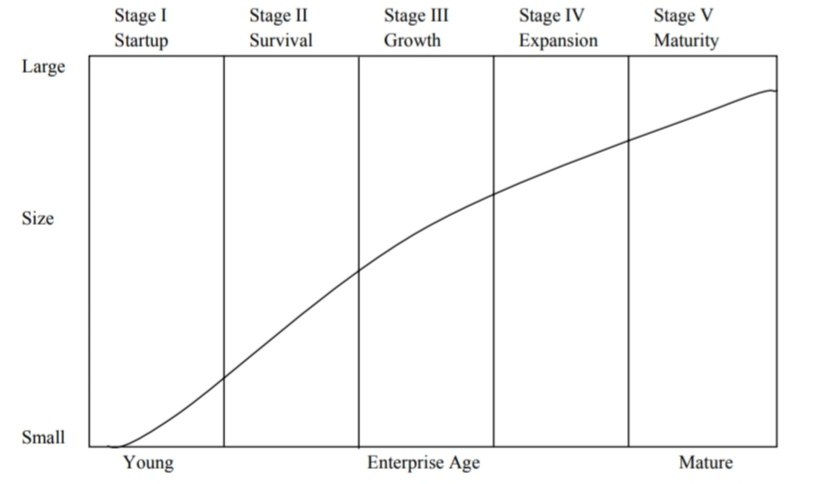
The enterprise grows in size as it moves forward on the firm life cycle and firm grow older at the same time. It should be noted that the size of the enterprise can be measured in different ways such as sales, assets and number of employees. It should, however, not be construed that a finite level of activity measured in any one of these ways automatically takes any enterprise from one level to the other. The time taken for any firm to move from one stage to another varies widely. Also, not all enterprises survive to grow large.
This may be either due to the nature of the activity or simply due to the personal desires or ambitions of the entrepreneur.
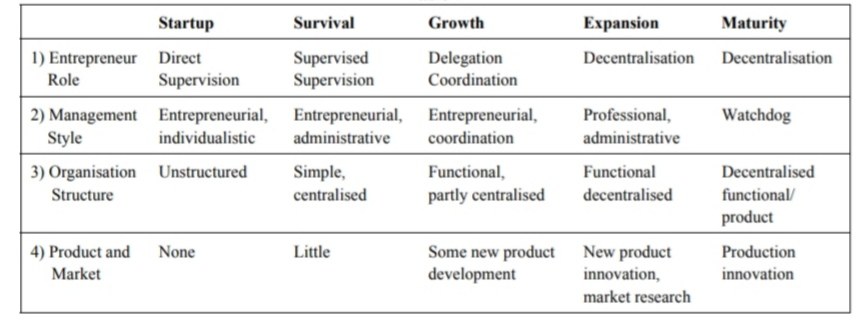
The characteristic changes that take place at different stages are following :
Stability Strategy
When an enterprise is satisfied by its present position, it will not like to change from here and it will be a stability strategy. Stability strategy will be successful when the environment is stable. This strategy is exercised most often and is less risky as a course of action. A stability strategy of a concern for example will be followed when the organization is satisfied with the same product, serving the same consumer groups and maintaining the same market share.
The organization may not be adventurous to try new strategies to change the status quo. This strategy may be possible in a mature industry with static technology. Stability strategy may create complacency among managers. The managers of such an organization may find it difficult to cope with the changes when they come.
Stability strategies can be of the following types:
1. No-Change Strategy
Stability strategy is a conscious decision to do nothing new, that is to continue with the present work. It does not mean an absence of strategy, rather taking no decision in itself is a strategy. When external environment is predictable and organizational environment is stable then a businessman may like to continue with the present situation. There may be major opportunities or threats operating in the environment.
2. Profit Strategy
Sometimes things change in such a way that the firm has to adopt changes in its working. There may be unfavorable external factors such as increase in competition, recession in the industry, government attitude, industry down turn etc. Under these situations it becomes difficult to sustain profitability.
A supposition is that the changed situation will be a temporary phase and old situation will again return. The firm will try to sustain profitability by controlling expenses, reducing investments, raise prices, cut costs, increase productivity etc. These measures will help the firm in sustaining current profitability in the short run.
Profit strategy will be successful for a short period only. In case things do not improve to the advantage of the firms then this strategy will only deteriorate their position. This strategy can work only if problems are temporary.
3. Proceed-With Caution Strategy
Proceed with caution strategy is employed by firms that wish to test the ground before moving ahead with full-fledged grand strategy or by those firms which had a rapid pace of expansion and now wish to rest for a while before moving ahead. The pause is sometimes essential because intervening period will allow consolidation before embracing on further expansion strategies. The main object is to let the strategic changes seep down the organizational levels, allow structural changes to take place and let the system adopt to new strategies.