
Environmental Analysis and Internal Analysis
Strategic analysis of any Commercial enterprise has two stages that include Internal and External analysis.
Environmental analysis: An environmental analysis in strategic management has a vital role in businesses by indicating current and potential opportunities or threats outside the company in its external environment. The external environment includes political, environmental, technological, and sociological events or trends that can affect the business directly or indirectly. An environmental analysis is usually conducted as part of an analysis of strengths, weaknesses, opportunities, and threats (SWOT) when a strategic plan is being developed. Managers practicing strategic management must conduct an environmental analysis three-monthly, semi-annually, or annually, depending on the nature of the industry. Managers who identify events or conditions in the external environments can achieve competitive advantage and decrease their risk of not being ready when faced with threats (Alok Goyal, Mridula Goyal, 2009).
In management studies, it has been shown that the intent of an environmental analysis is to help in strategy development by keeping decision-makers within an organization informed on the external environment. This may include changing of political parties, increasing regulations to decrease pollution, technological expansions, and shifting demographics. If a new technology is developed and is being used in a different industry, a strategic manager would understand how this technology could also be used to improve processes within his business. An analysis allows businesses to gain an outline of their environment to discover opportunities or intimidations. Environmental analysis facilitates strategic thinking in the organization. It provides input for strategic decisions. The analysis should provide an understanding of changes that occurs in the environment.
The link between environmental scanning and strategic management (Source: Alok Goyal, Mridula Goyal, 2009).)
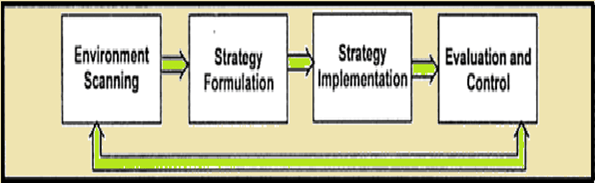
There are many strategic analysis mechanisms that the company can use. The most used comprehensive analysis of the environment is the PESTLE analysis. Company managers and strategy formulators use this analysis to find where their market currently. It also helps predict the future of the organization. PESTLE analysis comprises of numerous factors that affect the business environment. These factors can affect every industry directly or indirectly.
PESTEL denote the following factors:
Political factors
Economic factors
Social factors
Technological factors
Legal factors
Environmental factor
PEST analysis (Source: Farhad Analoui, 2003)

It is documented in studies that the company conducts an environmental analysis to identify the potential influence of particular aspects of the general and operating environments on business operations. This analysis recognizes the opportunities and threats in a business environment in terms of a company’s strengths and flaws. The environmental analysis consists of a three-step process in which a company first categorizes environmental factors that affect its business. In the second step, the company gathers information about the selected set of environmental factors that are most likely to impact business operations. This information serves as input to a forecast of the impact of each environmental factor on the business.
Studies indicated that environmental analysis gives strength to organizations to anticipate opportunities and help strategists to plan warning system to prevent the threat (Alok Goyal, Mridula Goyal, 2009).
There are some drawbacks of environmental analysis:
- The environmental analysis does not predict the future, nor does it eliminate uncertainty for any organization.
- Environmental analysis is not a sufficient guarantor of organizational effectiveness.
- The potential of environmental analysis is often not realized because of how it is practiced.
Internal analysis: Internal analysis is the methodical evaluation of the key internal features of an organization. Internal Analysis recognizes and assesses resources, capabilities, and core competencies. The internal analysis has four elements such as the organization’s Current vision, Mission, Strategic Objectives, and Strategies. Resources are the assets that an organization has for carrying out whatever work activities and processes relative to its business definition, business mission, and goals and objectives. These resources include financial resources, Physical assets, Human resources, Intangible resources, and Structural-cultural resources. Core competencies are the organization’s major value-creating skills and abilities that are shared across multiple product lines or multiple businesses. This internal sharing process is what differentiates core competencies from typical capabilities. Competitive advantage is The collection of factors that sets a company apart from its competitors and gives it a unique position in the market.
Internal Analysis is performed because it is the only way to identify an organization’s strengths and weaknesses it’s needed for making good strategic decisions. In order to start the strategic management process, managers are required to conduct an internal analysis. This involves ascertaining the business’ strengths and weaknesses, by analyzing its competencies. It also involves managers emphasizing the competitive advantage of the business. For effective strategies, the organization must exploit and expand on its strengths, as well as reduce its weaknesses; thus promoting its competitive advantage to gain cost-effectiveness.
There are four major areas which need to be considered for internal analysis:
- The organization’s resources, capabilities.
- The way in which the organization configures and co-ordinates its key value-adding activities.
- The structure of the organization and the features of its culture.
- The performance of the organization as measured by the strength of its products.
Internal analysis

To summarize, environmental analysis is a strategic device to distinguish external and internal elements, which can affect the performance of firms. The analysis includes appraising threat level or opportunity the factors might present. These assessments are translated into the decision-making process. The analysis helps align strategies with the firm’s environment. Internal analysis is the process of identifying and assessing an organization’s particular features that include Resources, Capabilities, and Core competencies.