
Table of Contents
Q.1. Define larder. Draw the layout diagram of a typical larder and list the equipment required. (3+4+3=10)
Definition: The Larder is a department set aside for the storage of all perishable foods both raw and cooked and is also used for processing and preparation of all cold items served.it is also known as Garde Manger. The term Garde Manger originally identified a storage area. Over the years this term evolved to mean more than just a storage area. It now also indicates a station in the professional kitchen, responsible for preparing Cold foods, Buffets, Decorative pieces, etc. and it‟s Chefs who prepare them.
The layout of the larder section:
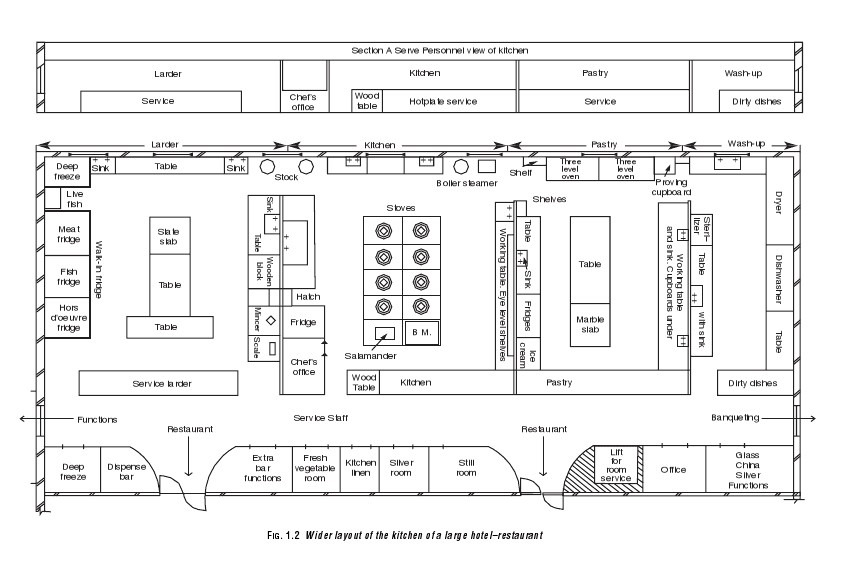
The larder of a 5-star operational kitchen will be segregated into the following section:
- Hors d’oeuvres and salad section
- Poultry and Butchery section
- The fish section.
- A general section with work tables.
- Cold rooms with deep freezer and walk-in facility.
- A weighing scale next to the entrance.
- Chef’s office
Types of equipment required in the larder section:
- Mincing machine and food processors
- The slicing machine
- Scales and weighing machines
- Electric grinding machine
- Salamander / grill / toaster
- Butcher’s blocks
- Other larder tools
- Serving spoons and ladles
- Sieves
- Colanders
- Conical strainers
- Meat presses
- Pie molds
- Whisks
- Egg slicers
- Steel basins
- Graters
Or Discuss in detail the functions of larder sections. Explain the essentials of larder control. (5+5=10)
In the modern-day catering business, the larder section has become one of the most important departments since it is dealing with the most expensive and mostly used food items in the business which directly affects the food cost.
Functions of the larder section
- Butchery (including the fish mongery & ecaillage)
- Marinated Product – Salads, Pickled Products, Brines / Cures – Smoked Products.
- Cold Soups and Sauces
- Appetizers and Hors d’oeuvres
- Forcemeat products – Pâté, Galantine, Terrine, Sausage, Quenelle, etc.
- Gelatin Products – Aspic, Mousse, Aspic jelly coating, Colle, Chaudfroid, etc.
- Cold Fish and Meat – Roasted, Poached
- Pièce Montée (Centerpiece) Ice-carving, Tallow/Butter Sculpture, Salt Dough, Vegetable & Fruit Carving
- Specialty items – Cheeses, Caviar, Foie gras, etc.
- Food Garnishes
Essential functions of larder control are as follows:
- Checking the quantity and quality of all goods delivered to the larder.
- Ensuring that all foodstuffs are stored at the right temperature and that they can be easily checked.
- That the food is protected from contamination by vermin.
- That Portion Control is rigidly carried out eg., a given piece of meat, fish, and vegetable should always Produce required portions of steaks, fillets, salads, or Hors d’oeuvre.
- Stocks are regularly turned over.
- That food is not overstocked.
- A simple daily stock sheet by each sub-department is maintained.
- Every Possible effort must be made to maintain the highest possible standard of hygiene. Every Precaution should also be taken to discourage Pilferage.
Q.2. What are the various types of forcemeats? Explain the different methods of forcemeat preparations.(5+5=10)
Various methods of forcemeat preparations
Straight
Produced by progressively grinding equal parts pork and pork fat with a third ingredient, dominant meat, which can be pork or another meat. The portions are cubed and then seasoned, cured, rested, ground, and finally placed into the desired vessel. Basic forcemeat of equal parts lean pork meat and pork fat plus dominant meat (veal, duck, pheasant). Uses progressive grinding to achieve a fine texture For pates, terrines, and galantines.
Country-style/Campagne
A combination of pork and pork fat, often with the addition of pork liver and garnish ingredients. The texture of this finished product is coarse. A rustic style forcemeat with a coarse texture prepared with raw pork, pork fat, pork liver, and seasonings for a simple pate or terrine ratio of meat to fat is but the fat can be as high as 1:1 Eggs and/or panada of 20% of the weight should be added to the mixture
Gratin
Partial cook some of the meats before grinding or pureeing the forcemeat. Livers, especially poultry, are commonly used and mixed with a panada. Eggs, cream, and panada are used as a binder. Gratin forcemeats are used as terrines or packed into crocks as a spreadable mixture.
Mousseline
Very light in texture, utilizing lean cuts of meat usually from veal, poultry, fish, or shellfish. The resulting texture comes from the addition of eggs and cream to this forcemeat. A forcemeat made with lean meat, fish or poultry, and emulsified with cream and egg whites (1-2 egg whites per lb./450 g of lean meat). Delicate forcemeat is suitable for lighter fish and seafood emulsions. Used for pates, terrines, quenelles or ravioli fillings
5/4/3 Emulsion Forcemeat
5/4/3 refers to the ratio of lean meat to fat to ice. The mixture is cured with nitrates to give its characteristic color. mainly used for making emulsified sausages like hotdogs and frankfurters.
Or Sausages are very popular in continental cuisine. Explain different types and varieties of casings used in sausage making. Name five popular sausages, one from each country with a brief explanation. (5+5=10)
Different types of casings used in sausage making
a.Natural casings
These are made from the intestines of animals such as hogs, pigs, wild boar, cattle, and sheep.
b.Collagen casings
These are edible and are not synthetic casings. They are made from the hide of cattle.
c.Fibrous cellulose casings
These are by-products of the food processing industry. Cellulose and fiber are extracted from the husk, skin, peels, pips, and seeds of the fruit and vegetables during the processing stage. These are processed further to make casings.
d.Protein lined fibrous cellulose casings
A protein lining is often added to the inside of the above type of casing. These casings are ideal for the dried sausages. The protein lining causes the casing to shrink as the meat is cooked or dried so that it retains the shape of the sausage.
Some popular sausages from different countries
- Andouillette French sausage made of pork, tripe, and calf mesentery.
- Berliner from Berlin, made of pork and beef, flavored with salt and sugar
- Bierschenken a German sausage containing ham or ham fat + peppercorns and pistachio
- Bier Wurst a German beef and pork sausage flecked with fat and smoked.
- Black Pudding/blood Sausage there are many versions of this sausage or pudding, made out of pigs’ blood. The British one has oatmeal. The German version is called blutwurst and the French one is known as Boudin Noir. The Spanish call it Morci//a, the Irish Drisheen and the Italians, Biro/do. They are usually sliced and sold.
- Bockwurst a delicately flavored, highly perishable German white sausage consisting of fresh pork and veal, chopped chives parsley, egg, and milk.
- Bologna There is a number of versions of this popular Italian sausage. It usually has a mixture of smoked pork and beef. The English version is called Polony.
- Boudin Blanc unlike boudin noir, this is a fresh sausage, made of pork, eggs, cream, and seasoning
- Bratwurst a German sausage made of minced pork/veal and spiced.
- Butifara a Spanish pork sausage flavored with garlic and spices -comes from the Catalonian region of Spain.
Q.3. Explain the process and preparation of ham and bacon. (10)
Bacon processing
Fresh pork bellies are shipped to processing companies in large containers called “combo bins.” Individual bellies undergo the following before being converted into sliced bacon for the consumer:
- Skinned (using a Townsend skinner)
- Trimmed of ragged edges (using Whizard knives)
- Pumped (usually Townsend injector)
- Placed on bacon combs and put on trees or trucks for thermal processing
- Thermal processing
- Chilling
- Pressing
- Slicing (Anco slicer)
- Premium slices
- Secondary slices
- Ends and pieces
- Packaging
Ham processing
There are three general ham processing systems depending on the ultimate product:
- Traditional bone-in cured/smoked ham
- Boneless, premium ham
- Boneless, sectioned or chopped and formed ham
Traditional bone-in cured/smoked ham
Made in the following sequence:
- Arrive at a processing plant in “combo bins” in weight range categories
- Trimmed off some of the collar fat and skin (Townsend skinner)
- Pumped
- Netted
- Placed on tree or truck for thermal processing
- Thermal processed
- Chilled
- Wrapped with paper
- Boxed
Boneless, premium ham
Hams are received as usual but are completely defatted and deseamed.
- Muscles are injected
- Cured muscles undergo massaging or tumbling
- Massaging and Tumbling
- Muscles are netted together or placed in casings (usually 2 or 1-1/2)
- Ham molds are placed on the product before thermal processing to give shape
- Thermal processing
- Chilling
- Cutting in half (for some of the hams)
- Packaging
Boneless, sectioned or chopped and formed
These are made virtually the same way that the premium hams are except that the biceps femoris-semitendinosus muscles are chopped or sectioned into smaller pieces along with muscles from the shank and the knuckle. Tumbling and massaging are used to cause the pieces to “stick” together.
Or With a neat diagram, explain different cuts of pork and their uses. (10)
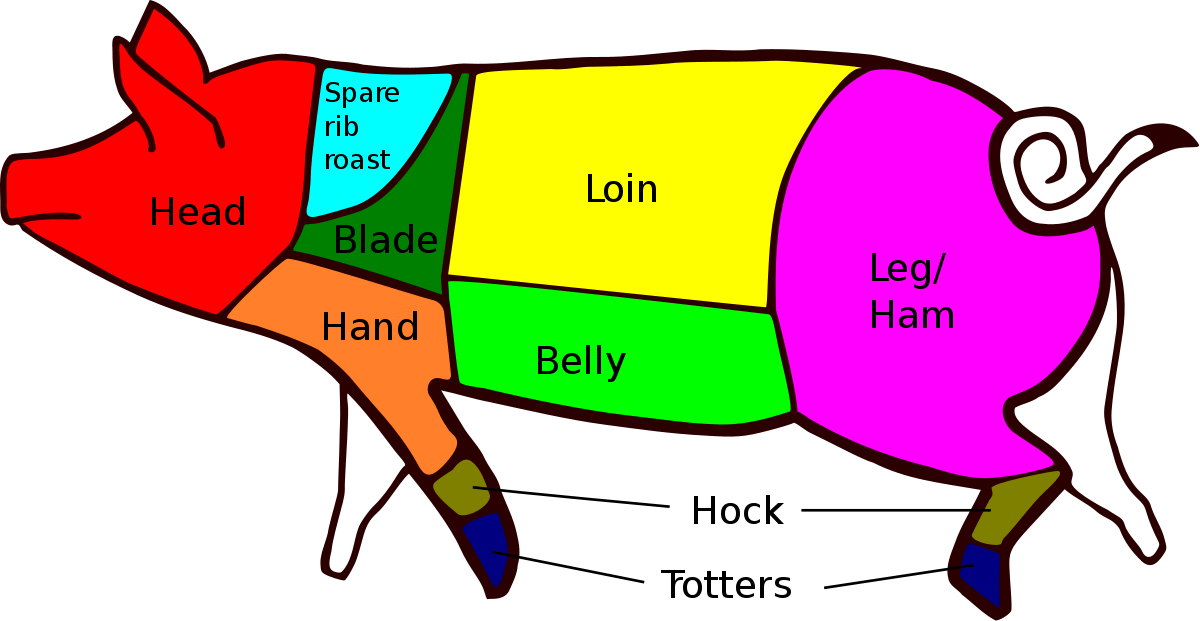
Head
This can be used to make brawn, stocks, and soups. After boiling the ears can be fried or baked and eaten separately, which are crunchy due to corliage bones. It is considered a delicacy.
Spare Rib
This is the shoulder and contains the shoulder blade. It can be boned out and rolled up as a roasting joint, or cured as “collar bacon”. Not to be confused with the rack of spare ribs from the front belly. Boston Butt, or Boston-style Shoulder, cut comes from this area, and may contain the shoulder blade.
Hand/Arm
This can be cured on the bone to make a ham, or used in sausages.
Loin
This can be cured to give back bacon or Canadian-style bacon. The loin and belly can be cured together to give a side of bacon. The loin can also be divided up into roasts (blade loin roasts, center loin roasts, and sirloin roasts come from the front, center, or rear of the loin), back ribs (also called baby back ribs, or riblets), pork cutlets, and pork chops. A pork loin crown roast is arranged into a circle, either boneless or with rib bones protruding upward as points in a crown.
Belly
The belly, although a fattier meat, can be used for steaks or diced stir-fry meat. Belly pork may be rolled for roasting or cut for streaky bacon.
Legs/Hams
Although any cut of pork can be cured, technically speaking only the back leg is entitled to be called a ham. Legs and shoulders, when used fresh, are usually cut bone-in for roasting, or leg steaks can be cut from the bone. Three common cuts of the leg include the rump (upper portion), center, and shank (lower portion).
Trotters
Both the front and hind trotters can be cooked and eaten, as can the tail.
Spare ribs
These are taken from the pig’s ribs and the meat surrounding the bones.
Q.4. Explain in detail the method of making chicken galantine. (10)
Method of making chicken galantine
- Preheat oven to 160C.
- Bone chicken – your butcher will do this for you, just give him a little notice.
- Generously season the inside of the chicken with salt and pepper. Set aside.
- In a large bowl, combine the pork mince, chorizo, olives, paprika, parsley, basil, and garlic.
- Arrange the stuffing lengthways along the inside of the chicken.
- Roll the chicken around the stuffing. Fasten with a skewer and tie with butchers twine.
- Roast in your preheated oven for about a 1 hour or until the core temperature of chicken reaches 72C.
- Rest for 10-15mins before carving.
OR Explain in detail the Method of making chicken Pâté. Discuss what precautions you will take to keep them fresh for long after the presentation. (10)
Method Of Making Chicken Pate
- Trim connective tissue and fat
- Brown the butter
- Sauté shallots and livers
- Add capers, thyme, garlic, anchovy paste
- Deglaze with brandy
- Pulse in a food processor, add butter, cream
- Place into ramekins and chill
The pâté will last a week or so in the fridge. If you want to preserve it for up to a month, pour a little melted lard or clarified butter on top to seal. Each time you dip into the pâté, you will need to reseal the top to preserve it. Serve spread on crackers or baguette slices.
Q.5. What are the parts of a sandwich? Explain various types of sandwiches with examples. (5+5=10)
The four parts of a sandwich
- Bread
- Spread
- Filling
- Garnish
Bread
Various types of bread can be used to make sandwiches. The type of bread has a dramatic effect on the finished fare. Sandwich bread (also referred to as sandwich loaf) is the bread that is prepared specifically to be used for the preparation of sandwiches.
Spread
A sandwich spread is a spreadable condiment used in a sandwich, in addition to more solid ingredients.
Filling
It could be a variety of limitless items. The filling gives the sandwich its name. Fillings could include meat, poultry, fish, eggs, cheese, vegetables. Salami, cooked roast chicken, ox tongue, sliced cucumber, and tomato are all popular fillings. The filling could be a single item or a combination of several. Ham and cheese, Cucumber and chutney, Bacon and tomato. It is important that the combinations are complementary to each other.
Garnish
To enhance the appearance and the presentation of the sandwich, it is necessary to create eye appeal. The garnish is not absolutely essential and can be avoided in an informal setting. The garnish should be delicate and dainty and not cumbersome and ugly.
Types of sandwiches
- Loaf: The loaf bread is taken and sliced length, wise, filled and iced in the same way as to sandwich cake. It is sliced across the bread and served.
- Pinwheel: the top crust is taken out of the sandwich loaf. It is taken sliced lengthwise, and butter and soft filling spread evenly, which is of a Colour to contrast with the spread. Each slice is rolled and wrapped firmly in a foil and chilled till it is set. It is cut into thin slices and served.
- Double Decker: Three slices are used with the filling placed on top, the next slices are buttered and placed on top, lettuce, tomato, and cucumber placed on top of this slice. The final slice is Placed on position, pressed at rimmed, and held together with a Plastic cocktail stick with stuffed olive or cherry.
- Club Sandwich: The sandwich is usually served hot and consists of two buttered slices of toast. One slice is the base on which sliced cooked chicken, Egg lettuce, tomato grilled bacon, and mayonnaise or ham is placed. The other slice of toast is placed on top pressed, trimmed and decorated, served between the folds of a paper napkin.
- Bookmaker: This is a buttered, roll or French Bread with French mustard and a grilled streak in between.
- Conventional closed sandwich: Two slices of bread with any fillings, cut into two without cutting crust.
- Tea sandwich: Thin slices of bread are used with any fillings cut into triangles and crust removed.
- Buffet sandwich: Smaller than conventional triangles, fingers or squares, and fancy shapes.
- French Sandwich: Consists of thin slices cut from French loaf and fillings added between two slices.
- Grilled Sandwich: Two slices of bread with fillings grilled and then served. They are hot Sandwiches.
Q.6. Non-edible displays are the center of attraction in buffets and banquets. Discuss briefly various types of displays that are commonly used. (10)
Although food holds the spotlight in all buffet presentations and the objective of buffet planning must be to achieve visual beauty both in the artistic presentation of each item of edible food and in the arrangement of the many dishes on the buffet table.
Different types of non-edible displays
- Ice Carvings
- Tallow Displays
- Butter/Margarine Sculptures
- Salt Carvings or sculptures (Saltillage)
- Sugar Craft (Pastillage)/Wedding Cake
- Chocolate Mouldings
- Fruit and Vegetable Carvings
Ice Carvings
The ice sculpture is the highlight of any buffet, the artistic touch, the focal point. Ice can be carved in any shape, size, or figure that fits the theme or occasion. For example, for Christmas, there could be a Santa Claus, for an anniversary, a heart.
Tallow work
When deciding on the selection of a pattern for a tallow display piece, it is essential that the display piece chosen to match the theme of the food design buffet. It is even more desirable, to select a pattern that may also fit into the décor theme of other buffets at a later date. Creating on eye-catching tallow piece is always time-consuming and should be planned well in advance.
Butter and margarine carvings
Very often in place of tallow, butter and margarine are used to produce centerpieces. Margarine is the preferred medium as it has a higher melting point and is easier to handle than butter. An outline of the sculpture is made out of suitable stiff material such as a wire piece, aluminum foil, and strips of wood.
Saltillage
Basic Salt Dough for Sculptures
- 1 cup of cold water
- 1 cup of corn starch
- 2 cups warm popcorn salt.
Salt dough is a modeling material made from a mixture of flour, salt, and water. It can be used to make ornaments and sculptures and can be dried in the oven or microwave. It can be sealed using varnish or polyurethane and can be painted with acrylic paint, or colored using food coloring, natural coloring, or paint mixed in with the flour or water.
Sugarcraft (Pastillage)
This could include:
- Pulled sugar
- Poured Sugar
- Blown Sugar
- Spun Sugar
Cooked sugar can be used in various forms to provide stunning works of art. They could adorn a dessert buffet.
Chocolate moldings
Tempered chocolate can be used to make figures which can be attractively arranged to be used as centerpieces during festive times like Christmas and Easter. They are also used to adorn the dessert buffet.
Fruit and vegetable carvings
Very attractive centerpieces can be made by carving various shapes out of fruits and vegetables. Large pumpkins, melons, and such vegetables can be used as containers or carved into objects such as boats and ships. The variety in the color of vegetables and fruits adds a lot to the eye appeal and the presentation of the centerpiece.
Q.7. Write short notes on (4×2 ½ =10)
(a) Chaud-froid
Chaud – Froid, translated literally means hot – cold. This name refers to the fact that the sauce is cooked and is applied hot, but then chilled and served cold. The high gelatin content of the sauce makes it possible to apply it to an item while still warm and flowing. As the sauce cools, it gels and adheres to the product. It gives a smooth, pristine surface and seals the product from the air.
(b) Quenelles
Quenelles are products that are made out of forcemeat. The forcemeat in this case is fish and is made out of a raw meat mixture. The fish is processed to a fine puree along with egg white which acts as a binder. Sometimes, bechamel sauce is also used. Seasonings, herbs, and sometimes, light spices can also be added. Two tablespoons dipped in hot water are used to shape the quenelles. These oblong-shaped quenelles are then poached in fish stock for a couple of minutes until they are cooked.
(c) Parfaits
This is the French term that means perfect. A savory parfait makes use of vegetables, fish, shellfish, or poultry. It is distinguished by its very fine texture and is made of a puree of the ingredients that is lightened by egg whites and cream, which is then molded and then poached.
(d) Gammon
Gammon is the hind leg of pork after it has been cured by dry-salting or brining. It may or may not be smoked. Like bacon, it needs to be cooked before it can be eaten. It may be sold on-the-bone or without bone, or as steaks or slices. It differs from a ham in that ham is cured after being cut from the carcass and the curing process for ham may be different.
Q.8. Distinguish between: (4×2 ½ =10)
(a) Bacon and Green Bacon
| Bacon | Green Bacon |
|---|---|
| It is salt-cured and processed | It is salt-cured but unprocessed |
| Have a longer shelf life | Have a shorter shelf life |
| Contains nitrates or nitrites | Contains no nitrates or nitrites |
| It is a smoked style of cured bacon | It is a non-smoked style of cured bacon |
| Usable for a long time | Should be used within one week after curing |
(b) Mousse and Mousseline
| Mousse | Mousseline |
|---|---|
| A mousse is soft prepared food that incorporates air bubbles to give it a light and airy texture. It can range from light and fluffy to creamy and thick, depending on the preparation techniques. A mousse may be sweet or savory. Sweet mousses are typically made with whipped egg whites or whipped cream, and flavored with one or more of chocolate, coffee, caramel, puréed fruits, or different herbs and spices. Savory mousses are made from meat, fish, shellfish, foie gras, cheese, or vegetables. Hot mousses often get their light texture from the addition of beaten egg whites. It is sometimes stabilized with gelatin. | Mousseline may be used either for a sauce or for a type of fabric. Sauce Mousseline is also known as Sauce Chantilly, is produced by folding whipped cream into hollandaise sauce. Mousseline is also used for a very fine, semi-opaque fabric that is similar to muslin. It is a cotton fabric of plain weave. A very fine, semi-opaque fabric similar to muslin, typically made of silk, wool, or cotton. A soft, lightly sweet, or savory mousse. A hollandaise sauce that has been made frothy with whipped cream or egg white, served mainly with fish or asparagus. |
(c) Aspic and Gelee
| Aspic | Gelee |
|---|---|
| Aspic Jelly must always be crystal clear and of a light golden (amber) color. The quantities of gelatin used in the aspic jelly should be of the correct proportion so that the jelly, when set, will neither be too rubbery, nor too light in consistency. Moreover, the aspic jelly provides special protection for cold dishes. A display of poultry, fish, game, or similar ingredients, when coated with aspic jelly, will keep its freshness and original flavor when covered with aspic jelly. | A Gelee or jelly in English is gelatinous meat or fish stock. A Gelee becomes an aspic jelly when it is clarified. The word aspic is used to refer to a combination of cold meats, fish, vegetables, or eggs, which are set in an aspic jelly in a decorative mold. When thoroughly chilled, the arrangement is de-molded onto a service platter and perhaps surrounded with aspic jelly croutons. |
(d) Brines and Marinades
| Brines | Marinades |
|---|---|
| Brine is a solution whose basis is salt, and you can use it to make large pieces of meat juicy. I prefer using it on meats which tend to lose moisture when exposed to heat. Examples include whole turkey, pork roasts, and whole chicken. | Marinades are known for their ability to add flavors to the meat. They also result in more tender meats as compared to using brines. The downside to them is that they do not add as much moisture. Marinades are essentially sauces with some acidic base. |
| Brining works for tough cuts. | Marination is best when dealing with soft meats as well as vegetables |
Q.9. Explain the following: (10×1=10)
(a) Kromeskies
a croquette consisting of a piece of bacon wrapped around minced meat or fish.
(b) Walewska
Walewska is a simple garnish for fish, which is often sole. It consists of poached langoustines and sliced truffles.
(c) Veronique
Denoting a dish, typically of fish or chicken, prepared or garnished with grapes. Origin. From the French given name Véronique.
(d) a la Anglaise
To cook a la Anglaise means to cook plainly in water. It also means the preparation of a dish dipped in egg and breadcrumbs and fried.
(e) Marquese
marquise is a rich chocolate dessert made with dark chocolate, butter, sugar, cocoa powder, eggs and cream. It may be flavored with vanilla and espresso.
(f) Tiramisu
This tiramisu recipe features rum and coffee-soaked ladyfingers layered with mascarpone custard and whipped cream.
(g) Crème anglaise
Crème anglaise (French for “English cream”) is a light pouring custard used as a dessert cream or sauce. It is a mix of sugar, egg yolks, and hot milk often flavored with vanilla.
(h) Fumet
A kind of essence extracted from the bones and the skin of fish.
(i) Tartine
an open sandwich, esp one with a rich or elaborate topping
(j) Pommes de Terre
Pomme de Terre means “potato” in French (literally “ground apple”).
Q.10. Classify herbs. Discuss the ideal uses of herbs in cooking with examples. (10)
Herbs are classified in many ways. Some of them are:
- According to the usage
- According to the active constituents
- According to the period of life
According to the usage:
the herbs are classified into 3 parts:
Medicinal Herbs – Medicinal herbs have curative powers and are used in making medicines because of their healing properties.
Culinary Herbs – Culinary herbs are probably the most used as cooking herbs because of their strong flavors like mint, parsley, basil.
Ornamental Herbs – Ornamental herbs are used for decoration because they have brightly colored flowers and foliage like lavender, chives.
According to the active constituents:
the herbs are divided into five major categories:
Aromatic Herbs – Aromatic Herbs, the name is a reflection of the pleasant odor that many of these herbs have. They are used extensively both therapeutically and as flavorings and perfumes.
Astringent Herbs – Astringent Herbs have tannins, which have the ability to precipitate proteins, and this “tighten,” contracts, or tones living tissue, and helps to halt discharges.
Bitter Herbs – Bitter Herbs are named because of the presence of phenols and phenolic glycosides, alkaloids, or saponins
Mucilaginous Herbs – Mucilaginous herbs derive their properties from the polysaccharides they contain, which give these herbs a slippery, mild taste that is sweet in water.
Nutritive Herbs – These herbs derive both their name and their classification from the nutritive value they provide to the diet. They are true foods and provide some medicinal effects as fiber, mucilage, and diuretic action.
According to the period of life:
these herbs also can be classified as :
Annual herbs – These plants complete their life cycle in one year; start them from seed.
Biennial herbs – These are plants that live two seasons and bloom in the second season only.
Perennial herbs – They grow for more than one season and include sweet marjoram, parsley, mint, sage, thyme, and chives. Most can be started from young plants except for parsley.
The ideal uses of herbs in cooking:
Flavoring– Herbs can be chopped, minced, torn, and added to soups and stocks, or they can be added in the form of bouquet garni which means “a bunch of herbs”.
Garnishing– Herbs are commonly used for garnishes. They can be minced finely as in the case of parsley or used whole in food and also dessert.
Seasoning– a mixture of dried herbs, such as dill, thyme, and oregano, are combined with dried onion, sesame seeds, black pepper, dried lemon peel, paprika, and garlic powder to make the saltless seasoning.
Herbal oils– Oil can be flavored by one or more herbs. These oils are used for making vinaigrettes or dressings for salads and also used for glazing meat or used as a sauce such as basil oil in Italian cuisine.
Herb butter– It is made by combining softened butter with chopped herbs. This kind of flavored butter is also known as compound butter.
Herbal drinks– herbs have been drunk as herbal decoctions that are believed to be a cure for many ailments including cancer. Before the advent of medicines, it was herbs and spices that were used as medicines.