
Table of Contents
Q.1. Define cost. What are the different types of costs that are incurred in hotels?
A cost is the value of money that has been used up to produce something or deliver a service and hence is not available for use anymore. In business, the cost may be one of acquisition, in which case the amount of money expended to acquire it is counted as cost. In this case, money is the input that is gone in order to acquire the thing. This acquisition cost may be the sum of the cost of production as incurred by the original producer, and further costs of transaction as incurred by the acquirer over and above the price paid to the producer. Usually, the price also includes a mark-up for profit over the cost of production.
Fixed Costs
Fixed costs are normally not affected by changes in occupancy or sales volume. They are said to have a little direct relationship to the business volume because they do not change significantly when the number of sales increases or decreases. The term fixed should never be taken to mean static or unchanging, but merely to indicate that any changes that may occur in such costs are related only indirectly or distantly to changes in volume.
Examples of Fixed costs are:
- Land, Building Taxes to the government.
- Wages to employees.
- Hotel employee’s health premiums.
- Outsourced services contracted for a fixed amount in a month eg:- security services.
- Yearly maintenance contract fees ( AMC ) for all equipment, machinery, etc.
- Fixed internet, telephone plans.
- Advertising cost.
- Yearly external auditing cost.
- Payroll.
- Provision.
Variable Costs
Variable costs are clearly related to hotel occupancy and business volume. As business volume or occupancy increases, variable costs will increase; as hotel occupancy decreases, variable costs should decrease as well.
Examples of variable costs are:
- Food, beverages, housekeeping cleaning supplies.
- Flower arrangements.
- Guest room amenities.
- The guest room, restaurants, and banquets linen.
- Banquet HVAC costs.
- Stationeries used in Front desks and restaurants.
- Chemicals for laundry and water treatment plants.
- T/A commission.
- Flower & decorations.
- Guest supplies -amenities.
OR Define control. What are the objectives of cost control? (2+8=10)
Cost control is the practice of identifying and reducing business expenses to increase profits, and it starts with the budgeting process. A business owner compares actual results to the budget expectations, and if actual costs are higher than planned, management takes action
The control procedure consists of 3 broad phases:
Planning
Policies are nothing but predetermined guidelines laid down by the management of the organization. It outlines such matters as the market that is being aimed at, how it is to be catered at the level of profitability, which is to be achieved.
Operational
After defining the policies it is important to outline how they are to be interpreted onto the day control activities of the catering operation.
Management control after the event
It consists of three main stages:
- F & B cost reporting:- The cycle of production is often perishable so it is compulsory to update your f & b cost reporting weekly or monthly.
- Assessment:- In the case of a large unit, it is necessary that someone from the f & b department analyses the f & b reports and confirms them with the budget & with potential food cost.
- Correction:- Control system does not cure or prevent problems occurring when the analysis of the performance of a department states that there is a problem. A corrective measure has to be taken to set aside any problem.
Objectives of Cost Control
- To analyze income and expenditure:- In financial accounts, stress is usually placed on the ascertainments of total cost and profit i.e. cost of sales, gross profit. In food cost control, on the other hand, much stress is placed on the various departments or a section of a business.
Gross profit = sales – food cost
Net profit = sales – (food cost + labor cost + overheads)
- Pricing of food:- Another major objective of food cost control is to provide a sound basis for menu pricing. It will also help in costing price for various types of banquets and functions. It also helps in giving quotations.
Sale = food cost + labor cost + overheads + profit
- Prevention of inefficiencies:- We know that the purpose of control is to ensure the current results are in accordance with the predetermined objectives which were expressed in terms of targets, costs, selling, and profit margins. If such objectives are to be reached all possible forms of wastage and inefficiency should be prevented. In order to be effective in preventing waste inefficiencies, a system of food cost control must cover the whole field of catering operation right from the purchase of foodstuff to the sale of a prepared meal.
- Data for the management:- The system of food cost control has an important function to fulfill in providing data for individual reports on food operations.
Q.2. What are the key points to be kept in mind while selecting a supplier for purchasing? (10)
Supplier Cost
We will have to figure out in mind which products we are looking for and how much we are willing to pay. Even so, prices between suppliers can vary, so it’s important to shop around and see who offers the best deal.
Determining Your Criteria
If you don’t know your requirements, you won’t be able to assess bids and quotes. Common criteria include price, quality, and delivery or service time. You might also have special requirements like minimum and maximum orders, payment methods, returns, time to resolution of errors, and guarantees.
Quality
There’s often a correlation between cost and quality: the more expensive the product, the better the quality. Regardless of price, there is still a predetermined, agreed level of quality, and you want to be sure that your expectations are met.
Reliability And Previous Experience
It’s important to remember that when choosing a supplier, you’re essentially entering into a long-term relationship with them. It’s similar to hiring a new recruit – you’ll want to see references. Don’t be afraid to ask them questions about their previous buyers and services.
Location
When choosing a supplier, location is a big factor to consider. If you’re a local business who has built your brand on expertise in your area, then you’ll want to focus on finding a supplier who is located nearby and shares your values.
Total Cost Of Ownership
Strategic sourcing and direct procurement departments realize that the price of an Ingredient or service does not always indicate the total cost for the company. Other factors such as transportation, logistics, and product quality can contribute to the total cost of ownership.
Supplier Capabilities
Ensuring that a supplier can actually do what they claim can save lots of time and headaches down the road. Additionally, the companies can expand their partnerships with suppliers to leverage other capabilities and expertise the supplier may have.
Consistency
Evaluating a supplier’s consistency is another best practice used by industry experts.you should be able to rely on the supplier to deliver the same results every time.
Risk
Strategic sourcing and direct procurement departments recognize the importance of identifying and mitigating potential risks in a supplier partnership beforehand to be prepared for any future uncalled for situations.
Considering Future Changes
Check your service contract has provisions for making changes, rather than locking you into rigid terms and conditions. For example, you’ll want to have room to negotiate discounts, enforce quality, and escalate complaints.
Or Enlist and describe the various methods of purchasing used by hotels. (10)
There are different methods of purchasing. The choice of the purchasing will depend upon the item to be purchased, frequency of requirement, quantity to be purchased, and the market situation, etc., none of the methods is best for all purchases.
Open Market Purchase
This method of purchasing is used for products that are not purchased frequently. A committee of 3 persons (purchase officer, accounts men, and one person from F & B) who knows about the quality of food items goes to the market and finds out the rate of the product to be purchased. After considering the rates and the quality the most advantages are selected. Quality must not be sacrificed while comparing the prices. The advantage of this purchase is that only the desired standard of quality will be purchased at the lowest possible rate.
Purchasing by contract
The food items that require frequent purchase calls for contract purchases. The tenders are awarded for items like mutton, fish, poultry, egg, dairy products, fruits, and vegetables. The annual requirement is marked out and the tenders are invited. The tenders should be evaluated for their total value depending upon the estimated consumption of the year. The contract is signed with the supplier who has to deposit security money to ensure that he will supply these items regularly. They are bound to supply the specified quality only.
Centralized Purchasing
It is based on the principles that the purchasing activity is done by one person or department. In operations that have centralized purchasing, HOD usually reports to the top management who has overall responsibility for making a profit. In this kind of purchasing all the H.O.D. combine together under a single head and purchase all the necessary items on a large scale.
Advantages
- Better control and coordination because all the H.O.D. are working under a single head or department.
- A better discount is gained.
- Few people are involved in purchasing.
- Economic and profit potential of purchasing policy making it a profit rather than a cost center.
Standing order purchase:
In this method, the surveyor sends merchandise at a fixed predetermined interval of time. The purchase may involve a fixed quantity every time or may involve replenishing stock from time to time. Milk and dairy product purchasing is normally made by this method, which is often used for specific items only. The delivery man will replenish the stock and this saves a considerable amount of time for the receiving person. Formal agreements are made for this type of delivery in advance and reviewed from time to time.
Periodical purchasing/ fortnightly quotation list/ purchasing bi-weekly:
This method is used to purchase grocery items where delivery once a week or a fortnight is adequate. H.O.D. would complete the stock in hand and fill in the wanted quantity of each item based on a normal order quantity and volume of business expected on the master list. Meanwhile, the purchase officer would send out a copy of the list of each supplier in which the supplier is required to quote the rates on receipt of the quotation. These would be entered into a master quotation list and the decision is then made about where the order for each item is to be placed.
Q.3. (a) What do you understand by Standard Purchase Specification?
It may be defined as a list of the detailed characteristics desired in a product for a specific use. It contains information like the name of the product, quality standards, price and no. of the portion to be produced out of it. The specification is prepared with the help of the concerned H.O.D., e.g. for the kitchen, all the standards of the raw material are prepared by the Executive Chef and for the F & B service department, it is prepared by the F & B manager. Written specifications are necessary for an efficient foodservice operation. All the specifications for the food product should include the following information:
- Name of the product.
- Grading (if any).
- Size of the container (quantity).
- Unit.
- Product used.
- Weight.
- Unit price.
(b) What are the objectives of Standard Purchase Specification? (3+7=10)
- It makes Quality assurance faster and easier for the supplier as well as the receiver.
- It helps the supplier to supply the right product. It helps the receiving clerk to identify the right product.
- Make sure that the product is ordered and received at the Right price.
- It helps in maximizing the output.
- It helps in producing the right amount of portion.
- All the purchasing procedures get easier and faster for the people and supplying and receiving ends.
- Product specification is a tool for management control and it helps the management to keep a check on the numbers and prevent fraud or pilferage.
- As all the items are recorded and documented onto paper and computers for future reference hence wastage is minimized.
Q.4. Describe the different stages that are part of the F&B cycle.
Phase 1 (Planning)
Menu Planning
In the first stage menu is prepared, choices available to the guests are decided Other F&B standards are formed such as standard purchase specification, standard recipes, standard portions, and standard costs.
Volume Forecasting
The quantity of food and beverage to be prepared is determined in this step to fix the amount of ingredients to order and mise en place.
Phase 2 (Pre-operational)
Purchasing
This step consists of activities like selection of suppliers, preparation of contracts, and the most economically efficient ordering quantities are determined.
Receiving
This step determines the steps of the receiving process like inspection of the Quality and Quantity of commodities and how the process can be conducted ergonomically.
Storing
Helps in determining the storage requirements and to set up the process of maintaining storage records.
Issuing
This step consists of the steps that are used while issuing the ingredients and other commodities, which then plays a vital role in calculating the food costing and rotation of stock.
Phase 3 (Operational)
Production
This step consists of all the steps required to produce the final ready food and beverages which can then be sold, there are mainly two steps to this, first is mise en place or pre-preparation and then second is creating a finished product in the form of food or a beverage.
Service/Selling
In this step, the features like the type of service, degree of comfort, SOP for the service staff is determined. acceptable meals and beverages are decided for recommendations and reasonable selling price is decided.
Phase 4 (Post-operational)
Accounting & Control
this consists of analysis, evaluation, suggestions, and reporting of departmental performance which later on helps us in taking basic policy decisions, measure the profitability and study the customers and market.
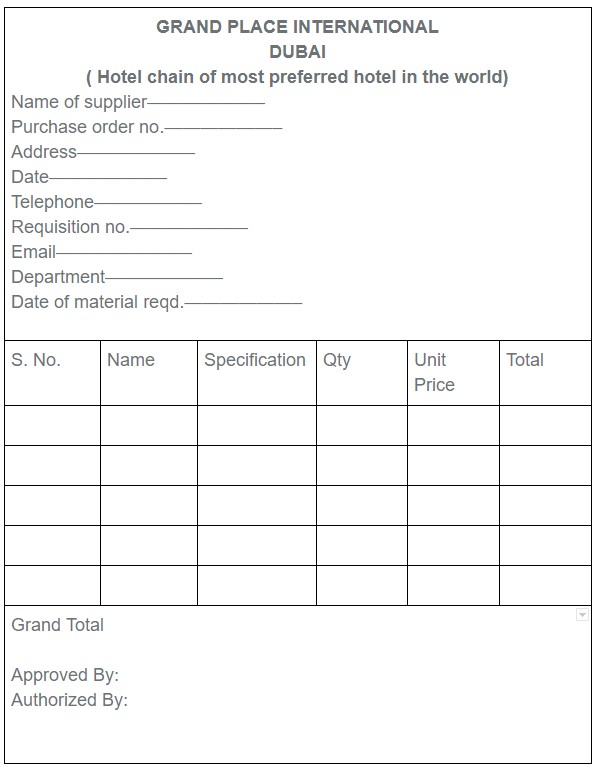
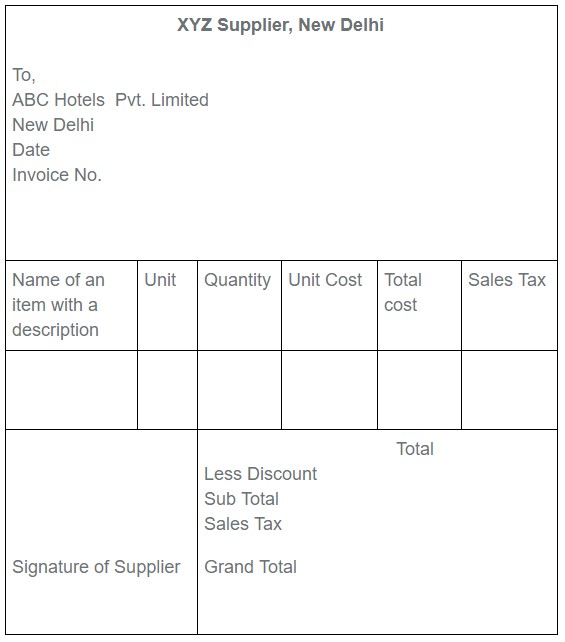
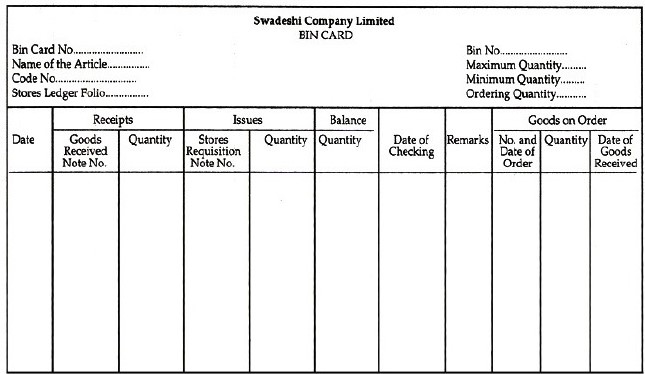
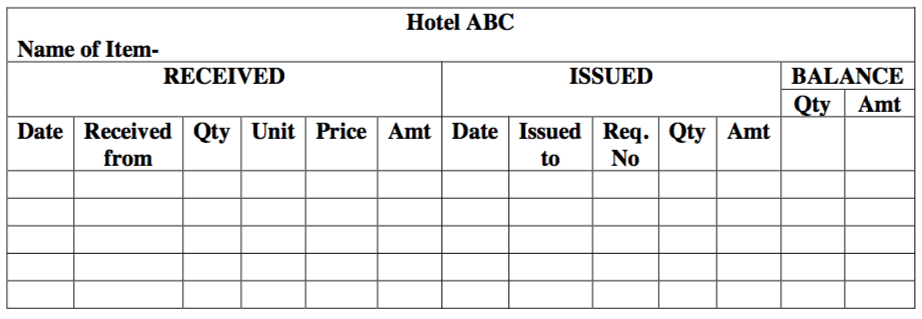
Q.5. Draw the standard format of the following documents (any two): (2×5=10)
(a) Purchase Order Form
(b) Bill / Invoice
(c) Bin Card
(d) Inventory Sheet
Q.6. Elucidate the importance of forecasting during Production Control, in detail. (3+7=10)
Forecasting is a technique of predicting the volume of sales of the establishment for a specific future period like, for a day, a week, etc.
The following are taken into considerations for forecasting –
- Estimating the total numbers of covers sold from the past records
- Analysis of the portions of menu items sold
- Popularity ratio – ratio between-meal period: no. of covers sold: menu items sold
- Occupancy in the hotel
- Special events
- Weather
- Season of the year
- Day of the week
- Holidays
Initial Forecasting
It is prepared a week in advance and indicates –
- The estimated meals to be prepared in each selling outlet,
- The estimated total of each menu item for each day of the following menu week.
Final Forecasting
This forecasting takes place the day before the preparation, and is based on –
- The previous days’ food production and sales figure,
- The weather condition.
The importance of Forecasting in Production Control is as follows –
- It predicts the total number of meals to be sold in each selling outlet of the hotel
- It predicts the choice of menu items by customers/guests
- It facilitates F&B purchasing
- It ensures the availability of all necessary ingredients required
- It controls food costs in relation to sales
- It controls the F&B Controller to compare the actual volume of sales with the one predicted
Or What do you understand by the term Standard Yield? What are the objectives of Standard Yield? (3+7=10)
Standard Yield is defined as the edible usable part of a food item / raw material, which is available after preparation/pre-preparation and cooking. A standard yield is the yield obtained when an item is processed as per the particular standard methods of preparation, cooking, and portioning of an establishment.
Objectives
- To establish a standard for the quantity and number of portions obtainable from a specific item of food.
- To establish a standard for comparison with operating results and thereby measure the efficiency of the production departments.
- To establish an objective method of further evaluating standard purchasing specifications.
- To establish a standard cost factor for the item of food.
- To assist in menu costing and pricing
- To assist in converting forecast requirements into raw material requirements.
- To establish standard recipes and portion sizes
- Helps to monitor the usage of raw materials.
Q.7. Describe the following terms (any four): (4×2 ½ =10)
(a) Standard recipe
A standard recipe is a method of standardizing recipes in such a way so that there is tight control on cost and quantity. Standardization should not be allowed to stifle the individual chef’s flair. A hotel can control quantities, quality, and cost more easily. It is most useful to use a standard recipe in a hotel where there are a number of chefs cooking the food. The standard recipe lays down all the ingredients, methods of production, and quantities used. It indicates the number of portions to be served. This will determine the size of the portion of production control. A section giving variation can be added to reduce the total number of recipes required.
(b) Blind receiving
When there is no document (invoice/delivery note) from the supplier, instead it is directly sent to the accounts and a list of articles is sent along with goods. the receiving clerk has to do his job more carefully preparing a Blind Receiving Report, and weighing and counting all good as per the purchase order, and checking their qualities as per SPS with the help of the list given by the supplier. the receiving clerk then sends the complete list to the accounts department.
(c) Credit Note
When there is a shortage of goods not as per SPS, the receiving clerk writes a credit memo/ credit memorandum/credit Note mentioning details and requesting the supplier to remove the goods mentioned in this from the bill giving the reason for returning along with the quantity.
(d) Economic Order Quantity
The Economic Order Quantity (EOQ) is the number of units that a company should add to inventory with each order to minimize the total costs of inventory such as holding costs, order costs, and shortage costs.
(e) Requisition
This is a form used for taking goods from the issuing department. Concerning the head of the department containing information like name, unit cost, total cost, and signature, issued, and balance prepared it. This is also known as indenting. The operating cost of a kitchen is deduced from this form and gross profit calculated.
(f) Transfer note
This is an internal form of requisition note, which is used when a department requisitions something from another department which is not in stores. For e.g. the kitchen may take out a transfer note to the dispense bar for items such as white wine and sherry. The dispense bar may take out a transfer note to the kitchen for oranges and lemons (when all perishable are a direct issue and go direct to the kitchen). The layout of the form used can be the same as that used for the store requisition, but of a smaller size.
Q.8. (a) What are the objectives of storing control?
Objectives of Store Control
- To ensure that an adequate supply of food materials for the immediate need of the operation are available at all times,
- To prevent losses through spoilage or pilferage,
- To have a minimum working capital.
- The factors involved in maintaining an appropriate internal arrangement of foods include keeping the most-used items readily available, fixing definite locations for each item, and rotating stock.
- Food should never be stored in a manner that permits pilferage. That is another reason for moving foods from the receiving area to storage as quickly as possible. Once in storage, appropriate security must be maintained at all times.
- The food controller must establish procedures to ensure that older quantities of any item are used before any new deliveries. The procedure used to do this is known as the first-in, first-out method of stock rotation
(b) List the important points of care and maintenance of stores. (5+5=10)
- Access to the Food Storeroom should be restricted to the Food Purchaser, Storeroom Attendants and Kitchen Managers.
- Delivery people and other hotel personnel should not be permitted in the storeroom.
- All food items should be issued by requisition only. Each property should establish a requisition system to expedite issues. Requisitions are for access control only! They should not normally be priced and costed for a daily food cost.
- Properties may choose to make an exception to this policy only under special circumstances and with the approval of the Regional Vice President and Vice President, Food and Beverage. All requisition must be approved and signed by the Manager/Supervisor of the department originating the requisition.
- Storeroom hours must be established, both for issue of requisition and receiving of the new products. Each property must establish a SOP regarding storeroom hours so as to keep traffic and interruptions to a minimum. This will allow the Storeroom Attendant to be more effective and also ensure that time is available for storeroom cleaning and organization.
Or (a) What are the documents prepared in receiving control? (5+5=10)
Advice Note
Advice notes are sent to the purchaser, informing him that goods ordered have been dispatched, giving the date of dispatch and method of carriage used. Post, rail, etc. Most suppliers on a regular basis do not use these procedures; the most common would be for equipment or deliveries of high value.
Delivery Note
These are sent by the supplier to the purchaser accompanying the goods ordered. The goods must be checked against delivery notes and then signed for. The delivery note should be in duplicate one copy for the purchaser and another for the supplier. Suppliers will require a delivery note to be signed by the receiver as proof of delivery and that the goods are satisfactory. Goods should never be signed without checking them or this being indicated on the delivery note.
Invoice
The supplier sends an invoice to the purchaser usually a few days after delivery has been made and accepted, giving financial details of the transaction (bill). Some suppliers will incorporate the invoice with the delivery note to minimize their paperwork. A disadvantage of this system is complications that may be created when goods are returned involving the issue of credit notes. The layout of an invoice will vary according to the supplier and their particular system; the supplier retains a copy for accounting purpose.
Request For Credit Memorandum
It is made up by the receiver when the goods have to be returned. It is signed by the delivery driver, who takes the duplicate copy back to the supplier as proof that the goods were sent back. The supplier will subsequently issue a credit invoice.
Credit Note
These are advice to clients, setting out allowances made for goods returned or adjustments. They should also be issued when crates, boxes, or containers are returned. A credit note is exactly the same form as invoices except the word “credit note” appears in place of the word invoice. To make them more easily distinguishable they are usually printed in red, whereas invoices are always printed in black.
Statements
Statements are summaries of all invoices and credit notes sent to the purchaser during the previous accounting period usually one month. They also show any sums owing or paid from a previous accounting period and the total amount due.
(b) What do you understand by Standard Portion Cost?
The standard portion cost is determined on the basis of the size of the portion served to a guest and the ingredients that are used in preparing a particular dish.
The following points are considered for determining standard food cost –
- Establishment of standards and standard procedures,
- Calculation of standard portion costs
Step 1 – Copy the ingredients from the standardized recipe card to the cost card.
Step 2 – List the amount of each ingredient used.
Step 3 – Indicate the cost of each ingredient as listed on the invoice.
Step 4 – Convert the cost of the invoice unit to the cost of the recipe unit.
Step 5 – Multiply the recipe unit cost by the amount required in the recipe.
Step 6 –Add the cost of all ingredients.
Step 7 –Divide the total recipe cost by the number of portions produced.
Q.9. List any five equipment that is used for portion control with their uses. (10)
Equipment used in Portion Control are as follows:-
Standard sized pans
Use- Food pans are used in every stage of the food preparation and presentation process. But from assembly to display they play different roles and help in measuring the number of items that are coming in and going out
Serving spoons
Use – these are more useful on the front end of the operation for the customer to approximately measure and portion the amount of food they consume. Commonly used for sauces and gravies.
Scoops.
Use – scoops are preferably used for items like ice creams and mashed potatoes for measuring and even serving. It helps in forming round balls for food items making it more presentable and easy to serve.
Cups
Use – these are a multipurpose tool which can be used to measure dry as well as wet ingredients for the recipes or serving. The cup usually have a scale marked in cup often with fluid measure and weight of a selection of dry food stuff.
Tins & molds
Use – These are mostly used in baking to get a product of desired weight and measurement making the portion control easier. Can be used for portioning cakes, cupcakes, cold desserts, ice creams, etc.
Q.10. Match the following: (10×1=10)
| (a) Prawns | (i) Standing Order |
| (b) Eggs | (ii) Count and Weight |
| (c) Ladle | (iii) Should sink in water |
| (d) Fruits and Vegetables | (iv) Butchery test |
| (e) Elevated slope | (v) Non-perishable |
| (f) Bind card | (vi) Transportation |
| (g) Milk | (vii) Grade A |
| (h) Cereals and pulses | (viii) Receiving area |
| (i) Carrying cost | (ix) Portion control |
| (j) Meat products | (x) Stores |
| (a) Prawns | (ii) Count and Weight |
| (b) Eggs | (iii) Should sink in water |
| (c) Ladle | (ix) Portion control |
| (d) Fruits and Vegetables | (i) Standing Order |
| (e) Elevated slope | (viii) Receiving area |
| (f) Bin card | (x) Stores |
| (g) Milk | (vii) Grade A |
| (h) Cereals and pulses | (v) Non-perishable |
| (i) Carrying cost | (vi) Transportation |
| (j) Meat products | (iv) Butchery test |