
Table of Contents
Q.1. Evaluate the role of customer relationship management (CRM) in long term sustainability and profitability for a hotel. Illustrate the importance of WOW factor in CRM with relevant examples.(10)
Customer Relationship Management In Hospitality Sector
CRM is a powerful management tool that can be used to exploit sales potential and maximize the value of the customer to the hospitality industry. In the long term, CRM produces continuous scrutiny of the hospitality business with the customer, thereby increasing the value of the customer’s business.
Hospitality sector’s greatest assets are their knowledge of their customers.They can use this asset and turn it into a key competitive advantage by retaining those customers who represent the highest lifetime value and profitability. They can develop customer relationships across a broad spectrum of touch points such as their franchise branches. Simply implementing a solution intended to achieve organizational goals is not enough to achieve CRM success.
The process should ensure that these goals are achieved.The hospitality sector needs a comprehensive CRM strategy in which all departments within the hospitality sector integrates. Customers are the backbone of any kind of business activity, maintaining the relationship with them yields better results. By capturing, tracking and analyzing customer service data, CRM enables a firm to identify new performance issues. Customer data will help a firm in identifying new product development opportunities, provide personalized services to the customer based on their behaviour and responses.
Benefits of using CRM in Hospitality Industry
CRM has some obvious benefits for the hotel industry, but these are not especially different than they are for any other industry. The principal benefits that come to mind are fairly obvious –
• Increased customer satisfaction and retention, increased repeat business,
• Increased share of category spend,
• Increased likelihood of referral business.
• Increased sales through better timing by anticipating needs based on historic trends
• Identifying needs more effectively by understanding specific customer requirements
• Cross-selling of other products by highlighting and suggesting alternatives or enhancements
• Identifying which of your customers are profitable and which are not This can lead to better marketing of your products or services by focusing on:
• Effective targeted marketing communications aimed specifically at customer needs
• A more personal approach and the development of new or improved products and services in order to win more business in the future
• Enhanced customer satisfaction and retention, ensuring that your good reputation in the marketplace continues to grow
• Increased value from your existing customers and reduced costs associated with supporting and servicing them, increasing your overall efficiency and reducing total cost of sales
• Improved profitability by focusing on the most profitable customers and dealing with the unprofitable in more cost effective ways
These results come from a strategy of strengthening customer relationships by constantly providing customer value leading to satisfaction.
Importance of WOW factor-
The “WOW” factor offers hotels and other companies with certain marketplace disadvantages the opportunity to differentiate themselves from the competition for customers looking for more than just a good price. One very positive experience prompts customers to come back for repeat visits. Over time, several consistent and very positive experiences of a similar vein lead to customer loyalty, the strongest connection your business can make with its customers.
Presentations
The “WOW” factor can also occur during a business presentation in which the company presents its brand, product or service, or in a sales presentation in which a salesperson uses visual support to enhance the presentation’s impact. By adding powerful visuals, impressive audio and visual support, or other unusual touches to a business presentation, you can impress your audience to the point where they feel compelled to respond or act.
Strategy
Some companies make the “WOW” factor a prominent element of their customer service approach, whereas others simply rely on good employees to routinely impress customers. Typically, to get employees to offer more than they and customers expect, you have to make impressing customers a specific goal. Managers can role-play with employees on how to go above and beyond in common sales and service scenarios to leave a memorable impression. Communication and training can help your company or brand “WOW” customers regularly.
Examples–
- In the hotel’s, while check-in the hotel stores the data related to the guest such as birthday, anniversary day, etc so on that day the hotel can wish them and offer some attractive package for their special day and make them feel special.
- Reduce the check-in time for the repeating guest to the least and make them feel special.
- Keep the record of the guest about their likes and dislikes, and offer them welcome bouquet accordingly.
OR
Analyze the importance of customer expectations and service delivery in reference to the hospitality industry. Mention some future trends in hospitality industry.(10)
In the tourism and hospitality industry, the success or failure of our businesses and destinations depends on service. Quality customer service is an experience of feeling valued or heard. Sometimes it’s an intangible component of why a guest may prefer one tourism or hospitality provider over another.
The guest satisfaction is heavily influenced by service factors such as employee attitude and the pacing and order of services provided. It found that the greater the client satisfaction, the higher the revenues for a given hospitality business, and that service plays a far greater role than price and location in the guest-purchase decision.
The concept of total quality (TQ) refers to an approach by businesses to integrate all employees, from management to front-level, in a process of continuous learning, with a goal of increasing customer satisfaction. It involves examining all encounters and points of interaction with guests to identify points of improvement.
Total quality management (TQM) in tourism and hospitality is a process where service expectations are created by the entire team, with a collaborative approach between management and employees.
Customer service training provides employees with a foundation for effective service delivery. Potential benefits of this training may include :
● Improved skills and attitudes,
● Better communication skills,
● Better understanding of workplace practices,
● Increased morale,
● Confidence,
● Self-satisfaction,and work satisfaction,
● Increased participation,
● Greater job/career advancement potential,
● Greater interest in and willingness to participate in further training, more independence
Businesses can also choose to implement tools to determine customer satisfactions levels, such as the SERVQUAL technique that compares customer perceptions of quality against customer expectations. Under the SERVQUAL model, the five dimensions of service are:
Reliability: where the quality and level of service is consistent
● Assurance: knowledge and courtesy of staff and their ability to convey trust and confidence
● Tangibles: the organization’s physical facilities, equipment, and appearance of staff
● Empathy: the degree of caring, individualized attention that the organization’s staff provide to its customers
● Responsiveness: the willingness of staff to help customers and provide prompt service
There are a number of points in time where this relationship is maintained.
For example:
●The first time potential guests visit a website and leave their email address to receive more information.
●The moment a reservation is made and the company captures their personal details
●The in-person service encounters from the front desk to the parking lot
●Welcome notes, personalized menus, friendly hellos, and other touches throughout the interaction
●Background messages including clean facilities and equipment in good repair, pleasant decor and ambiance (flowers, etc.)
●Follow-up communications like a newsletter
●Further interactions on social media
All of these touch points are opportunities to maintain strong relationships with customers and to increase the likelihood of positive word of mouth sharing.
Some future trends in hospitality industry
a. Capitalize on Tech
Mobile devices are transforming the hotel check-in process. While the majority still use key cards, there are some hotel chains that use smartphones to unlock a hotel room door. Even some staff are equipped with iPads to facilitate transactions with guests. If it makes you wonder whether front desk staff are still needed in the near future, you’re not alone. The hotel industry should embrace mobile technologies and innovative, streamlined check-in procedures in the near future.
b. More Emphasis on Health and Well-being
Guests today are so health-conscious they sometimes choose hotels based on their health and fitness amenities, pools and spas.
Maintaining an active lifestyle while traveling has become more of a requisite than an alternative. Innovative wellness options are expected, in addition to healthier food choices. Shower water with vitamins was unheard of a few years back but may become mainstream soon.
c. Green Living
Many hotels are installing solar panels. Apart from inverters, some hotels are updating systems that make air conditioners and lights automatically switch off when guests leave their rooms. You know hotels are taking both sustainability and wellness seriously when their twitter feeds announce not just their state-of-the-art wellness gym, but even their recycling programs and use of non-toxic cleaning supplies.
d. Word of “mouth” Promotion
Social media is so powerful it can it can bring down governments and political careers it’s silly to think it can’t topple a hotel chain. If a hotel guest is dissatisfied, he or she can easily complain on Facebook, Twitter, Yelp or TripAdvisor. One bad tweet and you can say good bye to millions of dollars in profit, if not the entire brand.
Q.2. Discuss the 5 GAP analysis in the service and hospitality industry and recommend the solutions to the existing GAPs.(10)
The GAP Model of Service Quality helps the company to understand the Customer Satisfaction. In-Service Industry, the GAP Model is widely used to understand the various deviations that are occurring in the process of service delivery to potential customers.
1. The gap between Customer Expectation and Management Perception
2. The gap between Service Quality Specification and Management Perception
3. The gap between Service Quality Specification and Service Delivery
4. The gap between Service Delivery and External Communication
5. The gap between the Expected Service and Experienced Service.
GAP MODELS
GAP 1: Gap between Management Perception and Customer Expectation
This gap arises when the management or service provider does not correctly analyze what the customer wants or needs. It also arises due to insufficient communication between contact employees and managers. There is a lack of market segmentation. This Gap occurs due to insufficient market research. For Instance- A café owner may think that the consumer wants a better ambience in the café, but the consumer is more concerned about the coffee and food they serve.
GAP 2: Gap between Service Quality Specification and Management Perception
This gap arises when the management or service provider might correctly comprehend what the customer requires, but may not set a performance standard. It can be due to poor service design, Inappropriate Physical evidence, Unsystematic new service Development process.
An example would be restaurant Managers who may tell the waiters to provide the order of the consumer quick, but do not specify “How Quick”.
GAP 3: Gap between Service Quality Specification and Service Delivery
This gap may arise in situations existing to the service personnel. It may occur due to improper training, incapability or unwillingness to meet the set service standards. It can be due to inappropriate evaluation and compensation systems. Ineffective Recruitment is the main cause of this gap.
The failure to match the supply and demand can create this gap. There is also a lack of empowerment, Perceived Control, and framework. An example would be a restaurant having very specific standards of the food communicated but the restaurant staff may not be given proper instruction as to how to follow these standards.
GAP 4: Gap between External Communication and Service Delivery
Consumer Expectations are highly influenced by the statements made by the company representatives and advertisements. This gap arises when these assumed expectations are not fulfilled at the time of Delivery of Service.
An example would be a restaurant that has printed on its menu that it serves 100% Vegetarian Food but in reality, it serves Non-Vegetarian Food as well. In this situation, consumer expectations are not met.
GAP 5: Gap between Experienced Service and Expected Service
This gap arises when the consumer misunderstands the service quality. For Instance, A Restaurant Manager may keep visiting their consumer to ensure quality check and consumer satisfaction, but the consumer may interpret this as an indication that something is fishy or there is something wrong in the service provided by the restaurant staff.
Close Various Gaps in Service Quality
Gap 1 Prescription: Learn What Customers Expect:
Get a better understanding of customer expectations through research, complaint analysis, customer panels, etc.
a. Increase direct interactions between managers and customers to improve understanding
b. Improve upward communication from contact personnel to management and reduce the number of levels between the two
c. Turn information and insights into action.
Gap 2 Prescription: Establish the Right Service Quality Standards:
a. Ensure that top management displays ongoing commitment to quality as defined from the customer’s point of view.
b. Get middle management to set, communicate, and reinforce customer-oriented service standards for their work units
c. Train managers in the skills needed to lead employees to deliver quality service.
Gap 3 Prescription: Ensure That Service Performance Meets Standards:
a. Clarify employee roles
b. Ensure that all employees understand how their jobs contribute to customer satisfaction
c. Match employees to jobs by selecting for the abilities and skills needed to perform each job well.
Gap 4 Prescription: Ensure That Delivery Matches Promises:
a. Seek inputs from operations personnel when new advertising programmes are being created
b. Develop advertising that features real employees performing their jobs
c. Allow service providers to preview advertisements before customers are exposed to them.
GAP 5 Perception – Make the customer understand the service quality
According to the Gap Model of Service Quality, the only way to close the customer gap is to close the other 4 gaps in the model. The extent to which one or more of these four gaps exist will determine the extent to which customer perceived quality falls short of their expectation.
There is no way for the company to directly close this gap.
OR
Explain the dimensions of quality. Discuss the quality assessment and assurance programs of the hotel. (10)
Garvin proposes eight critical dimensions or categories of quality that can serve as a framework for strategic analysis. There are eight such dimensions of quality. These are:
1. Performance
It involves the various operating characteristics of the product. For a television set, for example, these characteristics will be the quality of the picture, sound, and longevity of the picture tube.
2. Features
These are characteristics that are supplemental to the basic operating characteristics. In an automobile, for example, a stereo CD player would be an additional feature.
3. Reliability
Reliability of a product is the degree of dependability and trustworthiness of the benefit of the product for a long period of time.
It addresses the probability that the product will work without interruption or breaking down.
4. Conformance
It is the degree to which the product conforms to pre-established specifications. All quality products are expected to precisely meet the set standards.
5. Durability
It measures the length of time that a product performs before a replacement becomes necessary. The durability of home appliances such as a washing machine can range from 10 to 15 years.
6. Serviceability
Serviceability refers to the promptness, courtesy, proficiency, and ease in the repair when the product breaks down and is sent for repairs.
7. Aesthetics
The aesthetic aspect of a product is comparatively subjective in nature and refers to its impact on the human senses such as how it looks, feels, sounds, tastes and so on, depending upon the type of product. Automobile companies make sure that in addition to functional quality, the automobiles are also artistically attractive.
8. Perceived quality
An equally important dimension of quality is the perception of the quality of the product in the mind of the consumer. Honda cars, Sony Walkman and Rolex watches are perceived to be high-quality items by the consumers.
Quality assurance (QA) is a way of preventing mistakes and defects in manufactured products and avoiding problems when delivering products or services to customers.
Quality Assurance is defined as an activity to ensure that an organization is providing the best possible product or service to customers. QA focuses on improving the processes to deliver Quality Products to the customer. An organization has to ensure, that processes are efficient and effective as per the quality standards defined for software products.
Quality assurance has a defined cycle called PDCA cycle or Deming cycle. The phases of this cycle are:
• Plan
• Do
• Check
• Act
These above steps are repeated to ensure that processes followed in the organization are evaluated and improved on a periodic basis. Let’s look into the above steps in detail
- Plan – Organization should plan and establish the process related objectives and determine the processes that are required to deliver a high-Quality end product.
- Do – Development and testing of Processes and also “do” changes in the processes
- Check – Monitoring of processes, modify the processes, and check whether it meets the predetermined objectives
- Act – Implement actions that are necessary to achieve improvements in the processes
An organization must use Quality Assurance to ensure that the product is designed and implemented with correct procedures. This helps reduce problems and errors, in the final product.
Quality Assurance Programs
There are several certifications available in the industry to ensure that Organizations follow Standards Quality Processes. Customers make this as qualifying criteria while selecting a software vendor.
1. ISO 9000 Quality management
2. ISO 14000 Environmental management
3. ISO 26000 Social responsibility
4. ISO 50001 Energy management
5. ISO 31000 Risk management
6. ISO 22000 Food safety management
7. ISO 27001 Information security management
8. ISO 22000 HACCP
Q.3. Explain the importance of Wellness and Spa management in tourism industry. Illustrate the growth and development of spa industry in India.(10)
Role and Importance of Spa and Wellness Tourism in Tourism Industry
Since tourism comprises 9.2% of the total GDP and 8.1% of employment (both direct and indirect contribution), one can state that its role in the country’s economy is inevitable.
Since mass tourism appeared in India in 1990s, spa and wellness proved to be the most important tourism product of the country. It is also important to stress that tourism processes of India are heavily concentrated as far as time and space are concerned.
Seasonality is one of the major structural problems of India’s tourism processes where such a tourism product as spa and wellness plays an outstanding role in attracting visitors for a longer period of time and extend the season.
India has an outstanding potential for spa and wellness, even on international scale.
This tourism product can practically be established almost in the whole country – apart from the mountainous and hilly areas – providing a really high quality natural resource for India.
Based on this phenomenon, wellness and medical tourism are one of the most important factors and priority for the tourism industry of India and especially for its tourism development in the past, as well as in the future.
The main focus of health tourism in India is based on services built on the Ayurveda and medicinal water, however, the other classic forms of health tourism supply (such as healthy climate, medical caves, medicinal mud) should also be emphasized.
Benefits of Wellness Tourism
1. Environmental benefits : Wellness tourism provides much needed funding to preserve wild life centuries, marine parks and thermal springs, as conserved areas generate huge revenue from foreign as well as local tourists, which is further used to preserve the natural resources of that particular area.
2. Economic benefits: One of the major reasons for the rapid growth of wellness tourism is that wellness travelers generally spend 130 percent more than regular tourist. The quick expansion of wellness tourism is not only luring the private sector but also attracting the attention of government undertaking companies or public sector worldwide.
3. Building new facilities : It also helps in developing the public facilities in the society, as tourists not only participate in health activities bur also take part in different sports, educational and cultural activities of the region.
4. Generates employment : Wellness tourism creates employment opportunities in smaller towns and villages or far off areas, and checks the migration of country population to larger cities or urban areas. It makes small towns more attractive for young people planning to move to industrial areas in search of a job and changes their outlook toward their customs and society.
5. Higher spending capacity a vital contributor to wellness travel : The spending of wellness travelers is the highest. In 2017, they spent $ 1528 per trip on an average 53% more than an average international traveler. Increase in disposable income is no doubt the biggest driver of all forms of tourism but wellness-centric travel has few finer elements entwined.
Growth of Spa and Wellness industry
Spa and Wellness had become the main territory of wealthy person wanting to lose weight and look good by the mid-20th century. Its main focus was on prevention, healthy lifestyles, fitness, spirituality and relaxation.
The growing awareness among the middle class people, especially witnessing a different experience altogether, which was only a thing of luxury for the rich and royal clan is the only visible evolution of spa industry.
As per analysts, the Ayurvedic market is estimated to be at Rs. 4,500 crore at present. The herbal products forms 6-7 per cent of the overall personal care products market currently while the estimates are that it could grow to about 10 per cent of the segment by FY20 as the trend accelerates.
With a CAGR of 40 percent per year, the spa industry is the sub sector with the most significant growth prospects among all personal care sub sectors in India.
According to industry experts, the market size of India’s beauty, cosmetics and grooming market will touch 20 billion dollars by 2025 from the current level of 6.5 billion dollars.
There are other factors, which has resulted in the augmentation of spa industry in recent years, which are:
The rising awareness of personal care products, growing disposable incomes, changes in consumption patterns and lifestyles and improved purchasing power of women, is one of the major factors in the growth of personal care industry.
The market which was earlier women centric has started concentrating on male grooming and is coming up with large numbers of unisex salons.
The overall beauty and personal care market in India is estimated at Rs. 74,700 crore by retail sales value and the personal care industry in India has been expanding at 13 percent year-on-year, far surpassing the overall economic growth rate.
India’s consumer base has grown to multiple times in recent years due to the improved style of living. People now can afford to pamper themselves and the option is no more limited to the rich and royal clan or with the women only, the male counter parts too have started pampering themselves.
This has attracted a lot of international players to invest in Indian market by providing franchising opportunities. A lot of domestic players too have successfully made their mark in the business.
With over 700 spas predicted to open doors in the next two years, there’s no doubt that the spa industry in India is growing fast. With the extended global spa economy now estimated to be worth $255 billion. India will continue to be a hot spot for medical tourists that seek travel services that incorporate diverse wellness packages, including those that couple medical procedures with spa indulgences, Ayurvedic treatments or cultural immersion experiences.”
Existing players in the market are adopting franchisee route for expansion. The growth showcased by the industry has also caught the interest of private-equity and venture-capital investors who are funding expansion plans of businesses in the segment.
OR
Evaluate the growth of event management with special reference to hospitality industry.(10)
Event management is managing an Event. Event Management is the practice of analyzing, scheduling, marketing, producing and evaluating an event.Event management is a form of project management that involves the creation, development, and execution of processes for the promotion of different types of events. It helps in creating and enlarges events such as fairs, conferences, festivals, seminars, trade exhibitions, business meetings, and conventions.
Event Management industry consist of different types of occasions that diverge from ceremonies, conferences, events, trade shows, sporting events, etc.
Event Management 15 years ago from now would have meant nothing in the Indian corporate world. At this moment, it conjures up the image of celebrities packaged with glamour and flashiness in a gala event that is carefully planned and well turned out.
The process of planning and coordinating the event is usually referred to as event planning and which can include budgeting, scheduling, site selection, acquiring necessary permits, coordinating transportation and parking, arranging for speakers or entertainers, arranging decor, event security, catering, coordinating with third-party vendors, and emergency plans. Each event is different in its nature so the process of planning & execution of each event differs on the basis of the type of event.
Event management in India, which was born somewhere in mid 1980s, has grown in to a highly specialized and tech-savvy industry over the years.Events and Activation industry said that there is growth at 15% to INR 8,258 crore in 2018-19.
Even though managed Events stay at the back of the primary service contribution, IP (Intellectual Property) and digital events are budding at a faster rate than managed events.There is an awful need for the business to toil on hiring the right talent, running costs, suggesting ROI to marketers and growing
transparency in operations.
According to the reports, the events and activations industry is expected to grow to Rs 10,000 crore by 2022.
This growth will be on the back of marketers getting bigger their below-the-line (including digital) spends to 21% of their total marketing spends.The extension of Event industry is also be led by personal events, MICE (meetings, incentives, conferences and exhibitions), activations and sports.
Event management industry is a multi billion dollar business. This industry is a rapidly growing industry which includes hosting of the events of different semantics and stature.
Event management consists of different events like corporate events, religious events, cultural events, leisure events, personal events.Events can be of different types like school or college events, Christmas party, new year party, kitty party, anniversary party, birthday parties, magical shows, corporate or personal parties, wedding arrangements, fashion shows, ramp shows, competitions, road shows, shows for a cause, celebrity shows etc.
Today event management is emerging as a top industry, growing at the rate of 35% proving to be a very lucrative and rewarding one.
While event management companies initially faced a lot of problems in getting the right people, the introduction of structured courses on event management has created a class of trained even entrepreneurs, event coordinators, and event managers,. So, Event Management is a multi-million dollar industry that is growing rapidly with mega shows and events hosted on a regular basis.
Q.4. Analyze the methods and techniques used by hotels for ecological balance and energy conservation. Indicate the latest techniques employed by the hospitality industry. (10)
The hotel industry constitutes one of the most energy- and resource-intensive branches of the tourist industry. Substantial quantities of energy are consumed in providing comfort and services to guests, many of who are accustomed to, and willing to pay for exclusive amenities, treatment and entertainment.The energy efficiency of the many different end-users in hotel facilities is frequently low, and the resulting environmental impacts are, therefore, typically greater than those caused by other types of buildings of similar size.
The effects on the environment are caused by the excessive consumption of local/imported resources (e.g. Water, food, electricity, and fuels), as well as by emissions released to air, water and soil. The large quantities of waste products generated in hotel facilities pose a further significant environmental threat.
There is a widespread misconception in the hotel sector that substantial reductions in the energy use in hotels can only be achieved by installing and using advanced, high-maintenance, and prohibitively expensive technologies. While this may be true in some contexts, in the majority of cases, major energy savings can be achieved by adopting a common sense approach, requiring neither advanced expertise nor excessive investments.Important issues that need to be considered when planning/designing hotel facilities with a
Energy Conservation practices for hotels can be-
• Change staff practice
• Improve energy efficiency
• Invest in cost effective renewable sources
• Environmental friendly policy
• Organise workshop and awareness campaigns.
Some latest technologies used by hotels are
1. Smart Climate Control
If there’s any energy need that all businesses share, it’s climate control. Whether it’s air conditioning or heating, every business has the need for climate control, and often a dedicated HVAC system. Internet of Things and machine learning are helping businesses save significantly on their energy consumption and costs. From smart thermostats that allow users to program their energy consumption around daily occupancy needs to smart sensors that monitor fluctuations in real-time occupancy, there are no shortage of energy-management tools available to help business save on their energy costs.
2. Air Source Heat Pumps
Smart thermostats aren’t the only way that business can save on their heating costs. Advances in HVAC hardware technology also offer businesses new opportunities to save on energy costs. Specifically, air source heat pumps make it possible to transfer heat from outside a building to inside it (or vice versa). The science behind ASHPs involves using the principles of vapor compression-refrigeration to absorb heat from one place and release it to another. The advantage for hotels is that ASHPs can be used as energy-efficient space heaters or coolers, removing the need to overload a central HVAC system to accommodate the specific needs of a smaller or compartmental space.
3. Smart Lighting Technology
Smart lighting technology also enables hotels to better understand their energy needs, automate their consumption and adapt to real-time to changes in occupancy. Some companies have managed to cut energy costs by 75 percent and improved productivity by 20 percent by converting to a smart LED lighting system. Just like EMS helps hotels adjust energy consumption based on real-time climate-control needs, smart lighting systems also enable properties to set preferred lighting times and track activity to improve workflow throughout the facility.
4. Solar Panel Technology
Hotels of all sizes are leveraging increasingly affordable photovoltaic technology to reduce their energy costs. Solar power technology offers businesses a two-fold opportunity: to reduce energy consumption from the grid and sell excess production back into that grid. Therefore, hotels can save on their energy costs and subsidize whatever energy consumption they still have to pay for.
5. Automatic Shutdown Sockets
A significant energy cost for many hotels is vampire power draw. Also known as standby power, it refers to the way electric power is consumed by electronic and electrical appliances while they are switched off (or in a standby mode. This is where automatic shutdown sockets come in. These are simply smart power outlets that use infrared sensors or timers to cut power to any connected device when the device is not in use or the room is unoccupied. In other words, they allow hotels to save on powering devices whenever they are not in use.
6. Predictive Monitoring
Like energy-management systems that monitor, track and optimize energy consumption, predictive maintenance enables hotels to use sensor data to identify wasteful or hazardous trends and alert maintenance staff before the issue escalates into a much costlier one. Rather than waiting for a component to break down before being repaired or replaced, predictive maintenance enables engineering staff to predict maintenance needs based on system usage, prevent system failures and reduce the costs of operating a faulty system.
7. Smart Water Management
Water is a necessary requirement for life and every hotel relies on the stuff just to keep afloat. Whether it’s part of a manufacturing process or necessary to provide customers with food, drink and sanitary facilities, dihydrogen monoxide is an unavoidable cost of doing business. It’s easy to see how water can become an unnecessarily expensive business expense. By monitoring water lines with smart, low-cost water meters, however, facilities such as hotels and college campuses can see [return on investment] on their water consumption in less than five years.
OR
‘Terrorism has become a big threat to hospitality industry’. Discuss the safety and security system developed and adopted by hotels.(10)
Security System
When guests pick a hotel to stay in, they are rarely concerned about the security. However, high-end hotels consider the safety of their guests as a top concern. Typically, a hotel builds its reputation on the safety and comfort of its guests. A hotel owner needs to be prepared to deal with several risks including crime, fraud, and natural disasters.Safety measures that are essential in the hospitality industry, in order to prevent and control accidental mishaps and deter criminals:
a. Video Surveillance Systems
Today, almost every high-end hotel has video monitoring devices installed in their premises. Still, there are some small units such as nature resorts or lodges that refrain from installing video surveillance systems. It’s actually a bad idea to not consider installing video monitoring systems just to save money. You don’t want the reputation of your hotel to go down just because you don’t have the right security systems installed. For instance, if some precious item of any of your guests goes missing, it’ll be really hard for the investigators to find the culprit. This will certainly lower the reputation of your hotel.
b. Alarm Systems
There are different types of alarm systems that can be equipped in hotels such as local alarms, contact alarms, and remote alarms.
Local alarms may serve as deterrents, as they are not hard-wired to a central monitoring location. An example of a local alarm system that is integrated with the panic hardware on a fire exit – when the exit door is opened, the circuit is broken and the alarm gets triggered.
Contact alarms are hard-wired to a central point. Most silent alarms are always hard-wired to a central point are usually equipped in cashier areas, storerooms, and other areas. The alarm is silently transmitted to the telephone room, a private security service provider, or the police department. The culprit won’t even realize and the on-premises personnel will be alerted.
Remote alarms typically rely on some sort of transmission. For example, the more elaborate radio waves, microwaves, and photoelectric light. Microwave detectors are active units designed to detect motion through the transmission and reception of electromagnetic energy.
c. Sprinkler Systems And Carbon Monoxide Detectors
Sprinkler systems are mandatory in establishments that are four-storeyed or higher. Sprinklers can, to an extent, control the outbreak of a fire with the help of which the security personnel can safely direct and lead the guests to safety.
Carbon monoxide is most dangerous gas generated in any combustion. It is generally produced as a by-product of a malfunctioning water heater, HVAC unit, kerosene heater, coal boiler, or any other petroleum unit. Its hazardous nature can cause deaths, hence, installing carbon monoxide detectors becomes imperative in hotels.
d. Fire Safety Alarms:
While the use of some alarm systems is usually optional, fire alarm systems are generally required by local fire and safety Laws.
Fire alarms is required to alert employees of fires or other emergency conditions. Because of this reason all hotels, motels and apartments must have a fire alarm system in proper operating condition which is tested at least every two months.
Safety system
A safety system is designed to eliminate hazards before they cause serious accidents or damage.
The steps involved in a safety system –
1. Review work procedures-JOB SAFETY ANALYSIS
Using Job Breakdowns from all Job Lists analysis of each job element is done. In the Job breakdown, additional columns are added giving a safe and standard method for performing each step. Further columns add additional safety tips section for each such step.
2. Make department heads aware of the nature and variety of hazards–
making a list of SAFETY RULES. The hazards in housekeeping are generally related to
-lifting heavy objects
-use of mechanical and electrical equipment
-use of chemicals.
3. Establish a SAFETY COMMITTEE-consisting of key management personnel, supervisors and selected employees. They develop a security handbook and design training and awareness programmes . The role of the committee is –
-To monitor, analyze and suggest solutions for recurring security problems
-Maintain records of incidents. (theft, violence, etc.)
-Conduct spot checks and audits.
-Investigation of security incidents.
-maintaining communication with police etc.
4. Train staff members to implement Safety consciousness.
Training must begin on the first day. Orientation includes an introduction to the property rules and regulations. Written Safety rules must be read and signed by the employees.
Further employees must participate in safety education programmes at least on a monthly basis.
Refresher sessions must be done as and when procedures are refined or renewed.
5. Practice Safety management-
Follow standard universal laws on-
OCCUPATIONAL SAFETY AND HEALTH (OSH) as per OCCUPATIONAL SAFETY AND HEALTH ACT(OSHA)
Each country has its own OCCUPATIONAL HEALTH AND SAFETY MANAGEMENT SYSTEM (OHSMS)
India has published and follows-
IS-15001:2000 INDIAN STANDARDS on Occupational health and safety management systems –specifications and guidance for use.
6. Investigate, analyse all incidences that occur inspite the Safety system.
7. Evaluate the effectiveness of the Safety Management Programme from time to time.
Q.5. Indicate the right answer to the multiple choice provided- (5×2=10)
i) When was the Apprenticeship Act enacted in India ?
a. 1961
b. 1958
c. 1960
d. 1959
Answer – a. 1961
ii) What is the full Form of F.E.M.A ?
a. Federation of Economic Management Act
b. Foreign Exchange Management Act
c. Free Economic Management Act
d. Federal Exchange Management Act
Answer- b. Foreign Exchange Management Act
iii) What is the current tax under GST for room of a price range ₹2,500 to ₹7,500?
a. 5%
b. 12%
c. 18%
d. 28%
Answer- b. 12%
iv) An agreement becomes contract when
a. It becomes legally enforceable.
b. It is of mutual consent.
c. No body can object over it.
d. Both the parties agreed to provided conditions.
Answer- a. It becomes legally enforceable
v) How much Foreign Direct Investment (FDI) allowed in hotel sector in India?
a. 50%
b. 75%
c. 90%
d. 100%
Answer- d. 100%
Q.6 Explain the term ‘contract’ with relevant examples. Inlist the essential for a lawful contract and detail the different types of contract.(10)
Contract is an agreement between two private parties that creates mutual legal obligations. A contract can be either oral or written. However, oral contracts are more challenging to enforce and should be avoided, if possible.Some contracts must be written in order to be valid, such as contracts that involve a significant amount of money .
Contracts are part of everyday dealings in all aspects of life. Therefore, it is crucial to understand the rules governing them to ensure you have a valid contract.
Eg – a job contract where you promise to provide your time and labor in return for a monthly salary.
All valid contracts must include the following elements to be enforced:
• An offer
• And acceptance of the offer presented with
• A promise to perform
• A valuable consideration
• A time or an event of when the performance must be made
• Terms and conditions for the performance
• Performance
Essential Elements of a Valid Contract
According to the Act, “All agreements are contracts if they are made by free consent of the parties, competent to contract, for a lawful consideration and with a lawful object and are not hereby expressly declared to be void”. The analysis of the definition reveals that an agreement must have certain essential elements to constitute a contract. The essential elements of a valid contract are:
1. Two Parties: To constitute a contract there must be at least two parties, i.e. one party making an offer (offeror/proposer) and the other party accepting the offer (offeree /proposee). The terms of the offer must be definite. Offer means when a person reveals to another his willingness to do or to decline from doing something. Acceptance means when the person to whom the acceptance is made signifies his assent to it.
2. Agreement: A contract is initially an agreement when the person to whom the offer has been given signifies his acceptance on it. There arises an agreement which is the foundation of a contract.
3. Consent: The parties must agree to the same thing in the same sense and at the same time. An agreement without consent is not legally binding.
4. Intention to create a legal relationship: There must be an intention by both parties to create a legal relationship and to legally bind themselves as a result of such an agreement. Thus, agreements of social or household nature are not contracts, because the parties do not intend to create a legal relationship. E.g. – where two parties agree to take a walk together would not amount to a legal contract.
5. Contractual Capacity: The parties to the agreement must be capable of entering into a valid contract. According to the Act, every person is competent to contract if he or she,
• is of the age of majority;
• is of sound mind; and
• is not disqualified from contracting by any law.
6. Consideration: An agreement by an incompetent person is not valid. A valid contract must be supported by consideration. Consideration means “something in return”. It can be cash, kind or an act. It can be past, present or future. Consideration must be real and lawful.
Illustration – A, for natural love and affection, promises to give B Rs.10,000/-. A puts the promise to B in writing and registered it. This is a contract.
7. Free Consent: The parties are said to be in consent when they agree upon the same thing in the same sense, in addition to it, to constitute a valid contract there must be a free and genuine consent of the parties to the contract, i.e. not to be obtained by misrepresentation, fraud, undue influence or mistake. If the consent is not free the contract becomes revocable.
8. Unlawful Consideration: According to the Act, the consideration of an agreement is said to be unlawful, if
• it is forbidden by law,
• it is of such nature that, if permitted it would defeat the provisions of any law,
• it is fraudulent,
• it involves or implies, injury to the person/property of another, and
• the court regards it as immoral.
Illustration – X, Y, and Z enter into an agreement for the division of gains acquired by them through fraud. The agreement is void as its object is forbidden by law.
9. Certainty: Terms of the agreement must be certain and not vague.
Possibility to Perform: The promises made under a valid contract must be executable. An agreement to do some impossible act is cancelled from the beginning and never converted into the contract.
10. Legal formalities: Although Indian Contract Act does not provide any formality to enter into a contract, therefore, a contract may be express (oral or written) or even implied (by conduct). However, where the law requires, it must comply with all legal formalities such as in writing, registration, and attestation.
For example, under the provisions of Immovable Properties Act, a contract of immovable must be written, registered and duly stamped unless not enforceable by law.
Therefore, to form a valid contract there must be
(1) an agreement,
(2) based on the genuine consent of the parties,
(3) supported by a lawful consideration,
(4) made for a lawful object, and
(5) between the competent parties.
Types of Contracts
- A unilateral contract has to do with a promise in exchange for a specific performance.
- A bilateral contract is a promise in exchange for a promise. The following include some other common types of contracts:
• Express contracts usually specify orally or in writing the exact terms of the contract;
• Conditional contracts are based upon a completion of a condition;
• Joint and several contracts has multiple parties involved;
• Implied contracts where courts finds that a contract exists based on the situation;
• Unconscionable contracts put one party at a greater advantage than another one and are considered unjust;
• Adhesion contracts are considered to give one party more bargaining power than another and therefore result in a “take it or leave it” situation;
• Option contracts allow you to enter to another contract with another party at a later time; and
• Fixed prices contracts involve a buyer and a seller that agree to pay a fixed price for a project.
Q.7. Explain in detail Corporate Social Responsibility (CSR). Illustrate the various CSR activities done by the hospitality industry. (10)
Corporate Social Responsibility is a management concept whereby companies integrate social and environmental concerns in their business operations and interactions with their stakeholders. CSR is generally understood as being the way through which a company achieves a balance of economic, environmental and social imperatives, while at the same time addressing the expectations of shareholders and stakeholders.
The CSR of an organisation also make a valuable contribution to poverty reduction, will directly enhance the reputation of a company and strengthen its brand, the concept of CSR clearly goes beyond that.
Key CSR issues: environmental management, eco-efficiency, responsible sourcing, stakeholder engagement, labour standards, and working conditions, employee and community relations, social equity, gender balance, human rights, good governance, and anti-corruption measures.
A properly implemented CSR concept can bring along a variety of competitive advantages, such as enhanced access to capital and markets, increased sales and profits, operational cost savings, improved productivity and quality, efficient human resource base, improved brand image and reputation, enhanced customer loyalty, better decision making, and risk management processes.
- India is the first country in the world to make corporate social responsibility (CSR) mandatory, following an amendment to the Companies Act, 2013 in April 2014.
- As per the laws, the companies having Net worth of INR 500 crore or more; or Turnover of INR 1000 crore or more; or Net Profit of INR 5 crore or more during any financial year shall be required to constitute a Corporate Social Responsibility.
- Every qualifying company is required to spend at least 2% of its average net profit for the immediately preceding 3 financial years on CSR activities.
Benefits of CSR
1. Prevent financial ramifications:
2. Increase employee loyalty
3. Maintain a positive reputation: Demonstrated consciousness in a variety of areas can garner publicity and give a business tangible proof of their conduct, which can be proudly displayed on a company website.These include:
● Environmental consciousness
● Social Concern
● Local Community
Example of Corporate Social Responsibility
1. Starbucks was known for its keen sense of corporate social responsibility, and commitment to sustainability and community welfare. According to the company, Starbucks has achieved many of its CSR milestones since it opened its doors. As per its 2018 “Global Social Impact Report,” these milestones include “reaching 99% of ethically sourced coffee, creating a global network of farmers, pioneering green building throughout its stores, contributing millions of hours of community service, and creating a ground-breaking college program for its partner/employees.”
2. ITC Group
Their e-Choupal program, which aims to connect rural farmers through the internet for procuring agriculture products, covers 40,000 villages and over four million farmers. It’s social and farm forestry program assists farmers in converting wasteland to pulpwood plantations. Social empowerment programs through micro-enterprises or loans have created sustainable livelihoods for over 40,000 rural women.
3. Taj Group plans to strengthen its commitment to water conservation by adopting a group-wide challenge aimed at conserving and judiciously using one of the scarcest resource of the future. The water consumption of all hotels in the Taj portfolio will be recorded and reviewed on a regular basis – with a focus on increasing rain water harvesting, water recycling and reuse and ensuring zero water discharge into municipal sewers.
4. The Oberois
• Employees trained in First Aid from hotels visit SOS Children’s Villages to give interactive first aid demonstrations and training.
• Employees from hotels and Corporate Office host sports events for the children in the villages.
5. Accor Group
• Vocational Skill Development Programs
• Partnerships to Preserve & Promote Indigenous Heritage, Culture, Arts and.
• Income-generation and Livelihood Enhancement Programs
• Disaster Relief and Rehabilitation Programs
Q.8. Write Short Note on any five (5×2=10)
a. Psychological tricks of F&B outlets
Eating out is so common, most people don’t really think about the work that goes into creating a fine dining experience.
Yet behind the scenes, menu engineers and consultants put careful thought into the way you choose the foods you eat.
Here are some of the psychological tricks restaurants use:
1. LIMIT YOUR OPTIONS
The best menus account for the psychological theory known as the “paradox of choice,” which says that the more options we have, the more anxiety we feel. The golden number? Seven options per food category, tops (seven appetizers, seven entrees, etc.). No shame in sticking with what you know, but a well-designed menu might entice you to try something a bit different (and a bit more expensive).
2. ADD PHOTOS
Including a nice-looking picture alongside a food item increases sales by 30 percent. People who saw the salad photo were up to 70 percent more likely to order a salad for lunch. You respond to the image on the display like you would respond to a plate in front of you. This effect is even more powerful when it comes to digital signs that move or rotate, which fast food restaurants are beginning to implement.
3. MANIPULATE PRICES
One way to encourage you to spend more money is by making price tags as inconspicuous as possible. They remove the currency sign as they remind people they’re spending money. Instead of $12.00 for the club sandwich, you’re likely to see it listed as 12.00, or even just 12. Some times they also write $9.95 or $9.99 instead of $10.
4. USE EXPENSIVE DECOYS
On menus, perspective is everything. One trick is to include an incredibly expensive item near the top of the menu, which makes everything else seem reasonably priced.
Slightly more expensive items (so long as they still fall within the boundaries of what the customer is willing to pay) also suggest the food is of higher quality. This pricing structure can literally make customers feel more satisfied when they leave.
5. PLAY WITH YOUR EYES
Just like supermarkets put profitable items at eye level, restaurants design their menus to make the most of your gaze. The upper right corner is prime real estate, that’s where the most profitable items usually go. Then the appetizers on the upper left and salads underneath that.
Another trick is to create space around high-profit items by putting them in boxes or otherwise separating them from the rest of the options.
6. UTILIZE COLORS
Different colours help conjure feelings and “motivate” behaviour. “Blue is a very soothing color, so often times it is used to create a calming effect. As red stimulates the appetite, while yellow draws in our attention. The two combined are the best food coloring pairings.
7. USE FANCY LANGUAGE
Longer, more detailed descriptions sell more food. Nearly 30 percent more. Customers also rates the more thoroughly described food as tasting better.
8. MAKE YOU FEEL NOSTALGIC
We all have that one meal that takes us back to childhood. Restaurants know this tendency, and they use it to their advantage. Customers sometimes like the feeling of tasting something wholesome and traditional
b. Focal points of a menu
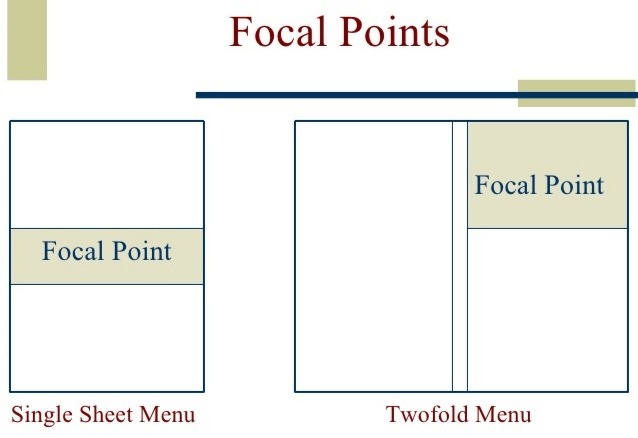
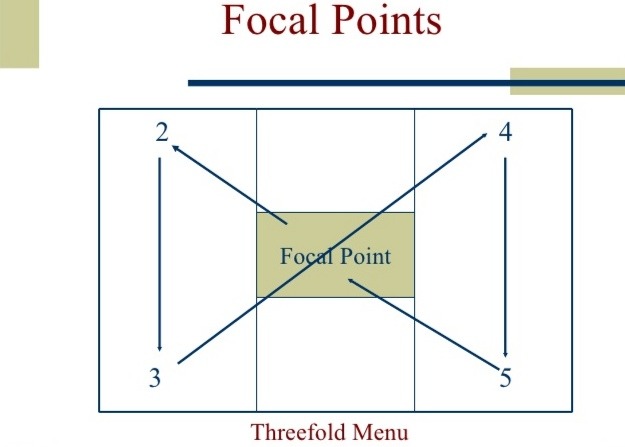
Use focal point on menu to push certain items and attract customers
- In single sheet menu ,the focal point is the middle part of the menu
- In two fold menu, the focal point is upper right side of the menu.
- In three fold menu, the sequence of focal point goes as shown in the fig.
c. Shop and Establishment Act
- Formed in the year 1953
One of the important regulation to which most businesses in India are subject to is the Shop and Establishment Act, enacted by every state in India. The Act is designed to regulate the payment of wages, hours of work, leave, holidays, terms of service and other work conditions of people employed in the shop and commercial establishments.
The Shop and Establishment Act is regulated by the Department of Labor and regulates premises wherein any trade, business or profession is carried out. The act not only regulates the working of commercial establishments but also societies, charitable trusts, printing establishments, educational institutions run for gain and premises in which banking, insurance, stock or share brokerage.
The Shop and Establishment Act regulates a number of aspects relating to the operation of a shop or commercial establishment. Some of the key areas regulated by the shop and establishment act include:
- Hours of work
- Interval for rest and meals
- Prohibition of employment of children
- Employment of young person or women
- Opening and closing hours
- Close days
- Weekly holidays
- Wages for holidays
- Time and conditions of payment of wages
- Deductions from wages
- Leave policy
- Dismissal
- Cleanliness
- Lighting and ventilation
- Precautions against fire
- Accidents
- Record keeping
d. Food Safety & Standard Authority of India
Food Safety and Standards Authority of India (FSSAI) is an autonomous body established under the Ministry of Health & Family Welfare, Government of India.
The FSSAI has been established under the Food Safety and Standards Act, 2006, which is a consolidating statute related to food safety and regulation in India. FSSAI is responsible for protecting and promoting public health through the regulation and supervision of food safety.
The FSSAI is headed by a non-executive Chairperson, appointed by the Central Government, either holding or has held the position of not below the rank of Secretary to the Government of India.
The FSSAI has its headquarters at New Delhi. The authority also has 6 regional offices located in Delhi, Guwahati, Mumbai, Kolkata, Cochin, and Chennai.
The following are the statutory powers that the FSS Act, 2006 gives to the Food Safety and Standards Authority of India (FSSAI).
1. Framing of regulations to lay down food safety standards
2. Laying down guidelines for accreditation of laboratories for food testing
3. Providing scientific advice and technical support to the Central Government
4. Contributing to the development of international technical standards in food
5. Collecting and collating data regarding food consumption, contamination, emerging risks etc.
6. Disseminating information and promoting awareness about food safety and nutrition in India
e. Market Segmentation
• Market segmentation is the process of dividing a market of potential customers into groups, or segments, based on different characteristics.
• Proper market segmentation allows a hotel to price and apply inventory controls in order to maximize revenue from various lines of business.
• In order to be as successful as possible, hotel management must ensure that they use the most logical method possible for tracking their business.”
• Hospitality market segments can focus on three key areas: product, pricing, and distribution. Many hospitality sales and marketing executives spend countless hours and cumulatively millions of dollars defining their respective market segments.
• Once defined, these same executives focus their sales and marketing efforts to mine customers from those segments. Revenue managers on the other hand use segmentation to deliver a more profitable customer through focused product, pricing and distribution, and to ensure proper reporting and tracking.
• The need for market segmentation is more prominent in the hospitality industry now due to the rapid changes in customer needs and the vast amount of product offerings.
Market segmentation can be in following categories:
• Geographic – region, size, population, and climate.
• Demographic – age, gender, lifestyle, income, occupation.
• Psychographic – activities, social interest, values.
• Behavioral – features, benefits, usage, loyalty, and occasion.
f. Importance of Cyber Law
The computer-generated world of internet is known as cyberspace and the laws prevailing this area are known as Cyber laws.
Cyber law can also be described as that branch of law that deals with legal issues related to use of inter-networked information technology. In short, cyber law is the law governing computers and the internet.
Cyber law is important because it touches almost all aspects of transactions and activities and on involving the internet, World Wide Web and cyberspace. Every action and reaction in cyberspace has some legal and cyber legal angles.
Cyber law encompasses laws relating to:
a. Cyber crimes
b. Electronic and digital signatures
c. Intellectual property
d. Data protection and privacy
Importance of Cyber Laws
We are living in highly digitalized world.
All companies depend upon their computer networks and keep their valuable data in electronic form. GovernmentGovernment forms including income tax returns, company law forms etc are now filled in electronic form.
Consumers are increasingly using credit cards for shopping.
Most people are using email, cell phones and SMS messages for communication.
Even in non-cyber cases, important evidence is found in computers/ cell phones e.g. in cases of divorce, murder, kidnapping, organized crime, terrorist operations, counterfeit currency etc.
Since it touches all the aspects of transactions and activities on and concerning the Internet, the World Wide Web and Cyberspace therefore Cyber law is extremely important.
Q.9. Evalute any two terms with relevant examples- (2×5=10)
a. Evolution of Revenue Management
British Airways experimented with differentiated fare products by offering capacity controlled “Early bird” discounts to stimulate demand for seats that would otherwise fly empty.
Taking it a step further, Robert Crandall, former Chairman and CEO of American Airlines, pioneered a practice he called Yield Management, which focused primarily maximizing revenue through analytics-based inventory control. Under Crandall’s leadership, American continued to invest in Yield Management’s forecasting, inventory control and overbooking capabilities.By the early 1980s, the combination of a mild recession and new competition spawned by airline deregulation act (1978) posed an additional threat.
This Yield Management system targeted those discounts to only those situations where they had a surplus of empty seats. The system and analysts engaged in continual re-evaluation of the placement of the discounts to maximize their use.
Other industries took note of American success and implemented similar systems. Marriott International had many of the same issues that airlines did: perishable inventory, customers booking in advance, lower cost competition and wide swings with regard to balancing supply and demand.Since “yield” was an airline term and did not necessarily pertain to hotels, Marriott International and others began calling the practice Revenue Management.
The company created a Revenue Management organization and invested in automated Revenue Management systems that would provide daily forecasts of demand and make inventory recommendations for each brand.
They also created “fenced rate” logic similar to airlines, which would allow them to offer targeted discounts to price sensitive market segments based on demand.A natural extension of hotel Revenue Management was to rental car firms, which experienced similar issues of discount availability and duration control.
By 2000, virtually all major airlines, hotel firms, cruise lines and rental car firms had implemented Revenue Management Systems to predict customer demand and optimize available price. These Revenue Management Systems had limited “optimize” to imply managing the availability of pre-defined prices in pre-established price categories. The objective function was to select the best blends of predicted demand given existing prices.
The sophisticated technology and optimization algorithms had been focused on selling the right amount of inventory at a given price, not on the price itself
b. Seven Steps in HACCP
HACCP is a systematic approach to the identification, evaluation, and control of food safety hazards based on the following seven principles:
Step 1: Conduct a hazard analysis.
The application of this principle involves listing the steps in the process and identifying where significant hazards are likely to Occur. The HACCP team will focus on hazards that can be prevented, eliminated or controlled by the HACCP plan. A justification for including or excluding the hazard is reported and possible control measures are identified.
Step 2: Determine the critical control points (CCPs).
A critical control point (CCP) is a point, step or procedure at which control can be applied and a food safety hazard can be prevented, eliminated or reduced to acceptable levels. The HACCP team will use a CCP decision tree to help identify the critical control points in the process. A critical control point may control more that one food safety hazard or in some cases more than one CCP is needed to control a single hazard. The number of CCP’s needed depends on the processing steps and the control needed to assure food safety.
Step 3: Establish critical limits.
A critical limit (CL) is the maximum and/or minimum value to which a biological, chemical, or physical parameter must be controlled at a CCP to prevent, eliminate, or reduce to an acceptable level the occurrence of a food safety hazard. The critical limit is usually a measure such as time, temperature, water activity (Aw), pH, weight, or some other measure that is based on scientific literature and/or regulatory standards.
Step 4: Establish monitoring procedures.
The HACCP team will describe monitoring procedures for the measurement of the critical limit at each critical control point. Monitoring procedures should describe how the measurement will be taken, when the measurement is taken, who is responsible for the measurement and how frequently the measurement is taken during production.
Step 5: Establish corrective actions.
Corrective actions are the procedures that are followed when a deviation in a critical limit occurs. The HACCP team will identify the steps that will be taken to prevent potentially hazardous food from entering the food chain and the steps that are needed to correct the process. This usually includes identification of the problems and the steps taken to assure that the problem will not occur again.
Step 6: Establish verification procedures.
Those activities, other than monitoring, that determine the validity of the HACCP plan and that the system is operating according to the plan. The HACCP team may identify activities such as auditing of CCP’s, record review, prior shipment review, instrument calibration and product testing as part of the verification activities.
Step 7: Establish record-keeping and documentation procedures.
A key component of the HACCP plan is recording information that can be used to prove that the a food was produced safely. The records also need to include information about the HACCP plan. Record should include information on the HACCP Team, product description, flow diagrams, the hazard analysis, the CCP’s identified, Critical Limits, Monitoring System, Corrective Actions, Recordkeeping Procedures, and Verification Procedures.
c. Objective Pricing Method
There are two main types of pricing methods-
i) Subjective Pricing Method
ii) Objective Pricing MethodObjective Pricing Method-
- Prices determine to a large extent whether the financial goals of the operation are meet.
- Objective Method pricing is based on cost of the product and profit.
1. Simple Markup Pricing Method
• Ingredients Mark Up
• Prime ingredients Mark Up
• Mark Up with accompaniments
2. Contribution Margin Pricing Method
3. Ratio pricing Method
4. Simple prime cost method
5. Specific prime cost method
A. Simple Markup Pricing Method
It considers a mark up from the cost of the goods sold (in case of menu item that would be the standard food cost) the mark up is designed in such a way that it covers all costs to yield the desired profit levels1. Ingredient mark up method :
• Determine ingredients cost
• Determine multipler to the mark up
• Determine base selling price2. Prime ingredient mark up method
Mark up pricing is directly linked to the main/prime ingredient of the item
3. Mark up with accompaniments costs
Operator determines the ingredient cost based only upon the entrée item & then the standard accompaniment cost is added before multiplying with the mark up contributions.
B. Contribution Margin Pricing Method
Contribution margin = selling price – food cost
Example to calculate C.M. Pricing
Non food costs = $695,000
Profit required = $74,000
No. Of guests expected to be served = 125,000
Food cost of a menu item = $4.60
Ave. C.M./guest = non F.C.+profit required/total guests
= ($695,000+$74,000)/125,000=$6.192
B.S.P. = 4.60 + $6.192 = 10.8
C. Ratio Pricing Methods
Food cost = $ 435,000
Non food cost = $ 790,000
Profit requirements = $ 95,000
F.C. of menu item = $ 4.75
• Determine the ration between F.C. , N.F.C. & profit
N.F.C. +profit/F.C. = Ratio
790,000+95,000/435,000 = 2.03
the ratio implies that for every $ 1 earned to cover food cost we have to earn $ 2.03 to cover N.F.C & profit.
• Amount required to cover n.f.c & profit =$ 4.75 x 2.03 = $9.64
• B.S.P. = $9.64 + $4.75 = $14.39
D. Simple Prime Cost method
Prime costs refers to the significant costs in f & b operations such as food cost & labour cost.
Example to calculate simple prime costs method:-
Menu item F.C. = $3.75
Labor cost = $ 210,000
No. Of exp. Guests = 75,000
Desired prime cost = 62%
• Labor cost per guest = $ 210,000/75,000= $2.8
• Prime cost per guest = $ 3.75 + $ 2.8 = $6.55
• B.S.P. = prime costs per guest/desired P.C.
= $6.55/62% = $10.56
E. Specific Prime Cost Method
Operator develops mark ups for menu items which takes into account their food costs & also fair share of labor cost
Menu items requiring more labor intensive preparation would have a higher mark up & those requiring less labor would have less mark.
Q.10. Discuss the concept of Menu Engineering and evaluates its role in restaurant business. With the help of Menu Engineering matrix, categories the items mentioned in the table below (4+6=10)
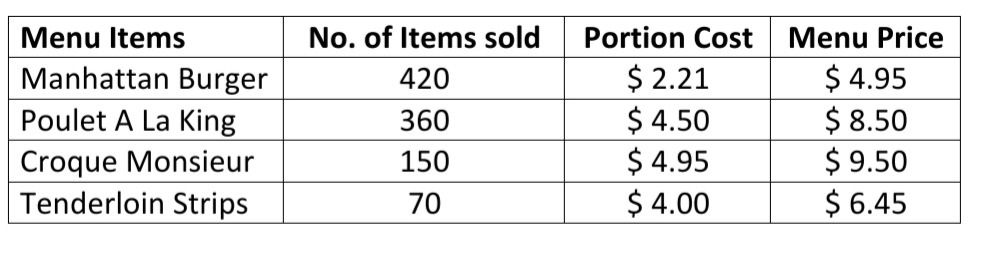
Menu engineering is an interdisciplinary field of study devoted to the deliberate and strategic construction of menus. It is also commonly referred to as menu psychology.
Menu engineering is an empirical way to evaluate restaurant menu pricing, using your restaurant data to influence your menu’s design and content decisions. It involves categorizing all menu items into one of four menu engineering categories, based on the profitability and popularity of each item.They are-
1. Stars: Menu items high in both popularity and contribution margin. Stars are the most popular items on your menu. They may be your signature items.
2. Plough Horses: Menu items high in popularity but low in contribution margin. Plough horses are but low in contribution margin. Plow horses are demand generators. They may be the lead items on your menu or your signature items. They are often significant to the restaurant’s popularity with price-conscious buyers.
3. Puzzles: Menu items low in popularity but high in contribution margin. In other words, Puzzles yield a high profit per item sold. But they are hard to sell.
4. Dogs: Menu items low in popularity and low in contribution margin. These are your losers. They are unpopular, and they generate little profit.
Once you have grouped your menu into the four key categories, you are ready to make decisions. Each category must be analyzed and evaluated separately.
Purpose of Menu Engineering
The primary goal of menu engineering is to encourage purchase of targeted items, presumably the most profitable items, and to be able to make educated decisions about whether a dish needs to be changed or removed from the menu.
• Helps to foodservice operator when to keep menu items and when to take off items from the menu.
• Helps to determine which menu items are over or under-priced.
• Helps in designing profitable menu.
• Helps to select the menu items to be repositioned to gain popularity.
• Helps to revise recipe and portion size of the menu item.
• Helps in monitoring menu performance.
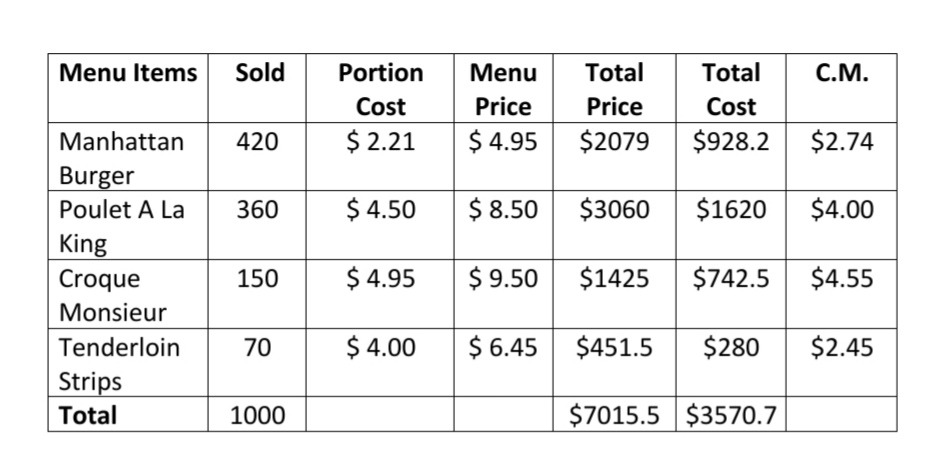
Food Cost % = 3570/7015.5*100 = 50.8%
Total Contribution Margin = $3444.8
Average contribution margin /customer = 3444.8/1000=3.44
Average Popularity = 80% Of average items sales = 80/4 =20%
Popularity of each menu item
Manhattan Burger = 420/1000= 42%
Poulet A La King = 360/1000= 36%
Croque Monsieur = 150/1000= 15%
Tenderloin strips = 70/1000 = 7%
MENU ENGINEERING RANGE = ($3.44, 20%)
- Manhattan Burger 42%, $2.74 = C.M.-LOW, POP – HIGH (PLOUGH HORSE)
- Poulet A La King 36%, $4 = C.M. – HIGH, POP – HIGH (STAR)
- Croque Monsieur 15%, $4.55 = C.M.- HIGH, POP- LOW (PUZZLE)
- Tenderloin strips 7%, $2.45 = C.M. – LOW, POP – LOW (DOG)