
Table of Contents
Q.1. Draw the kitchen organization chart of a large hotel and explain the duties and responsibilities of an Executive Chef.
Kitchen organization chart

Duties and Responsibilities of Executive chef
-
Plan and direct food preparation and culinary activities
-
Modify menus or create new ones that meet quality standards
-
Estimate food requirements and food/labor costs
-
Supervise kitchen staff’s activities
-
Arrange for equipment purchases and repairs
-
Recruit and manage kitchen staff
-
Rectify arising problems or complaints
-
Give prepared plates the “final touch”
-
Perform administrative duties
-
Comply with nutrition and sanitation regulations and safety standards
-
Keep time and payroll records
-
Maintain a positive and professional approach with coworkers and customers
OR (a) Explain the various points a food handler needs to keep in mind for maintaining good personal hygiene.
Do’s for Personal Hygiene
• Bath or shower daily.
• Wear clean uniforms and aprons.
• Keep hair neat and clean. Always wear a hat or hairnet.
• Keep mustaches and beards trimmed and clean. Better yet, be cleanly shaven.
• Wash hands and exposed parts of arms before work and as often as necessary during work, including:
• After eating, drinking, or smoking.
• After using the toilet.
• After touching or handling anything that may be contaminated with bacteria.
• Cover cough and sneezes and then wash hands.
• Keep your hands away from your face, eyes, hair, and arms.
• Cover cuts or sores with clean bandages.
• Use spoons for a tasting, not your finger.
Don’ts for Personal Hygiene
• Do not work with food if you have any communicable disease or infection.
• Keep fingernails clean and short. Do not wear nail polish.
• Do not smoke or chew gum or tobacco while on duty.
• Do not sit on worktables.
• Avoid wearing jewelry in the kitchen.
• Do not use kitchen sinks for personal washing or for spitting.
(b) Discuss the attitude and behavior required in a professional kitchen.
A positive attitude towards the job is expected from the kitchen personnel as the job requires a lot of hard work and patience. To become a successful chef, zeal to learn, creative nature, and a strong sense of responsibility are desired.
While working in the kitchen, a person is dealing with sharp tools, electric machines with blades, gas, fires which all are very dangerous if treated without carefulness, therefore a presence of mind is a must.
Following are the main causes of accidents in the kitchen-
-
Distraction:-
Distraction in the kitchen can be caused by the other personnel working in the kitchen, mobile phones, and personal problems. It is advised while working in the kitchen mobile phones should not be kept or attended, must keep the mind free from the personal issues while at work, and should not participate in gossips/jokes/talks especially while dealing with sharp tools.
-
Haste:-
The guest is god, his satisfaction is a must but not at the cost of someone’s life/health.
A given work must be finished on time for which a work plan or schedule can be made, mise-en-place can be done in advance to avoid the running situations in the kitchen which can cause an accident either by falling or by pushing someone or by harming oneself by the sharp tools.
-
Failure to observe rules and regulations:-
As new machines are getting the place in the kitchens to create new recipes and to ease the job of chefs but attention must be paid to rules and regulations to operate these machines as avoidance of the same could call for the major accidents. The guidelines must be pasted over the walls near to the machines to read the instructions before operations.
Q.2. How are vegetables classified? Discuss the effects of heat on vegetables.
Classification of Vegetables
-
Cabbage Family: Consist of vegetables used for their head, leaves, or flowers are also known as BRASSICA. E.g. Cabbage, Brussels Sprouts, Cauliflower, Kohlrabi, Broccoli etc
-
Stalk Vegetable: Stalk vegetables are plant stems that are high in cellulose. E.g. Asparagus, Celery, Bok Choy etc.
-
Leafy Vegetables: Leafy vegetables are plant grown specifically for their edible leaves. E.g. Spinach, Kale, Sorrel etc.
-
Salad Greens: Endive, Lettuce
-
Seeds, Edible Pods and Young Shoots: This is a broad category of vegetables it includes Peas, Snow peas, All types of beans, Bean sprout, Corn etc.
-
Vegetable Fruits: Botanically vegetable fruit are considered fruits; however they are used in the kitchen as vegetables. E.g. Cucumber, Okra, Eggplant, Tomatoes, Pepper, Squash etc.
-
Bulbs: Bulbs are stems holding A food reserve in the fleshy, overlapping which give shape to the vegetable. E.g. Onion, Scallion, Green onion, Shallots, Garlic etc.
-
Fungi: Mushrooms are not actually vegetables. They are an edible fungus. There are over 38,000 kinds of mushrooms. Three-quarters of these are edible. E.g. Mushroom, Morel, Truffles etc.
-
Tubers: These are formed from underground stems, which extend from the root of the plant. E.g. Jerusalem Artichoke, Carrot, Potatoes, Raddish, Turnips etc.
-
Spatiality Vegetables: There are vegetables that do not fit it any other category. E.g. Artichoke, Rhubarb etc.
Effects of heat on vegetables
Cooking is the application of heat to food to make it safer to eat, digestible, and more palatable. Cooking also changes the appearance of the food. Heat breaks down the cellulose and the starches present, changes and blend flavor within the food, and also destroy bacteria to make food digestible.
-
Carbohydrates: Caramelization and Gelatinization. Both sugar and starch are carbohydrates. Caramelization is the browning of sugars and Vegetables get softened by the gelatinization of the starch.
-
Vegetable Fibres: Fibbers are a group of complex substances that give structure and firmness to plant. they cannot be digested. Heat breaks down the fibers. Alkali makes fiber softer but makes them mushy and lose essential vitamins.
-
Minerals, Vitamins, Pigments, And Flavour Components: Minerals dissolve in water during cooking. Vitamins and pigments may also be destroyed by prolonged cooking. Pigment and flavor may also determine whether the food is appetizing enough to eat or not.
-
Protein: When heat is applied to the protein they become firm or they start to coagulate with heat. Proteins become tough and dry when exposed to high heat.
OR Classify Salads and discuss the various components of a Salad.
Salads can be classified into the following types
Simple:
A salad where one ingredient is the main feature, usually a vegetable or leafy green or tomato-based and may have dressing added.
-
tomato salad
-
lettuce salad
-
cucumber salad
Mixed/Compound:
A salad that has two or more main ingredients as well as dressing.
-
Coleslaw salad
-
Tabouli salad
-
Greek salad
Classical Salads:
Based on French Cuisine, this term refers to all the traditional salads which are based on french influential cuisine and tradition.
-
Nicoise salad
-
Waldorf salad
Modern Salads:
A term used to classify any contemporary developments in salads, which may use previously unavailable ingredients or adopted international cuisines.
-
Thai Beef Salad
-
Mesclun
Components of a salad
Base or Underliner
Body
Garnish
Dressing
- Base or Under-liner: The base is a layer of leafy vegetables as an underliner of the salad such as Boston lettuce, Romaine, Iceberg, Radicchio, Endive, Red oak lettuce, Spinach, Arugula, Cabbage, etc.
- Body: The most important part of the salads. The body of the salad is the main ingredient. It may include vegetables, fruits, meats, beans, eggs, pasta, or cheeses. The ingredients used have a balance of flavor and testes. This part gets the most attention and its appearance is enhanced by decorations. The salad gets its name from the ingredients that are used for the body.
- Garnish: The garnish of the salad adds color and appeal, and sometimes flavor. It must be edible and may be as simple as a sprinkling of cheese crumbs, seeds, nuts, or spice. The main purpose of the garnish is to add an eye appeal to the finished product, but in some cases, it improves the taste and form.
- Dressing: The dressing is a liquid or a semi-liquid used to flavor, moisten or enrich the salad. It adds flavor, provides food value, helps digestion and improves palatability and appearance.
Q.3. What do you understand by the term “Fond de Cuisine”? Explain the components of stock and list the precautions to be kept in mind for preparing a good stock.
The term ‘Fond de Cuisine” is referred to as the foundation of cuisine which is in turn meant to be stock. Without stocks, there would be no French cuisine. They are a crucial element in soups, sauces, braises, and stews. Good stocks are made by simmering raw meat or fish, and bones, with aromatic vegetables and herbs, peppercorns, water, and a little salt. Richly colored brown stocks, made with beef and veal, are made by first browning the meat and bones in the oven before simmering them with the remaining ingredients; brown stocks are used in brown sauces and with red meats and game. Light-colored white stocks, made with veal, poultry and fish require no browning and have a lighter flavor suitable for the delicate flavors of poultry, fish, and vegetables.
Components of a Stock
- Bones: Beef and chicken bones are most commonly used; fish is also common. The flavor of the stock comes from the bone marrow, cartilage and other connective tissue. Connective tissue contains collagen, which is converted into gelatin that thickens the liquid. Stock made from bones needs to be simmered for long periods; pressure cooking methods shorten the time necessary to extract the flavor from the bones.
- Meat: Cooked meat still attached to bones is also used as an ingredient, especially with chicken stock. Meat cuts with a large amount of connective tissue, such as shoulder cuts, are also used.
- Mirepoix: Mirepoix is a combination of onions, carrots, celery, and sometimes other vegetables added to flavor the stock. Sometimes, the less desirable parts of the vegetables that may not otherwise be eaten (such as carrot skins and celery cores and leaves) are used, as the solids are removed from stock.
- Herbs and spices: The herbs and spices used depend on availability and local traditions. In classical cuisine, the use of a bouquet garni (or bag of herbs) consisting of parsley, bay leaves, a sprig of thyme, and possibly other herbs, is common. This is often placed in a sachet to make it easier to remove once the stock is cooked.
Precautions to be taken while preparing a stock
- Stocks must be simmered long enough to extract the maximum flavor from the ingredients. For a veal stock, this means at least 3.5 hours, while a chicken stock requires only 2.5 hours and a fish stock just 20 minutes. The stock must be carefully skimmed after it is brought to a boil to remove any fat and gray scum that rise to the surface, but it must never be boiled during cooking, as this would make it cloudy.
- Stocks may be refrigerated for several weeks provided they are brought to a boil every 2 to 3 days. Or they may be reduced to a thick, syrup glaze, called a glace, that will set to a very firm consistency when chilled and may be refrigerated for several months (glaces are used as sauce bases of or to intensify the flavor of and give body to sauces). Stocks may also be frozen for several months; it makes good sense to freeze them in small quantities so that you need thaw only the amount necessary.
OR Distinguish between Stock and Soup. Classify soup with examples. Write the recipe for preparing two litres of Minestrone soup.
A classic or traditional stock is made from bones plus a few vegetables (usually aromatic vegetables like onion, carrots, and celery) with no seasoning. The bones may be roasted for additional flavor. When cooking stock, the aim is to get the collagen from the connective tissues, which makes a stock thick, and even gelatinous when cool. The body that the collagen gives to stock is its defining characteristic. A stock is not thought of as a finished product but as a base for other things such as sauces and soup.
A traditional broth, on the other hand, is the liquid in which meat has been cooked. It has basically the same vegetables as stock, but it is usually seasoned. A broth may be served as-is, in which case it is then officially a soup. Consommé is an example.
One way of looking at it is that stocks stay in the kitchen but broths may go to the table. When it comes to vegetarian varieties, “vegetable stock” is exactly the same as “vegetable broth” since vegetables have no bones.
Classification Of Soups with Examples
Majorly soups are categories into four types as Thin, Thick, Cold and International. Thin soups are further divided into two types; Passed and Unpassed. Thick soups are categorized as chowder, bisque, puree, cream and veloute.
Passed- consommne
Unpassed- broth- minestrone
Puree- carrot and sweet potato soup
veloute- broccoli cheese soup
Cream- cream of tomato
Bisque- chicken tomato bisque
Chowder- potato chowder
Recipe of two litre minestrone soup
Ingredients:
- 1 big sized potato, peeled and finely diced*
- 1 big sized onion, peeled and finely diced
- 1 big sized carrot, peeled and finely diced
- 3-4 cloves garlic, peeled and finely chopped
- 1 red chili pepper, deseeded and finely sliced
- 350 g celery leaf stalks, trimmed and finely diced
- 150 g (1 cup) green peas
- 300-350 g zucchini, trimmed and finely diced
- 1 x 400 g tin white beans, drained
- 1 x 400 g tin tomatoes diced
- 1 medium bunch of fresh basil, separate leaves from the stems, and finely chop everything
- 70-100 ml (1/3 cup) olive oil
- 1 liter tomato juice (or water, or meat/vegetable stock)
- 250 g bacon, finely sliced
- 100-300 g (about 1 cup) wholemeal pasta, optional
- Salt, ground black pepper, Parmesan cheese to taste
- 1-2 liters hot boiled water
Procedure
- Put diced tomatoes into a blender and shake them well.
- Heat olive oil in a large saucepan (4-5 liters) on a medium high heat. Add bacon and fry about 2 minutes. Put garlic, onion and fennel. Stir and fry two minutes more. Add chili pepper, basil stems, carrot and celery. Thoroughly mix, reduce the heat to a minimum and stew about 5 minutes.
- Put tomatoes and potato, stir and stew 10 minutes more. Pour tomato juice into the saucepan, bring to a boil, reduce the heat and cook about 10 minutes. Add zucchini, green peas. Thoroughly mix and simmer about 5 minutes.
- Put white beans and pour hot boiled water. Add salt and ground black pepper to taste and cook 5 minutes more.
- Remove from the heat, cover with cap and let minestrone rest for 15-20 minutes.
- Cook pasta. In medium saucepan bring water to the boil on a high heat. Add 1 teaspoon salt and put pasta. Mix well, so pasta doesn’t stuck to the bottom and cook 3-5 minutes or more (see instruction on the package). Finely chop basil leaves.
- Serve minestrone soup with pasta if desire. Sprinkle with basil leaves and grating Parmesan cheese.
Q.4. With the help of a neat labelled diagram, explain the parts of an egg. List the uses of egg in cookery.
Structure of chicken egg
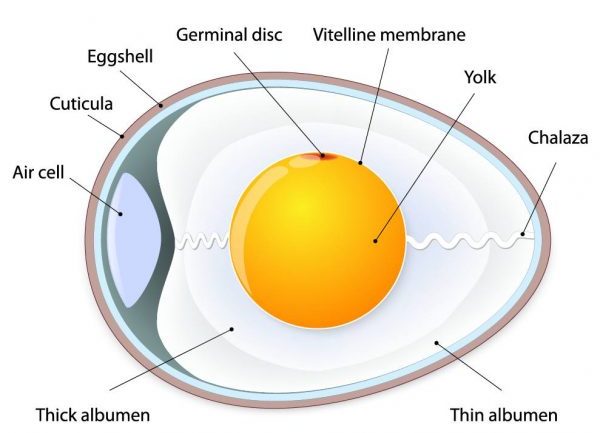
Shell
Bumpy and grainy in texture, an eggshell is covered with as many as 17,000 tiny pores. Eggshell is made almost entirely of calcium carbonate (CaCO3) crystals. It is a semi-permeable membrane, which means that air and moisture can pass through its pores. The shell also has a thin outermost coating called the bloom or cuticle that helps keep out bacteria and dust.
Inner and Outer Membranes
Lying between the eggshell and egg white, these two transparent protein membranes provide efficient defense against bacterial invasion. If you tug at these layers, you’ll find they’re surprisingly strong. They’re made partly of keratin,
a protein that’s also in human hair.
Air Cell
An air space forms when the contents of the egg cool and contract after the egg is laid. The air cell usually rests between the outer and inner membranes at the egg’s larger end, and it accounts for the crater you often see at the end of a hard-cooked egg. The air cell grows larger as egg ages
Albumen
The egg white is known as the albumen, which comes from albus, the Latin word for “white.” Four alternating layers of thick and thin albumen contain approximately 40 different proteins, the main components of the egg white in addition to water.
Chalazae
Opaque ropes of egg white, the chalazae hold the yolk in the center of the egg. Like, little anchors, they attach the yolk’s casing to the membrane lining the eggshell. The more prominent they are, the fresher the egg.
Vitelline Membrane
The clear casing that encloses the yolk.
Yolk
The yolk contains less water and more protein than the white, some fat, and most of the vitamins and minerals of the egg. These include iron, vitamin A, vitamin D, phosphorus, calcium, thiamine, and riboflavin. The yolk is also a source of lecithin, an effective emulsifier. Yolk color ranges from just a hint of yellow to a magnificent deep orange, according to the feed and breed of the hen.
Uses Of Egg In Cookery
Binding
Addition of eggs to minced mead and mashed vegetables etc. helps to bind the mixture. As the heat coagulates, the proteins are bound into a cohesive mass. It helps to retain the shape of mutton croquettes, meatloaf, medallions, hamburgers, etc.
Coating
The egg and egg batter help to give a coat to the food items and prevent them from disintegrating and give them a protective coating. Many of the food items such as fish fillets, croquettes, etc. are dipped into the batter before crumbing and then fried. Eggs are also used for preparing pancake batters.
Leavening
By beating the egg whites, foam is made up of air bubbles, surrounded by a thin elastic film of egg white. The mixture, when added to products such as sponge cakes, meringues, soufflés, etc., increases the volume and the egg white film hardens. The addition of sugar to egg white makes it stable, smooth, and the foam does not collapse easily. Egg yolk has a less foaming power because of its fat content. An egg is used as the principal ingredient for Chou paste from which éclairs, beignets, fritters, and profiteroles are made.
Emulsifying
Eggs form stable emulsions. For example, mayonnaise, oil, and vinegar separate unless oil droplets are coated with a substance that keeps them from separating. Eggs are the emulsifiers that give a smooth mayonnaise sauce. It is also used as an emulsifier in ice creams, cakes, cream puffs. Eggs enhance color and shine.
Thickening
Eggs help to improve the consistency of gravies, curries, sauces, and soups. Egg liaisons used in soups and sauces help to thicken and improve consistency. When used in custards, the heat coagulates the eggs and makes the custard firm.
Decoration and Garnishing of Dishes
Silver, sieved or quarters of boiled eggs are used to decorate or garnish dishes such as salads, biryanis, curries, Vienna steaks, etc. For Consommé Xavier, threaded eggs are added as a garnish.
Clarifying
Consommés are clarified with egg whites.
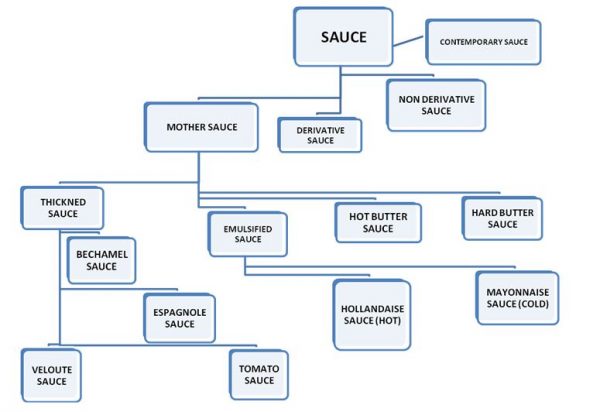
OR Classify and describe sauce. Explain the thickening agents used in sauce.
Definition
Sauces are liquid or semi-liquid mixtures. A keen sense of smell, delicate sense of taste, a light, strong hand for blending – all contribute to the perfect sauce. Long ago, Grimande de la Royere, philosopher and gastronomer wrote: “The sauce is to culinary art, what grammar is to language”. A perfect sauce has a colorful appearance, is glowing in its rich smoothness, its texture is that of velvet, and it has a definite taste. It has natural flavor and complements the food it accompanies, rather than mask its taste.
These are different ingredients added to give the thick consistency to a sauce. The different agents make each sauce unique by way of its taste, color, consistency & flavor.
Roux
It is a fat and flour mixture, which are cooked together. It is cooked to various degrees, namely white, blond or brown. Equal quantities of flour and butter and margarine are taken to prepare the different colored roux. The colour acquired depends upon the degree of cooking of the flour and the color of the sauce depends upon the liquid and roux used. While preparing the sauce, the boiling liquid should never be added to a hot roux as it may become lumpy, a cold liquid to a hot roux or hot liquid to an old roux may be added to get a smooth texture.
Starch
Arrowroot, corn flour, fecule (potato starch), tapioca are used to thicken the sauce. A paste should be made of cold liquid and starch and then stirred into boiling liquid and allowed to boil, till the starch is cooked. It gelatinizes at 93°C.
Starch contains no gluten and gives a clear sauce and thickens more as it cools.
Beurre Maine
It is chiefly used for fish sauces. Equal quantities of flour and butter are kneaded, and very little quantity is added at a time to the boiling liquid and stirred well to form a smooth consistency.
Yolks of Eggs and Cream
It is a liaison, added as a finishing agent at the end of cooking. The product is never boiled when the liaison is added, or it would curdle. The liaison is added to thicken delicate cream or veloute sauces or cream soups. Yolks of eggs are used to prepare the mayonnaise by emulsifying with oil.
Blood
It is usually used for game cooking. It thickens the sauce and gives a particular flavor e.g. preparation of Jugged Hare.
Sauces could be grouped as follows:
• Basic sauces
• Cold Basic Sauces
• Butter Sauces
• Others sauces (miscellaneous)
Q.5. Briefly explain the various methods of cooking. List the points to be kept in mind while poaching fish.
Various Methods Of Cooking
Baking
This involves applying a dry convection heat to your food in an enclosed environment. The dry heat involved in the baking process makes the outside of the food go brown, and keeps the moisture locked in. Baking is regularly used for cooking pastries, bread and desserts.
Frying
This means cooking your food in fat – there are several variations of frying: Deep-frying, where the food is completely immersed in hot oil Stir-frying, where you fry the food very quickly on a high heat in a oiled pan Pan-frying, where food is cooked in a frying pan with oil; and Sauteing, where the food is browned on one side and then the other with a small quantity of fat or oil. Frying is one of the quickest ways to cook food, with temperatures typically reaching between 175 – 225ºC.
Roasting
Roasting is basically a high heat form of baking, where your food gets drier and browner on the outside by initial exposure to a temperature of over 500F. This prevents most of the moisture being cooked out of the food. The temperature is then lowered to between 425 and 450F to cook through the meat or vegetables.
Grilling
This is a fast, dry and very hot way of cooking, where the food is placed under an intense radiant heat. You can use various sources of heat for grilling: wood burning, coals, gas flame, or electric heating. Before grilling, food can be marinaded or seasoned. A similar method to grilling is broiling, where the heat source originates from the top instead of the bottom.
Steaming
This means cooking your food in water vapour over boiling water. For this, it’s handy to have a steamer, which consists of a vessel with a perforated bottom placed on top of another containing water. Steam rises as the water boils, cooking the food in the perforated vessel above.
Poaching
This involves a small amount of hot liquid, ideally at a temperature between 160 and 180F. The cooking liquid is normally water, but you can also use broth, stock, milk or juice. Common foods cooked by poaching include fish, eggs and fruit.
Simmering
This involves cooking liquid on top of a stove in a pot or pan. It should be carried out on a low heat, and you will see bubbles appearing on the surface of the liquid as your dish cooks.
Broiling
Similar to grilling, the heat source comes directly from the top. You should be able to adjust your oven setting to broiling, but be careful, as this cooking methods works quickly and your meal could easily become burned. Favourite dishes for broiling include chicken, beef and fish.
Blanching
Here the food is part-cooked, and then immediately submerged in ice cold water to stop the cooking process. All sorts of vegetables can be blanched, including green beans, asparagus and potatoes.
Braising
First the food is sauted or seared, and then simmered in liquid for a long period of time until tender. Pot roasts, stews and casseroles can be cooked in this way if they contain larger food items such as poultry legs.
Stewing
Again, the food is sauted or seared first, and then cooked in liquid, but normally uses smaller ingredients such as chopped meats or vegetables.
Poaching Fish
- Thoroughly rinse the fish and pat dry with paper towels. Place fish in a large saucepan and add enough poaching liquid to the pan to cover the fish. You can also use a fish poacher fitted with a rack for holding fish instead of a saucepan or soup pot.
- Bring your poaching liquid to a simmer over medium heat, and cook the fish for 10 minutes or until the center of the fish seems opaque and it flakes easily when prodded with a fork. Do not bring the liquid to a rolling boil – keep it at a simmer.
- When the fish is done, remove it from the liquid with a slotted spatula. Serve poached fish hot, right out of the poaching liquid, with the sauce of your choice. You can also chill it and serve it later.
Q.6. Classify raising agents and briefly explain the chemical raising agents.
Raising agents that are used in the kitchen can be classified into the following categories:
-
Biological (yeast)
-
Chemical (baking powder, baking soda, baking ammonia)
-
Mechanical (beating, whisking, creaming, sieving)
-
Lamination
-
Combination of all
Chemical Raising Agents
Chemical raising agent is brought about by the production of carbon dioxide in a solution of acid and alkali, in the presence of heat.
-
Baking Powder
It is a leavening agent made up of a mixture of an acid reacting salt with bicarbonate of soda. We also add some starch to the mixture to keep it in a dried condition and also to act as a separator between sodium bicarbonate and acid reacting salt, until used. On the presence of both heat and moisture, the acid reacting salt reacts with sodium bicarbonate and releases carbon dioxide. A part of the gas is entrapped into the gluten structure or small air cells of a batter which already has developed because of creaming action of fat, these structures now expand with the production of the gas and during baking also and the small part of the gas is absorbed by the media itself. Cream of tarter is a form of refining tartar which is a by-product of precipitation from the grape wine manufacturing process
-
Ammonium Carbonate
It also produces carbon dioxide in the presence of heat but because of the strong offensive flavor, it is always to be used with very strong flavoring agents.
Q.7. Write short notes on any two:
(a) Objectives of cooking
The object of cooking is to achieve certain results such as:
• To facilitate and hasten digestion, so that the cooked food is absorbed by the digestive system and subsequently assimilated by the body. This is largely determined in the manner the food is cooked.
• During the cooking process, it breaks down the cellulose in plant food, softens some of the connective tissues of meat, breaks down and gets starch released. The alteration is brought about in texture by physical and chemical changes thus assisting mastication.
• A physical change occurs when a substance changes its form, colour or size, but still remains that same substance, like water that changes to ice. A chemical change occurs when changes its form, colour, size,
combining so as to form an entirely new body, e.g. milk changes to curd.
(b) Role of shortenings
- It’s main use is to shorten baked goods like pastries and pie crusts to create a tender and flaky final product. This is accomplished by preventing the cohesion of wheat gluten strands during mixing, this action physically shortens the strands of gluten resulting in a less elastic and sticky protein.
- Shortening is great for frying. Since it has a low percentage of unsaturated fatty acids, it shows higher resistance to oxidation and rancidity than alternative typical vegetable oils that may be used for frying. It’s also a good vehicle for delivering flavor as well as richness to bread and cakes.
- Shortening is used for creaming due to its ability to incorporate large volumes of air bubbles. This creates a fine, delicate structure in the end product.
- In cake making, it is used to tenderize the product by incorporating air in the finished cake batter as well as lubricating the other ingredients allowing the cake to rise more freely and increase the shelf life of the product.
(c) Types of sugar
Sugar is available in many different forms. Some various forms of sugar are white sugar, caster sugar, granulated sugar, icing sugar, decorating sugar, vanilla sugar, cube sugar, jam sugar, jelly sugar, granulated brown sugar, soft brown sugar, demerara sugar, muscovado sugar, sugar syrup.
White Sugar
Refining raw sugar obtained from sugar cane or sugar beet, removing all impurities, makes white sugar.
Caster Sugar
Caster sugar is white, granulated sugar with very fine sugar crystals. It is also called superfine sugar, ultra-fine sugar or bar sugar. It is best used in baking and desserts, in the making of cakes, mousses, and drinks, as well as in foods and pastries that are sprinkled, rolled or coated with sugar. Also known as Breakfast sugar. In dishes where sugar is to be whipped with eggs, cream, etc, it is best to use superfine sugar.
Granulated Sugar
Regular granulated sugar has coarser crystals than caster or superfine sugar. It may be used in making preserves, jams,
marmalades and sugar syrups. In making jams, marmalades, preserves, etc, superfine sugar can be replaced with coarser granulated sugar.
Icing Sugar
Icing sugar, also known as confectioners’ sugar, is made of white sugar ground into a smooth, white powder and used in icings, confections, drinks, etc. There is usually an amount of starch mixed in icing sugar to prevent clumping. Also differently colored or flavored icing sugars can be found in the sale.
Decorating Sugar
This white, large crystal sugar is unevenly shaped and used to sprinkle on top of sweet buns and other baked goods for garnish. It may also be called pearl, sanding, coarse or crystal sugar. There are also colored decorating sugars
on sale.
Vanilla Sugar
A rather good substitute for real vanilla, vanilla sugar is powdered or granulated white sugar flavored with real vanilla bean. Usually, there are little black dots of powdered vanilla bean or seeds visible in the sugar. Vanilla sugar is used instead of vanilla bean to give vanilla flavor to various sweet baked goods, desserts, whipped cream, and beverages. It is added to foods only in a small amount (usually 1 – 2 teaspoons per batch of batter, dough, etc).
Cube Sugar
Also called lump sugar, sugar cubes are made by molding and drying moistened, hot granulated sugar. Coming in various forms and colors, lump sugar is mainly used to sweeten various hot drinks. In cooking, lump sugar and sugar cubes may be used instead of granulated sugar in recipes where sugar is melted, like syrups and caramel. Sugar cubes are also used in desserts like Crêpes Suzette, where they are rubbed against the zest of citrus fruit to absorb their essential oils, to flavor the dish. Lump sugar can be ground into granules or powdered using a mortar, a blender or a food processor.
Jam Sugar
Jam sugar is a special gelling sugar used in making jams, marmalades, jellies, and other preserves, instead of regular white sugar. It consists of white, granulated sugar (about 98 %) added with natural fruit pectin (E440, gelling agent), citric acid (E330, antioxidant) and potassium sorbate (E202, preservative). When using jam sugar, the cooking time of various preserves is often reduced, thus better maintaining the flavors, colors, and vitamins of the fruits and berries used. Jam sugar cannot be used instead of regular sugar in baking or cooking, but only in making of jams, marmalades and fruit compotes or soups.
Jelly Sugar
Jelly sugar is used to decorate desserts and pastries and to make a set, clear dessert jellies. Jelly made with jelly sugar is spooned or brushed over berry and fruit garnishes to give them a thin and shiny, protective jelly coating. Jelly sugar is not suitable to be used in milk-based jellies and puddings or canning and preserving. Jelly sugar consists of white, granulated sugar, glucose syrup, natural fruit pectin (E440, gelling agent) and citric acid (E330, antioxidant).
Granulated brown sugar
Regular granulated brown sugar is made by coating white sugar with a layer of dark molasses. It has loose, non-sticky sugar crystals with the color ranging from light to dark brown. This type of brown sugar has a light, clean molasses flavor and coarser texture than white, superfine sugar. Granulated brown sugar can be replaced for example with demerara sugar.
Soft Brown Sugar
Soft brown sugar is made by coating white sugar with a layer of dark molasses. It is firmly packed, moist and slightly sticky, and has a stronger molasses flavor than brown, loose sugar. Soft brown sugar should be stored wrapped airtight to prevent it from drying and hardening into a clump.
Demerara Sugar
Named after the Demerara area of Guyana, the coarse-grained demerara sugar is brown, partially refined raw sugar-containing some residual impurities. The color of demerara sugar varies from golden brown (e.g. turbinado sugar) to dark brown, with a strong dark molasses flavor. Demerara sugar can be used to sweeten and flavor various hot beverages, and it is used in fruit and berry desserts or in making candies and toffees. Depending on its color, texture, and depth of flavor, it can be used to replace granulated or soft brown sugar in many sweet and savory dishes. Turbinado sugar is a further refined type of demerara sugar with a pale color and a mild flavor.
Muscovado Sugar
Muscovado sugar is the darkest of the partially refined brown raw sugars. It has slightly sticky crystals, with the color varying from light to dark brown. Muscovado sugar can be used to flavor tea, coffee, and other beverages. It brings a deep and dusky flavor of molasses into various dishes and desserts. Light muscovado sugar can be used to replace soft brown sugar in cooking and baking.
Sugar Syrups
Heating a measured quantity of sugar and water to boiling to dissolve the sugar and then boiling very briefly until the syrup is clear makes simple sugar syrups. Cooked sugar syrups differ from simple syrups in that they are left to boil until the water evaporates and the sugar cooks to a higher temperature. (The quantity of water used to make a cooked sugar is not crucial because it will be completely boiled off; you need use only enough to dissolve the sugar and in fact, some professionals do without the water entirely). Cooked sugars are categorized by different stages of cooking, from the softball stage at a temperature of about 240ÚF, through a hard bill, light crack, hard crack and finally to caramel, which measures well over 300ÚF, depending on the darkness of the color.
Q.8. Explain the following terms:
(a) Bouquet Garni:
A bouquet of fresh herbs such as parsley, bay leaf, thyme tied together in a cheese cloth bag, to flavour soups, stews and removed before dish is served.
(b) Meringue:
an item of sweet food made by baking a mixture of stiffly beaten egg whites and sugar until crisp.
(c) Abats:
Meat items such as offal’s, heads, hearts, liver, kidneys, etc.
(d) Mire-poix:
Carrots, onions, celery, pork (salted optional) cut into fine dices, with thyme, bay leaf. Improves the flavour of the dish
(e) Bisque:
a thick type of soup that is made from crustaceans such as lobters, crabs etc.
(f) Farci:
farci means stuffed.
(g) Chiffonade:
a preperation of shreded or finely cut leafy vegetables
(h) Emulsion:
A mixture-oil and yolk incorporated, does not separate on standing, e.g. mayonnaise, hollandaise.
(i) Mise-en-place:
Basic preparation in the kitchen before serving.
(j) Mousse:
Applied to a very light dessert generally prepared with whipped cream, egg whites, gelatin and sugar, etc. chilled and frozen. Also referred to meat dishes with egg, cream, gelatin and seasoning, served for cold buffets.
Q.9. Match the following:
| (a) Liaison | (i) United States of America |
| (b) Paysanne | (ii) Knife |
| (c) Minestrone | (iii) Egg Yolk and cream |
| (d) Bolster | (iv) Cuts of vegetable |
| (e) Boulanger | (v) Italy |
| (f) Clam Chowder | (vi) Baker |
| (g) Anthocyanin | (vii) Fish Stock |
| (h) Mushroom | (viii) Red Vegetable |
| (i) Flat Fish | (ix) Fungus |
| (j) Fumet | (x) Both the eyes are on one side |
Solution
| (a) Liaison | (i) Egg Yolk and cream |
| (b) Paysanne | (ii) cuts of vegetable |
| (c) Minestrone | (iii) Italy |
| (d) Bolster | (iv) Knife |
| (e) Boulanger | (v) Baker |
| (f) Clam Chowder | (vi) USA |
| (g) Anthocyanin | (vii) Red vegetable |
| (h) Mushroom | (viii) Fungus |
| (i) Flat Fish | (ix) Both the eyes are on one side |
| (j) Fumet | (x) Fish Stock |
Q.10. A Fill in the blanks:
(a) Braising is a combined method of wet cooking and dry cooking.
(b) A conical strainer is also called chinois.
(c) Choron sauce is a derivative of Hollandaise mother sauce.
(d) Green colour in green vegetables is due to the presence of a pigment called chlorophyll.
(e) Jerusalem artichoke is root type of vegetable.
B State True or False:
(a) The temperature for poaching fish is between 80ºC to 85ºC.
(b) The ideal temperature for storing egg is 2ºC.
(c) A good stock should be boiled for longer period of time.
(d) Demi-glaze is a derivative of Béchamel sauce.
(e) Champignon is French term for mushroom.
True or False
(a) true
(b) false, ideal temperature is 7°C
(c) false, a good stock should never be boiled , it should be simmered
(d) false, its a derivative of espagnole sauce
(e) true