
Table of Contents
There could be many types of Subsidiary Books depending upon the volume and type of transactions. Here are five major types of Subsidiary books which our syllabus suggests:-
- Purchase Book
- Sales Book
- Purchase Returns
- Sales Returns
- Journal Proper
1. Purchase Book or Purchase Journal:
Purchase book is a book of original entry in which only credit purchases of goods are recorded. Cash purchases of goods are recorded in the cash book. Credit purchases of other assets are also not recorded in the purchase book; they are recorded in the journal proper.
Goods here mean the items or articles in which business enterprise is dealing with or we can say that goods are the items which are used by the business enterprise for regular sale. For example, purchase of a computer by a business enterprise which is dealing in cloth shall not be treated as its goods and items related to computers shall be regarded as its assets. Similarly, purchase of cloth by a business enterprise which is dealing in computers shall not be treated as its goods since items relating to only computers are its goods.
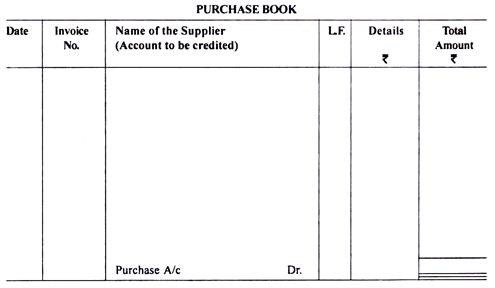
Instead of recording transactions in the journal, the transactions relating to credit purchases of goods are directly recorded in the purchases book. However, the total of the purchases book shall be recorded on the debit side of the ‘Purchases Account’. The main intention for preparing the purchases book is to know the credit purchases at any particular period of time.
The format of purchases book is as under:
2. Sales Book or Sales Journal:
Sales book is a book of original entry in which only credit sales of goods are recorded. Cash sales of goods are recorded in the cash book. Credit sales of other assets are also not recorded in the sales book; they are recorded in the journal proper.
Goods here mean the items or articles in which business enterprise is dealing or we can say that goods are the items which are used by the business enterprise for regular sale. For example, sale of furniture by a business enterprise which is dealing in stationery shall not be treated as its goods and items related to stationery alone shall be regarded as its goods.
Instead of recording transactions in the journal, the transactions relating to credit sales of goods are directly recorded in the sales book. However, the total of the sales book shall be recorded on the credit side of the ‘Sales Account’ The main intention for preparing the sales book is to know the credit sales at any particular period of time.
The format of sales book is as under:

3. Purchases Return Book or Purchases Return Journal:
Purchases return book is a book of original entry in which transactions related to the return of purchases of goods are recorded.
There may be several reasons for returning the goods to the supplier; some of them are as under:
(a) On finding some defects in the goods.
(b) When goods sent are not as per the samples or specifications.
(c) If the quantity of goods supplied is more than the requirements.
(d) When there is a breach of an agreement between the seller and the purchaser.
When the business enterprise returns the goods to the supplier, a debit note is sent to the party to whom this document is sent. The business enterprise may make a debit note against the supplier for an amount which is to be recovered from him when the business enterprise returns some goods which are defective in nature or not as per specifications.
In this document, all details about the date and amount of transaction, the name of the party whose account is debited along with the reason for debiting his account shall be mentioned.It should be noted that the trade discount availed at the time of purchase shall also be adjusted at the time of returning the goods.
The format of purchases return book is as under:

4. Sales Return Book Or Sales Return Journal:
Sales return book is a book of original entry in which transactions related to the return of sales of goods are recorded. The sales return book does not record return of goods sold on cash basis. There may be several reasons for returning the goods by the customers.
Some of them are as under:
(a) On finding some defects in the goods.
(b) When there is delay in supply of goods to the customers.
(c) When goods sent are not as per the samples or specifications.
(d) If there is an oversupply of goods.
(e) When there is a breach of agreement between the seller and the purchaser.
When a business enterprise receives back the goods sold earlier, it makes a credit note in favour of the purchaser showing that his account has been credited in the books of business enterprise. In this document, all details about the date and amount of transaction, the name of the party whose account is credited along with reason for crediting his account shall be mentioned.It should be noted that the trade discount allowed at the time of credit sale shall also be adjusted at the time of receiving goods.
The format of sales return book is as under:

7. Journal Proper or General Journal:
So far we have discussed that in the case of subdivisions of journal, transactions relating to the cash are recorded directly in the cash book and transactions relating to non-cash specialised items, are directly recorded in subsidiary books viz. sales book, purchase book, sales return, purchase return, bills receivable and bills payable book.
Now the question arises what will happen to those transactions which neither relate to cash nor relate to the other subsidiary books, like sale/purchase of an asset on credit? It cannot be recorded in the cash book as no cash flow is there and asset is not included in the terminology of goods; it cannot be recorded in the purchase book either. These are the residual transactions which cannot find a place in any of the subdivisions of the journal and are recorded in the journal known as journal proper or general journal.
Usually, the following types of transactions are recorded in the journal proper:
(i) Opening Entries:
Through opening entries, the balances in respect of various assets, liabilities and capital appearing at the end of previous accounting year are brought forward at the beginning of current accounting year.
(ii) Closing Entries:
Closing entries are the entries which are passed to transfer nominal accounts to respective income statements so that financial statements of the business enterprise can be prepared.
(iii) Transfer Entries:
Transfer entries are those entries which are passed to transfer an amount of an account or the balance of an account to another account. For example, transferring the balance of the current account to capital account.
(iv) Adjusting Entries:
At the end of an accounting year, some adjustments are to be carried out which were revealed later on. For example, recording closing stock, depreciation and various outstanding expenses or incomes. These items are recorded through passing adjusting entries.
(v) Entries for rectification of errors:
To rectify any accounting errors, these entries are to be passed.
(vi) Other Entries:
The entries related to credit sale or purchase of assets etc. are recorded in the journal proper.