
Table of Contents
Opening entries
Opening entries are those entries which record the balances of assets and liabilities, including capital brought forward, from a previous accounting period. In the case of going concerns, there is always a possibility of having balances of assets and liabilities, including capital, which was lying in the previous accounting year. To show a true and fair view of the business concern, it is necessary that all previous balances are to be brought forward in the next year by way of passing an opening entry.
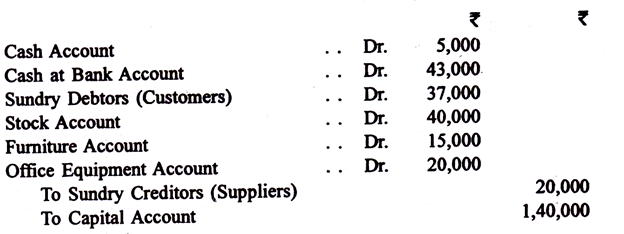
An opening entry (with imaginary figures) looks like the following:
Simple Entry and Compound Entry:
Every transaction affects two accounts – one is debited and another is account is credited. Thus in recording a transaction in a journal one account is debited and another account is credited. This type of entry is called simple entry.
The entry in which more than one account is debited or more than one account is credited, is known as a compound entry. Three or more accounts are connected with a compound entry
Example of Simple Entry:
For example, on 10.04.05 we bought furniture from S. The entry is:
Date |
Particulars |
L.F |
Amount |
Amount |
10.04.05 |
Furniture A/C ………………………..Dr. S A/C (Being furniture purchased on credit) |
10,000 |
10,000 |
Example Compound Entry:
For example, on 16.05.05 we paid $ 1,000 on account of salaries and $600 on account of rent. For this the entry will be:
Date |
Particulars |
L.F |
Amount |
Amount |
16.05.05 |
Salary A/C ………………………..Dr. Rent A/C Cash A/C (Being salaries and rent) |
1,000 600 |
10,000 |
Here two accounts have been debited and the entry involves three accounts. Hence, it is a compound entry.