
Table of Contents
Q.1. Prepare a funds flow statement of XYZ hotel Ltd. for the year 2016 from the following balance sheet:
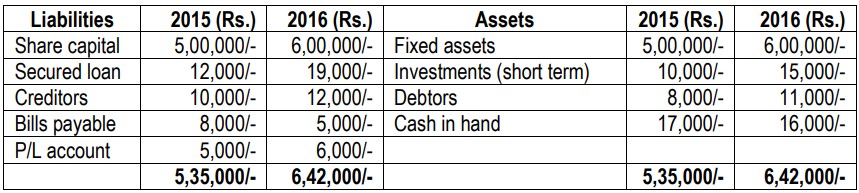
Funds Flow Statement of XYZ Hotel Ltd. for the year 2016 in :
Sources of Funds: |
Amount (Rs.) |
Application of Funds: |
Amount (Rs.) |
|---|---|---|---|
Increase in Share Capital |
1,00,000 |
Purchase of Investments |
5,000 |
Increase in Secured Loan |
7,000 |
Increase in Debtors |
3,000 |
Increase in Creditors |
2,000 |
Decrease in Bills Payable |
3,000 |
Decrease in P/L Account |
1,000 |
Purchase of Fixed Assets |
1,00,000 |
Total |
1,10,000 |
Total |
1,11,000 |
Note: The increase/decrease in each account has been shown as a positive/negative figure in the respective column. The net increase in funds for the year is Rs. 1,000 (i.e., Sources of Funds – Application of Funds).
OR
What do you mean by a cash flow statement? How does it differ from a funds
flow statement?
A cash flow statement is a financial statement that reports on the cash inflows and outflows of a business over a specific period. It provides information on how cash has been generated and used by the business, and is an essential tool for assessing a company’s liquidity and financial health.
The cash flow statement is different from other financial statements in its focus on the cash inflows and outflows of a business during a particular period. The key differences between a cash flow statement and other financial statements are:
- Focus on cash: The cash flow statement focuses on the cash transactions of a business, while other statements, such as the balance sheet and income statement, focus on assets, liabilities, and revenue and expenses.
- Time period: The cash flow statement covers a specific period of time, usually a month, quarter, or year, whereas the balance sheet and income statement reflect the financial position and performance of the company as of a specific date or period.
- Source of information: The cash flow statement relies on information from the income statement and balance sheet to provide a comprehensive view of the company’s cash position, while the balance sheet and income statement are standalone statements that provide different types of financial information.
- Format: The cash flow statement has a specific format that separates cash inflows and outflows into three categories: operating activities, investing activities, and financing activities. In contrast, the balance sheet and income statement do not have a standard format and can be presented in different ways.
- Uses: The cash flow statement is primarily used by investors and creditors to evaluate the company’s liquidity and cash flow management, while the income statement and balance sheet are used to evaluate profitability, financial health, and overall performance.
Q.2. A project requires an initial cash outlay of Rs.1,20,000/-. Its life span is estimated to be 5 years. It generates the annual cash inflows as follows:
Calculate the pay-back period of the project. Also suggest whether it should be accepted, if the minimum pay-back period is 3 years.
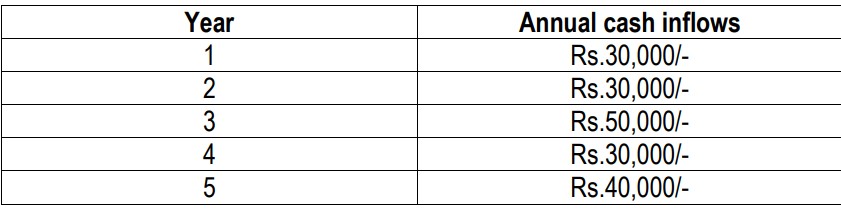
To calculate the payback period, we need to determine the number of years it will take for the project’s cumulative cash inflows to equal the initial cash outlay.
| Year | Annual cash inflows | Cumulative cash inflows |
|---|---|---|
| 0 | -1,20,000 | -1,20,000 |
| 1 | 30,000 | -90,000 |
| 2 | 30,000 | -60,000 |
| 3 | 50,000 | -10,000 |
| 4 | 30,000 | 20,000 |
| 5 | 40,000 | 60,000 |
To calculate the payback period, we need to find out in which year the cumulative cash inflows become equal to or greater than the initial cash outlay. Here, the cumulative cash inflows become positive in the fourth year. Therefore, the payback period is 3 years + (20,000/30,000) = 3 years 8 months.
Since the minimum payback period is 3 years and the calculated payback period for this project is also less than 3 years, the project can be accepted.
Q.3. Explain the meaning of financial analysis. Discuss the various techniques of making financial analysis of a five-star hotel.
Financial analysis is the process of evaluating the financial health and performance of a business by using financial statements and other financial information. The objective of financial analysis is to assess the financial position and profitability of a company, identify its strengths and weaknesses, and make informed decisions about its future. A five-star hotel is a high-end hospitality business that requires careful financial analysis to evaluate its performance and profitability.
Some of the techniques of financial analysis that can be used for a five-star hotel are:
- Ratio Analysis: Ratio analysis is a widely used technique of financial analysis that involves calculating various financial ratios such as liquidity ratios, profitability ratios, solvency ratios, and efficiency ratios. These ratios provide valuable insights into the financial health and performance of a hotel and help in comparing its performance with that of its competitors.
- Trend Analysis: Trend analysis involves analyzing the financial data of a hotel over a period of time to identify any trends or patterns in its financial performance. This helps in identifying the key factors that have contributed to the hotel’s financial performance and can help in making informed decisions about its future.
- Comparative Analysis: Comparative analysis involves comparing the financial performance of a hotel with that of its competitors in the industry. This helps in identifying the strengths and weaknesses of the hotel and can help in developing strategies to improve its competitive position.
- Cash Flow Analysis: Cash flow analysis involves analyzing the cash inflows and outflows of a hotel over a period of time. This helps in identifying the hotel’s liquidity position and its ability to meet its financial obligations.
- Profit and Loss Analysis: Profit and loss analysis involves analyzing the hotel’s revenue and expenses to identify its profitability. This helps in identifying the key drivers of the hotel’s profitability and can help in developing strategies to improve it.
In conclusion, financial analysis is a crucial tool for evaluating the financial health and performance of a five-star hotel. By using various techniques of financial analysis, hotel managers and investors can make informed decisions about the hotel’s future and develop strategies to improve its performance and profitability.
Q.4. What do you mean by capital structure? Discuss the various factors that influence the capital structure of a company
Capital structure refers to the composition of a company’s sources of funds, including equity, debt, and other securities used to finance its operations and investments. It represents the way a company finances its operations and expansion plans.
Factors that influence the capital structure of a company are:
- Business risk: Companies with high business risk tend to have lower debt-to-equity ratios, while companies with low business risk tend to have higher debt-to-equity ratios.
- Financial risk: Companies with high financial risk tend to have lower debt-to-equity ratios, while companies with low financial risk tend to have higher debt-to-equity ratios.
- Cost of capital: The cost of capital is the rate of return required by investors to invest in a company. If the cost of debt is lower than the cost of equity, the company may choose to use more debt in its capital structure.
- Growth rate: Companies with higher growth rates tend to have higher debt-to-equity ratios as they need more capital to finance their growth.
- Size of the company: Larger companies tend to have more access to capital markets and are able to issue more securities, resulting in a higher debt-to-equity ratio.
- Taxation: Debt is usually tax-deductible, while equity is not. As a result, companies may choose to use more debt in their capital structure to take advantage of the tax benefits.
- Industry norms: Companies within the same industry tend to have similar capital structures. A company may adjust its capital structure to match the industry norms to remain competitive.
- Investor preferences: Investors may have a preference for either debt or equity, depending on their risk appetite and investment objectives. This may influence a company’s choice of capital structure.
- Market conditions: The availability and cost of debt and equity in the capital market can influence a company’s decision regarding its capital structure.
By considering these factors, a company can make an informed decision about its capital structure to achieve a balance between risk and return, and to ensure that it has adequate funds to support its operations and growth plans.
OR
Define capital budgeting. How is it important for a five star hotel? Also
enumerate the limitations of capital budgeting.
Capital budgeting is the process of evaluating and selecting long-term investment projects or capital expenditures in a business. It involves determining which investment opportunities to pursue, given the available financial resources of the company, to maximize profitability and shareholder value.
For a five-star hotel, capital budgeting is crucial as it helps in identifying the best investment opportunities for the hotel’s expansion or improvement. It ensures that the available resources are efficiently utilized in the most profitable investment projects. For instance, a hotel may need to invest in upgrading its rooms or adding new amenities, such as a spa or gym, to remain competitive and meet customer demands. Capital budgeting helps in determining the feasibility of such projects, estimating the expected cash inflows, and assessing their financial viability.
However, capital budgeting has several limitations that must be considered, such as:
- Uncertainty: Future cash flows and cost estimates used in capital budgeting are based on assumptions and projections. Therefore, uncertainty in the economy, market demand, or competition may affect the accuracy of these estimates.
- Time-consuming: Capital budgeting involves extensive analysis and evaluation of investment projects, which may require a significant amount of time and resources.
- Difficulty in quantifying non-financial benefits: Some capital expenditures, such as adding new amenities or upgrading customer service, may not result in direct financial benefits. Such intangible benefits are challenging to quantify, making it difficult to justify the investment decision.
- Inflexibility: Once a capital investment is made, it may be challenging to modify or reverse the decision. Therefore, companies need to ensure that they have thoroughly evaluated the investment opportunity before making any decisions.
- Capital rationing: The company may have limited financial resources, making it challenging to pursue all viable investment projects simultaneously. Therefore, the company needs to prioritize and allocate resources to the most profitable projects.
In conclusion, capital budgeting is essential for five-star hotels as it helps in identifying and evaluating the most profitable investment projects. However, the limitations of capital budgeting must also be considered to make informed investment decisions.
Q.5. Discuss the various concepts of working capital. Also explain the various factors that influence the working capital requirements of a hotel.
Working capital is the amount of funds that a business uses to maintain its daily operations. The concept of working capital is critical for the hospitality industry, especially for hotels that need to manage their cash flow, inventory, and receivables effectively. Here are some of the key concepts of working capital in the hotel industry:
- Current Assets: These are assets that a hotel can quickly convert into cash, such as cash and cash equivalents, inventory, and accounts receivable.
- Current Liabilities: These are short-term debts that a hotel must pay within one year, such as accounts payable, short-term loans, and accruals.
- Net Working Capital: This is the difference between a hotel’s current assets and current liabilities, representing the amount of funds available for daily operations.
- Operating Cycle: This is the time it takes for a hotel to convert its inventory into cash, including the time it takes to receive payment from customers and pay suppliers.
- Cash Conversion Cycle: This is the time it takes for a hotel to convert its inventory and accounts receivable into cash while paying its accounts payable.
The working capital requirements of a hotel can vary depending on several factors, including:
- Seasonality: The hotel industry is highly seasonal, and the demand for rooms and services can fluctuate throughout the year. Hotels may need to adjust their working capital requirements to manage cash flow during peak and off-peak seasons.
- Occupancy Rate: The occupancy rate is a critical factor that determines a hotel’s revenue and cash flow. Higher occupancy rates require higher working capital to manage inventory, pay suppliers, and collect payments from customers.
- Average Room Rate: The average room rate is another key factor that affects a hotel’s revenue and cash flow. Hotels with higher average room rates may have lower occupancy rates, which can impact their working capital requirements.
- Size of Hotel: Larger hotels with more rooms and services may require more working capital to manage their daily operations.
- Payment Terms: The payment terms offered by suppliers and customers can impact a hotel’s working capital requirements. Longer payment terms may reduce cash flow, while shorter payment terms may require more working capital to manage inventory and pay suppliers.
In summary, working capital is a critical concept for hotels to manage their daily operations effectively. Understanding the various factors that influence working capital requirements can help hotels optimize their cash flow and maintain their financial stability.
Q.6. Explain the meaning, causes and effects on the following:
(a) Over capitalisation
(a) Overcapitalization refers to a situation where a company has raised more capital than it requires to run its operations efficiently. It means that the company has invested more funds in its fixed assets, such as land, buildings, and equipment, than it needs to generate revenue. Overcapitalization can occur due to various reasons, such as overestimating future growth prospects, inaccurate cost estimation, or excessive borrowing.
The effects of overcapitalization can be severe for the company and its shareholders. The company may experience low returns on its investment, as its assets may not generate sufficient revenue to cover the high cost of capital. Overcapitalization can also result in reduced profits, lower dividends, and a decline in the company’s share price. Moreover, it may make the company less competitive, as it may have less cash available for investment in new technologies, research, or development.
(b) Under capitalisation
(b) Undercapitalization refers to a situation where a company has inadequate capital to meet its current and future financial obligations. It means that the company has raised less capital than it requires to finance its operations effectively. Undercapitalization can occur due to various reasons, such as insufficient equity, high debt burden, low profitability, or poor creditworthiness.
The effects of undercapitalization can be equally severe for the company and its stakeholders. The company may face financial distress, as it may not have sufficient funds to pay its creditors, suppliers, or employees. Undercapitalization can also limit the company’s growth prospects, as it may not have sufficient funds for investment in new projects or expansion. Moreover, it can affect the company’s creditworthiness, as it may have difficulty in raising additional funds from the market. In extreme cases, undercapitalization can lead to bankruptcy or insolvency.
OR
Define a financial plan. Enumerate the requisites of a good financial plan.
Q.7. Calculate cash from operations for the year 2016 from the following information:
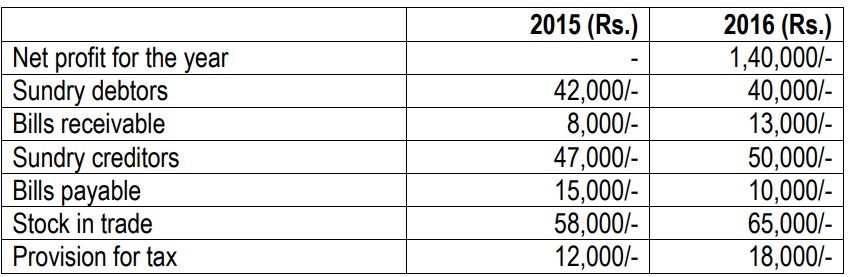
To calculate cash from operations, we need to use the indirect method by adjusting the net profit for the non-cash items and changes in working capital.
Calculation of Cash from Operations:
Net Profit for the year 2016 = Rs. 1,40,000/-
Add: Depreciation charged during the year (Assumed) = Rs. 20,000/-
Operating Profit before Working Capital Changes = Rs. 1,60,000/-
Adjustments for Working Capital Changes:
Increase in Sundry Debtors = Rs. (42,000 – 40,000) = Rs. 2,000/-
Increase in Bills Receivable = Rs. (13,000 – 8,000) = Rs. 5,000/-
Increase in Sundry Creditors = Rs. (50,000 – 47,000) = Rs. 3,000/-
Decrease in Bills Payable = Rs. (15,000 – 10,000) = Rs. 5,000/-
Increase in Stock in Trade = Rs. (65,000 – 58,000) = Rs. 7,000/-
Increase in Provision for Tax = Rs. (18,000 – 12,000) = Rs. 6,000/-
Net Change in Working Capital = Rs. 18,000/-
Cash from Operations = Operating Profit before Working Capital Changes – Net Change in Working Capital
= Rs. 1,60,000/- – Rs. 18,000/-
= Rs. 1,42,000/-
Therefore, the cash from operations for the year 2016 is Rs. 1,42,000/-.
OR
Explain the following in brief:
(a) Wealth maximization objective
(a) Wealth Maximization Objective: This is a financial management objective that aims to maximize the wealth of shareholders by increasing the value of the business. It is achieved by making investments that generate returns greater than the cost of capital. This objective considers the time value of money and focuses on long-term benefits.
(b) Over trading
(b) Over Trading: Over trading occurs when a company exceeds its working capital capacity by buying too much inventory or taking on too many projects without having the financial resources to complete them. This can result in cash flow problems, increased borrowing costs, and ultimately, bankruptcy.
(c) Profitability index
(c) Profitability Index: The profitability index is a financial ratio that measures the relationship between the present value of future cash flows and the initial investment. It is calculated by dividing the present value of cash inflows by the initial investment. A profitability index greater than one indicates a profitable investment, while a profitability index less than one indicates an unprofitable investment.
(d) Trend analysis
(d) Trend Analysis: Trend analysis is a financial analysis method that involves examining a company’s financial statements over time to identify patterns and trends. It helps to identify changes in financial performance and predict future performance.
(e) Funds from operations
(e) Funds from Operations: Funds from operations (FFO) is a financial metric used to measure the cash generated by a business’s operations. It is calculated by adding back non-cash items such as depreciation and amortization to the net income. FFO is useful for analyzing the cash flow generation potential of a business and is commonly used in the real estate industry.
Q.8. From the information furnished below, calculate:
(a) Gross profit ratio (b) Net profit ratio
(c) Current ratio (d) Acid test ratio
(e) Inventory turnover ratio
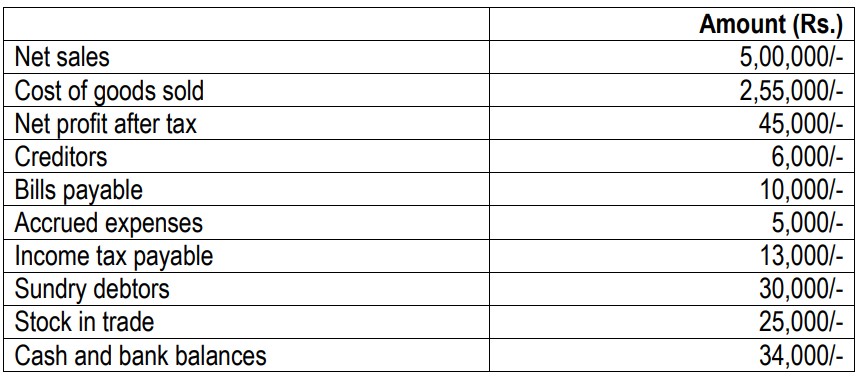
(a) Gross Profit Ratio: Gross Profit = Net Sales – Cost of Goods Sold = Rs. 5,00,000/- – Rs. 2,55,000/- = Rs. 2,45,000/-
Gross Profit Ratio = (Gross Profit / Net Sales) x 100% = (Rs. 2,45,000 / Rs. 5,00,000) x 100% = 49%
(b) Net Profit Ratio: Net Profit Ratio = (Net Profit After Tax / Net Sales) x 100% = (Rs. 45,000 / Rs. 5,00,000) x 100% = 9%
(c) Current Ratio: Current Ratio = (Current Assets / Current Liabilities) = (Rs. 30,000 + Rs. 25,000 + Rs. 34,000 / Rs. 6,000 + Rs. 10,000 + Rs. 5,000 + Rs. 13,000) = 2.63:1
(d) Acid Test Ratio: Acid Test Ratio = (Current Assets – Stock in Trade / Current Liabilities) = (Rs. 30,000 + Rs. 34,000 / Rs. 6,000 + Rs. 10,000 + Rs. 5,000 + Rs. 13,000) = 1.52:1
(e) Inventory Turnover Ratio: Inventory Turnover Ratio = Cost of Goods Sold / Average Inventory Average Inventory = (Opening Stock + Closing Stock) / 2 = (Rs. 25,000 + Rs. 0 + Rs. 0 + Rs. 25,000) / 2 = Rs. 12,500/-
Inventory Turnover Ratio = Rs. 2,55,000 / Rs. 12,500 = 20.4 times
Therefore, the gross profit ratio is 49%, the net profit ratio is 9%, the current ratio is 2.63:1, the acid test ratio is 1.52:1, and the inventory turnover ratio is 20.4 times.
Q.9. Convert the following income statements of ABC hotel into a comparative income statement for the year 2016:

To create a comparative income statement for the year 2016, we need to compare the income statement for 2016 with the income statement for 2015. We can present this information in the form of a table as follows:
| Particulars | 2015 (Rs.) | 2016 (Rs.) |
|---|---|---|
| Net Sales | 1,50,000/- | 1,80,000/- |
| Cost of Sales | 70,000/- | 80,000/- |
| Gross Profit | 80,000/- | 1,00,000/- |
| Administration Expenses | 25,000/- | 20,000/- |
| Selling Expenses | 10,000/- | 15,000/- |
| Operating Profit | 45,000/- | 65,000/- |
| Interest Paid | 3,000/- | 2,000/- |
| Profit Before Tax | 42,000/- | 63,000/- |
| Income Tax (40%) | 16,800/- | 25,200/- |
| Net Profit After Tax | 25,200/- | 37,800/- |
In this comparative income statement, we have presented the income statement for 2016 side by side with the income statement for 2015. We have also calculated the changes in each line item from 2015 to 2016.
We can see that the net sales increased from Rs. 1,50,000/- to Rs. 1,80,000/-, while the cost of sales increased from Rs. 70,000/- to Rs. 80,000/-. As a result, the gross profit increased from Rs. 80,000/- to Rs. 1,00,000/-.
The administration expenses decreased from Rs. 25,000/- to Rs. 20,000/-, while the selling expenses increased from Rs. 10,000/- to Rs. 15,000/-. As a result, the operating profit increased from Rs. 45,000/- to Rs. 65,000/-.
The interest paid decreased from Rs. 3,000/- to Rs. 2,000/-. The profit before tax increased from Rs. 42,000/- to Rs. 63,000/-. Finally, the net profit after tax increased from Rs. 25,200/- to Rs. 37,800/-.
Q.10. Fill in the blanks:
(a) Capital budgeting is also known as __________.
(a) Capital budgeting is also known as investment appraisal. It is the process of evaluating potential investments or projects to determine which ones are viable and should be undertaken by a company.
(b) There is a time gap between cash inflows and__________.
(b) There is a time gap between cash inflows and outflows. This is because cash inflows from an investment or project typically occur over time, while cash outflows occur upfront or at the beginning of the project.
(c) __________ is called the life blood of a business.
(c) Cash flow is called the life blood of a business. This is because without adequate cash flow, a business cannot pay its bills, invest in growth, or pay dividends to its shareholders.
(d) NPV is the difference between present value of cash inflows and
__________.
(d) NPV is the difference between the present value of cash inflows and the present value of cash outflows. It is used to determine whether an investment or project is financially viable, by assessing whether the future cash inflows from the investment will exceed the present value of the cash outflows.
(e) Capital gearing refers to the relationship between equity capital & reserves
and ______________.
(e) Capital gearing refers to the relationship between equity capital & reserves and debt capital in a company’s capital structure. It measures the degree to which a company relies on debt financing to fund its operations and growth.
(f) The discount rate at which the present value of cash inflows and cash
outflows become equal is known as__________.
(f) The discount rate at which the present value of cash inflows and cash outflows become equal is known as the internal rate of return (IRR). This is a key metric used in capital budgeting to evaluate the financial viability of potential investments or projects.
(g) Ratio of net sales to fixed assets is called __________.
(g) Ratio of net sales to fixed assets is called fixed asset turnover ratio. It measures the efficiency with which a company uses its fixed assets to generate revenue.
(h) Depreciation is sometimes treated as __________ of funds.
(h) Depreciation is sometimes treated as a source of funds. This is because it reduces a company’s taxable income and therefore its tax liability, freeing up more cash for the company to use in its operations or invest in growth.
(i) The ratios calculated to test the short term solvency position of a company
are called __________ ratios.
(i) The ratios calculated to test the short-term solvency position of a company are called liquidity ratios. These ratios measure a company’s ability to meet its short-term obligations and financial commitments.
(j) __________ statement shows the cash inflows and cash outflows of a
business during a given period.
(j) Cash flow statement shows the cash inflows and cash outflows of a business during a given period. It is used to assess a company’s ability to generate cash and its ability to meet its financial obligations. It includes operating activities, investing activities, and financing activities