
Table of Contents
Q.1. Discuss the factors to be considered while selecting large equipment for banquet kitchen preparing Indian menu which can cater to 1500 pax. (10)
Factor affecting the selection of equipment in quantity kitchen:
- Selecting the right size: Selecting the right size for the kitchen equipment in accordance with your kitchen space is one of the most significant factors when it comes to choosing the right product.
- Functionality: Selecting any equipment having the right functionality is also an important point to consider when shopping for kitchen appliances. There are a lot of useful functions being added to kitchen equipment by various manufacturers.
- Color Coordination: Any new purchase of kitchen equipment must be made in accordance with the overall theme of the kitchen and its design.
- Your budget and affordability: Selecting the kitchen equipment within one’s budget is quite an essential part of any equipment purchase. With many models and diverse functionality of various equipment in the market today, it is very easy for buyers to go overboard.
- Warranty and After Sales: Comparing after-sales service and warranties being offered by various shortlisted products is recommended to choose the right product for your respective needs.
- Suitability for the commercial kitchens: It goes without saying that you should never use domestic equipment in commercial kitchens. Not only are such appliances unable to keep up with the day-to-day demands of professional kitchens hence only commercial equipment should be used.
- Energy Efficient: When it comes to the kitchen equipment, rather than focusing on the up-front expense, it pays to consider the whole life cost. Commercial kitchens consume approximately 2.5 times more energy per square foot than any other commercial space. However, significant savings can be achieved by using energy-efficient appliances
- Should meet food safety Requirements: There are more than a million cases of food poisoning a year in the UK. Many of these cases are the result of eating food prepared in a professional kitchen. So only the equipment approved by the FDA and FSSAI should be used.
- Buying Future-proof Equipment: Once you’ve selected the kitchen equipment you want, also check to make sure a new model isn’t coming out anytime soon. Which makes it easier for us to get service and repair parts.
- Deciding to buy or rent: In many cases, renting equipment may end up making far more sense than purchasing outright, particularly if this includes a regular maintenance package to keep your kit in top-notch condition. Rental options may also make long-term sense – allowing you to upgrade with the needs of your business.
Q.2. Indenting plays an important role in bulk food production. Explain. Prepare an indent for 100 pax. for Haryali Murg. (10)
The basic fundamental of a food operation is to turn a raw food item into an edible product by applying or extracting heat from it. The success of any food service operation is dependent on how the raw ingredients are procured, processed, cooked, and then served to the customer to generate profit.
Indenting helps in controlling food costs in the following ways:
- It prevents wastage of food from not being used or getting expired
- The consumption of the ingredients is kept in kind while ordering
- The yield of each ingredient in each dish is checked and then is ordered as per the demand of the particular dish
- Helps to keep track of any pilferage that is happening.
- Make sure that no amount of ingredients goes unused and new is only ordered when the previous stock is used.
- Makes the implementation of FIFO and LIFO easy
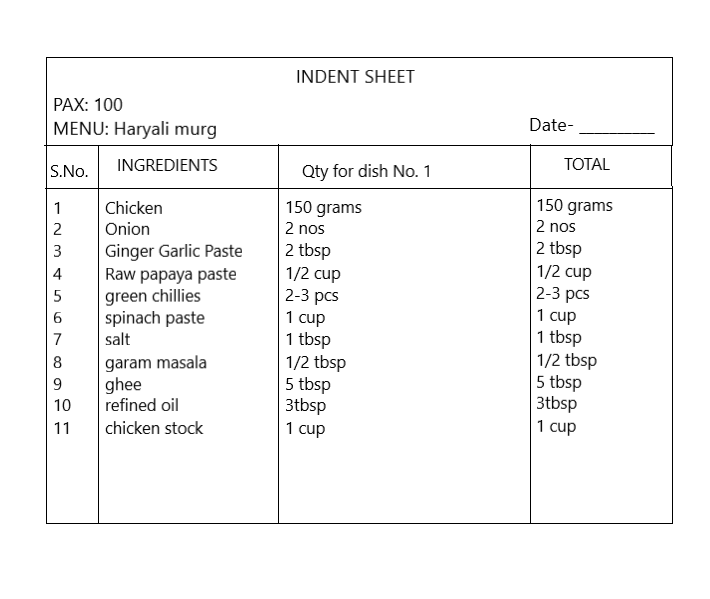
Or Plan a cyclic menu for the Institute canteen kitchen for breakfast and dinner which serves for 250 students. The cost should not exceed Rs.85/- per day. (10)
Breakfast
- Monday- Bread, Butter, Jam, Milk.
- Tuesday- Milk, Cornflakes, Bread, Butter/Jam.
- Wednesday- Bread, Butter, Jam, Milk.
- Thursday- Milk, Chocos, Bread, Butter/Jam.
- Friday- Bread, Butter, Jam, Milk.
- Saturday- Milk, Cornflakes, Bread, Butter/Jam.
- Sunday- Bread, Butter, Jam, Milk.
Dinner
- Monday- Aloo Beans, Black masoor, Tawa Roti, Salad
- Tuesday- Green leaves Vegetable, Moong Dhuli dal, Rice, Salad
- Wednesday- Bhindi kurkuri, Urad Dhuli, Tandoori Roti, Salad
- Thursday- Arbi Masala, Masoor dhuli, Plain paratha, Salad
- Friday- Jeera Aloo/ Seasonal vegetable, Moong Chilka, Tawa Roti, Salad
- Saturday- Chowmein, Veg. Manchurian
- Sunday- Pasta, Baked Vegetables, Bread rolls.
This menu is for an institutional canteen that serves 250 students. and is prepared to keep the cost of food per day per person to not exceed Rs. 85/-.
Q.3. Write in detail the functioning of a flight kitchen catering to domestic and international flights. (10)
An airline meal or in-flight meal is a meal served to passengers on board a commercial airliner. These meals are prepared by airline catering services. These meals vary widely in quality and quantity across different airline companies and classes of travel. They range from a simple beverage in short-haul economy class to a seven-course gourmet meal in long-haul first class.
The airline dinner typically includes meat (most commonly chicken or beef) or fish, a salad or vegetable, a small bread roll, and a dessert.
Caterers usually produce alternative meals for passengers with restrictive diets. These must usually be ordered in advance, sometimes when buying the ticket. Some of the more common examples include:
- Cultural diets, such as French, Italian, Chinese, Japanese, or Indian style.
- Infant and baby meals. Some airlines also offer children’s meals, containing foods that children will enjoy such as baked beans, mini-hamburgers, and hot dogs.
- Medical diets, including low/high fiber, low fat/cholesterol, diabetic, peanut-free, non-lactose, low salt/sodium, low-purine, low-calorie, low-protein, bland (non-spicy), and gluten-free meals.
- Religious diets, including kosher, halal, and Hindu, Buddhist, and Jain vegetarian (sometimes termed Asian vegetarian) meals.
- Vegetarian and vegan meals. Some airlines do not offer a specific meal for vegetarians; instead, they are given a vegan meal.
- Condiments (typically salt, pepper, and sugar) are supplied in small sachets. For cleanliness, most meals come with a napkin and a moist towelette. First and business class passengers are often provided with hot towels and proper salt and pepper shakers.
Or Explain in detail the challenges of preparation and service of food in trains. (10)
As the rail is the main transport to travel from one place to another and very convenient transport. The catering facility is provided by the rail staff and the food is prepared at the railway station kitchen. There is a coach in the rail, in which the food and beverage are stored and served from time to time. The catering facilities are provided in the limited rails which run on long routes such as Rajdhani, The Palace, and Duranto express, Shatabadi, etc.
Challenges of preparation and service of food faced in the railway catering are as follows:-
- The cost of the food is sometimes included in the ticket itself so the food cost should be kept low and within the allotted budget.
- A simple menu needs to be planned which is widely acceptable by all kinds of passengers traveling on the train.
- There is limited space available on the train for the kitchen set up and equipment.
- Maintaining hygiene and sanitation is a challenge in a limited space available on the train.
- Corruption plays an important factor in deteriorating the quality of catering in IRCTC trains catering.
- Separating and marking veg and non-veg items using red and green dot stickers is a mess and creates and a lot of problems for customers as well as the staff.
- Due to the standardization of the menu on trains like Rajdhani, Shatabdi, etc. it has become boring and monotonous.
- Tighter seating and more berths make the service of the food difficult and slow.
Q.4. Name ten types of Indian bread with its origin and procedure of preparation. (10)
- Adai – a typical dish in South India and Sri Lanka. In Tamil Nadu, the popular adai dishes are made from millet dough or rice dough. It is closer to a dosa when made with a fermented batter of a mixture of lentils.
- Appam – a type of South Indian pancake made with fermented rice batter and coconut milk
- Baati – hard, unleavened bread cooked in the desert areas of Rajasthan, and in Madhya Pradesh
- Bhakri – round flat unleavened bread made mainly using Sorgham bicolr or Pearl millet often used in the cuisine of the state of Maharashtra in India but is also common in western and central India, especially in the states of Rajasthan, Gujarat, Malwa, Goa, and northern Karnataka.
- Chapati – unleavened flatbread (also known as roti) from India, Nepal, Bangladesh, and Pakistan which is baked on a hot surface. It is a common staple food in India
- Cheela – crepes made from a batter of varying ingredients in North India – ingredients usually include pulse (dal) flour, wheat flour, and sometimes finely chopped vegetables.
- Chikkolee – spicy wheat dish common in southern Andhra Pradesh and parts of Maharashtra.
- Dosa – fermented crêpe or pancake made from rice batter and black lentils. It is a staple dish in South Indian states of Karnataka, Tamil Nadu, Andhra Pradesh, and Kerala.
- Paratha – layered or stuffed flatbread from North India – traditionally made from whole wheat flour by baking with oil on a hot surface.
- Pitha/Pithe – a type of cake made from fermented rice batter, dim sum, or bread common in Bengal, Assam, and Orissa.
Or Mention ten types of popular Indian sweets covering different regions of India. Describe each in one or two lines. (10)
- Balushahi Dessert prepared in the north region of India using ingredients like maida flour, yogurt, oil, sugar and soaked in sugar syrup after deep frying
- Gajar ka halwa its a very popular dessert in the northern region of India in the winters made using carrots, mils, sugar, ghee, cashews, and raisins.
- Gulab jamun these are Fried milk balls soaked in sweet syrup, such as rose syrup or honey. Famous in the northern region of India.
- Cham cham It is a traditional Bengali sweet, popular through the Indian subcontinent. The sweet comes in a variety of colors, mainly light pink, light yellow, and white. It is coated with coconut or mawa flakes as a garnish.
- Malpua is a pancake served as a dessert or a snack originating from the Indian subcontinent, popular in India, Nepal, and Bangladesh.
- Mishti Doi is a fermented sweet doi (yogurt) It is popular in the Indian states of West Bengal, Tripura and Assam’s Barak Valley. It is made with milk and sugar/jaggery.
- Ras malai or rossomalai is a dessert originating from the eastern regions of the Indian subcontinent, possibly Bengal. The name ras malai is the Hindi cognate of Bengali: Rosh, meaning “juice”, and malai, meaning “cream”. It has been described as “a rich cheesecake without a crust”.
- Double ka meetha, also known as Shahi Tukra, is a bread pudding Indian sweet of fried bread slices soaked in hot milk with spices, including saffron and cardamom. Double ka meetha is a dessert of Hyderabad,
- Mysore Pak is an Indian sweet prepared in ghee. It originated in the city of Mysuru, one of the major cities in the Indian state of Karnataka. It is made of generous amounts of ghee, sugar, gram flour, and often cardamom.
- Puran Poli is an Indian sweet flatbread. Prepared using wheat flour, gram, and jaggery. Common in the Maharashtra region of India.
- Shrikhand is an Indian sweet dish made of strained Dahi (yogurt). A creamy dessert made out of strained yogurt often served with dried fruits such as mangoes.
Q.5. Explain the salient features of Rajasthani cuisine, considering food habits and major ingredients used. List five specialty dishes of this region. (10)
Some salient features can be discussed as follows:
- The cooking of Rajasthan was immensely influenced by the warlike and belligerent way of life of its people and the accessibility of the ingredients that were grown in this region. Rajasthani food is well known for its spicy curries and delicious sweets.
- Major crops of Rajasthan are Jowar, Bajri, Maize, Ragi, Rice, Wheat, Barley, Gram, Tur, pulses, Groundnut, Sesame, etc. Millets, lentils, and beans are the most basic ingredients in food.
- Rajasthani food is characterized by the use of Jowar, Bajra, legumes, and lentils, its distinct aroma and flavor achieved by the blending of spices including curry leaves, tamarind, coriander, ginger, garlic, chili, pepper, cinnamon, cloves, cardamom, cumin, and rosewater.
- Rajasthani cuisine uses a lot of dry coconuts.
- Clarified butter or ghee forms the main medium of cooking.
- A distinct feature of the Maheshwari cooking is the use of mango powder, a suitable substitute for tomatoes, scarce in the desert, and asafoetida, to enhance the taste in the absence of garlic and onions.
- The meat prepared was mainly of hare or rabbit, wild boar or deer, or game birds.
Five specialty dishes of this region:
- Dal Bati Churma – This famous Rajasthani dish needs no introduction. Dal bati churma is synonymous to Rajasthan; known for its crunchy batis, dipped in ghee along with spicy daal and sweet churma.
- Laal Maas – One of the most common parts of the non-vegetarian platter, Laal maas owes its color to the hot red chilies. The meat is cooked in a hot gravy of tomatoes, chilies, and sizzling spices. Don’t miss this pungent yet scrumptious food of Rajasthan next time you visit this vibrant state.
- Mawa Kachori from Jodhpur is a must-try dish in Rajasthan. These kachoris are stuffed with mawa along with crispy dry fruits and served hot, making your mornings sweet and perfect.
- Mirchi Bada – Another snacky delight from Rajasthan, Mirchi badas are perfect answers to complement evening tea or morning breakfast. The hot and spicy badas are scrumptiously delicious.
- Pyaaz Ki Kachori – A common breakfast snack from Rajasthan, pyaaz ki kachoris are yummy kachoris stuffed with onions, spices, and garnished with chutneys and dahi.
Q.6. Write short notes on any two: (2×5=10)
(a) Off-premise catering
Off-premise catering is serving food at a location away from the caterer’s food production facility. One example of a food production facility is a freestanding commissary, which is a kitchen facility used exclusively for the preparation of foods to be served at other locations. Other examples of production facilities include, but are not limited to, hotels, restaurants, and club kitchens. In most cases, there is no existing kitchen facility at the location where the food is served.
(b) Wazwan
Wazwan is a multi-course meal in Kashmiri cuisine, the preparation of which is considered as an art and a point of pride in Kashmiri culture and identity. Almost all the dishes are meat-based using lamb or chicken with a few vegetarian dishes. It is popular throughout the Kashmir. Moreover, Wazwan is also served internationally at Kashmiri food festivals and reunions.
(c) Tandoori kebab tenderizers
Raw Papaya is used as a meat tenderizer in tandoori kebabs because contains an enzyme called Papain. This is a digestive enzyme that is often found in the leaves, skin, and the flesh of the papaya. Normally raw papaya is grated and the flesh is both crushed in a food processor and spread on the meat or the juice squeezed out and mixed with the remaining ingredients of the marinade.
Q.7. Describe the following: (5×2=10)
(a) Zarda
Zarda is a traditional boiled sweet rice dish, native to the Indian subcontinent, with (orange) food coloring, milk and sugar, and flavored with cardamoms, raisins, saffron, pistachios or almonds
(b) Basundi
It is sweetened condensed milk made by boiling milk on low heat until the milk is reduced by half. In North India, a similar dish goes by the name rabri. It is often made on Hindu festivals such as Kali Chaudas and Bhai Dooj
(c) Nimish
It is a dessert from the Awadhi cuisine. Nimish is made during the cold months. It has an interesting method of preparation. Early morning dew is collected on a sheet spread outside and it is collected and mixed into the cream then milk is added to it and finished with flavorings.
(d) Chorizo
Chorizo is a fermented, cured, smoked sausage, which may be sliced and eaten without cooking, or added as an ingredient to add flavor to other dishes. Elsewhere, some sausages sold as chorizo may not be fermented and cured, and require cooking before eating.
(e) Dhungar
Dhungar is an ancient technique of smoking and infusing the flavor of burnt charcoal smoke into a dish. This technique was marked during ancient times when Mughals came to India (Bharat; Ancient name for India) they brought this technique with them.
Q.8. Briefly explain the following: (5+5=10)
(a) Parsi cuisine Or Chettinad cuisine
Parsi Cuisine refers to the traditional cuisine of the Parsis of India and Pakistan. The basic feature of a Parsi lunch is rice, eaten with lentils, or a curry. Curry is made with coconut and ras without, with curry usually being thicker than ras. Dinner would be a meat dish, often accompanied by potatoes or other vegetable curries. Kachumbar (a sharp onion-cucumber salad) accompanies most meals.
Popular Parsi dishes include:
- Chicken Farcha (Fried chicken appetizer)
- Dhansak (Lamb, mutton, goat, chicken or vegetables in a mixed lentil or toor daal gravy served with brown rice)
- Patra ni Machhi (Fish – Pomfret or Surmai stuffed heavily with green coconut chutney and wrapped in a banana leaf – steam cooked.)
- Sali Murghi (Spicy chicken with fine fried matchstick potatoes)
- Saas ni Machhi (Yellow rice with pomfret fish fillets in white sauce)
Also popular among Parsis, but less so elsewhere, are the typical Parsi eeda (egg) dishes, which include akuri (scrambled eggs with spices) and the pora (“Parsi” omelet). Also, vegetables like okra, tomato, potato, and others are often cooked with eggs on top.
Or Chettinad cuisine is the cuisine of a community called the Nattukotai Chettiars, or Nagarathars as they call themselves, from the Chettinad region of Tamil Nadu state in South India. Chettinad cuisine is perhaps the most renowned fare in the Tamil Nadu repertoire. It uses a variety of spices and the dishes are made with fresh ground masalas. Chettiars also use a variety of sun-dried meats and salted vegetables, reflecting the dry environment of the region. Most of the dishes are eaten with rice and rice-based accompaniments such as dosais, appams, idiyappams, adais, and idlis. The Chettiars, through their mercantile contacts with Burma, learned to prepare a type of rice pudding made with sticky red rice. Chettinad cuisine offers a variety of vegetarian and non-vegetarian dishes. Some of the popular vegetarian dishes include idiyappam, paniyaram, vellai paniyaram, karuppatti paniyaram, and athirasam. In Chettinad food, major spices used include anasipoo (star aniseed), kalpasi (a lichen), puli (tamarind), milagai (chillies), sombu (fennel seed), pattai (cinnamon), lavangam (cloves), bay leaf, karu milagu (peppercorn), jeeragam (cumin seeds), and venthayam (fenugreek).
(b) Purchase specifications Or Meat & Fish storage
Purchase specification is a concise description of quality, size, weight, or count factor desired for a particular item, Specification buying will give uniformity and consistency to purchasing and receiving, which will aid to maintain a desire food cost and create a standard product.
objectives of standard purchase specification:
- To establish a suitable buying standard for a particular commodity for the hotel.
- To furnish the supplier in writing in specific terms the requirement of the hotel.
- To help in setting the price of a commodity.
- To obtain a standard product material for f & b dept.
- To obtain a standard product so that measurement of performance of departments can be accurate.
Or storing raw meat commercially should ensure that the fridge is never overloaded, as this can mean the temperature rises beyond the safe temperature zone (more than 5°C). This happens when food blocks the cooling unit inside the refrigerator. Restaurant fridges tend to have fans in them to distribute cold air as evenly as possible. Remember that the optimum temperature for storing meat is around – 0-5°C.
Fresh fish can be stored at 40°F or less for 2 to 3 days but if it is not going to be used within that time, it should be frozen to prevent it from perishing. Freeze the fish while it is as fresh as possible. Proper handling of the fish is also necessary to produce a quality frozen product. The same factors stated above will have an effect on the quality of the fish when it is frozen. Be sure the fish has been cleaned properly before freezing. There are several methods that can be used for freezing fish. The method you select may depend on if you are freezing whole fish, large cuts, steaks or fillets. Also, take into consideration how much freezer storage room you have available. Fish should be frozen in a freezer at 0°F or less. Several methods are shown below.
Q.9. Differentiate between the following: (5×2=10)
(a) Foogath and Poriyal
Foogath is a vegetable preparation known to be originated in goa. it means ‘to stew in seasoning’. It is a quick way to make cooked vegetables spicier. vegetables have some crunch but not raw and lemon juice is added to the dish.
Poriyal is a vegetable preparation known to be originated in Tamil Nadu.usually made by shallow frying shredded or diced vegetables along with spices. Vegetables are cooked properly and Desiccated coconut is used.
(b) Pulao and Biryani
Pulao is said to be originated in the awadh region of ancient India. prepared with rice and vegetables, can be made with or without meat. very tasty and light for the stomach. Various types are pulaos are present. Rice and meat are cooked together.
Biryani is said to be originated in Hyderabad. prepared with rice and meat usually lamb. it involves two steps- marination and dum cooking. parboiled rice and meat layered and cooked on dum with fried onion rings and, mint leaves.
(c) Phulka and Chapatti
Phulka is smaller than chapati. It’s round and ballooned Indian flatbread. It’s one side is cooked on a Tawa and another side on direct heat usually in the form of fire due to which it puffs up and should be served immediately.
Chapatti is bigger than a phulka and not necessarily puffed up. made using whole wheat flour. It’s both sides are cooked on a Tawa. chapattis are served hot after applying some ghee on them.
(d) Shorba and Saar
Saar is basically a tangy soupy curry like preparation made with tomatoes, coconut, and spices. This recipe comes from the coastal region of Maharashtra.
Shorba is a kind of hot soup or stew relished across Middle-East Asia, South and Central Asia, and North Africa. Believed to have originated in Persia, Shorba is traditionally prepared by simmering meat in boiling water along with salt and flavored with aromatic curry spices and herbs.
(e) Potli ka masala and goda masala
Potli ka masala is an authentic masala for making paaya nihari or sirey paaya nihari both. It can also be used for cooking lamb head curry. The masala has to be tied up in a muslin cloth and dropped into the cooking pot. The slow cooking makes the masala also to release its aroma and taste into the boiling broth.
Goda masala is a special spice blend unique to Maharashtrian cuisine. the spices used here are aromatic spices and these lend a subtle sweet aroma without hints of pungency & heat. So when you smell goda masala, you won’t sense the heat & pungency which is felt in other spice blends like garam masala and its variations. Hence this masala gets translated in English to the sweet masala.
Q.10. Write short notes on any two: (2×5=10)
(a) Indian Heritage Cuisine
Indian cuisine is diversified in its varieties similar to its cultures, races, and regions. Thousands of variations of dishes are prepared in the different parts of the country every day. The essence of Indian cooking lies in the aroma of the spices which are blended together and added to enhance the basic flavor of a particular dish. Spices are always freshly ground to the required combination called Massalas. Many of these spices are noted for their medicinal values and are also used as appetizers and digestive. The ingredients for the masala vary from region to region.
Besides spices, ghee and curd are the other two main ingredients in Indian cooking. Even though India is known for the Hindu vegetarian tradition, many Hindus eat meat now. Meat dishes are more common in North India while more vegetables are eaten in the South. The Muslim tradition is more evident in the cooking of meats. Mughlai foods comprising kababs, kurmas, koftas, biriyanis, rogan josh, tandoori chicken, tandoori rotis, etc are the contribution of Muslims.
Rice is the staple food of the South while in the North it is supplemented or substituted by pooris, chappathis, or nan. Dhal(lentil soup) and Dhai (curd) are common throughout India. Vegetable dishes are prepared based on the main dish with which they are served. Rice is served with vegetable curries, vegetable side dishes, and curd. As India has a very long coastal area, dishes prepared with fish are also popular. Varieties of sweets representing the style and taste of different regions are available in India. The main ingredients of the sweets and desserts are sugar, milk flour, and ghee.
(b) Factor affecting eating habits in India
- Religious reasons will affect a follower’s food choices and behaviors.for example, in some religions specific foods are prohibited, such as pork in the Jewish and Muslim religions.
- Food Availability The growth of different crops and vegetables vary in different regions throughout India hence affecting the food habits of people in India
- Health is also an important factor in affecting the eating habits of people throughout India. Various diseases come with different dietary restrictions.
- Education also plays an essential role in food habits as with education comes exposure to the different cuisines and that promotes and affects the food culture in different places around India.
- Ethnicity India is a country with an extensive ethnic diversity and different regions in India have their own version of Indian cuisine which makes India a place with a diverse place for food habits.
- The economic status of a person, place, and city plays a major role in the kind of food or dining experiences one gets to see in that place which directly affects the food habits of people in that region.
- The social status of a person also affects the choice of food items and habits because different societies adopt different eating habits.
- The family background of a person plays a major role in food habits because that decides what are a persons food preferences making the person like or dislike something.
(c) Advantages of a centralized kitchen
- Economies of scale – This is a cost advantage that a large F&B operation enjoys due to its larger size. It refers to the reductions in unit cost as the size of a facility and usage levels of systems and equipment increase.
- Better consistency – F&B operations can deliver a uniform standard and achieve consistent quality of food sold and served at different outlets.
- Greater efficiency – Centralized kitchens are more efficient than separate kitchens as it facilitates a person to increase the production volume without any significant capital investment or time.
- Purchasing – Indenting and placing order becomes fast and easier because it all comes under the same indent and it makes the consumption of ingredients better reducing wastage.
- Human Resources – this system provides us more efficient use of manpower through automation and specialization of tasks as the central kitchen takes care of preparation work while outlet staff focuses on serving.