
Table of Contents
Types of Accounting
- Financial Accounting
- Cost Accounting
- Management Accounting
- Tax Accounting
- Social Responsibility Accounting
1) Financial Accounting
The main purpose of this branch of accounting is to record the business transaction in a systematic manner, to ascertain the profit or loss of the accounting by preparing a profit and loss account and to present the financial position of the business by preparing a balance sheet. This branch of accounting provides information required by the management and various interested parties.
2) Cost Accounting
The main purpose of cost accounting is to ascertain the total cost and per unit cost of goods produced and serviced rendered by a business. It also estimates the cost in advance and helps the management in exercising strict control over cost.
3) Management Accounting
The main purpose of management accounting is to present the accounting information in such a way as to assist the management in planning and controlling the operation of a business. The management accountant uses various techniques and concepts to make the accounting data more useful for managerial decision making .These techniques include ratio analysis budgetary control, fund flow statement, cash flow statement.
4) Tax Accounting:
The branch of accounting which is used for tax purpose is called Tax accounting. Income tax and sales tax are computed on the basis of this accounting.
5) Social Responsibility Accounting:
The society provides the infrastructure and the facilities without which business cannot operate at all.Hence the business also has a responsibility to the society.
Classification of Accounting
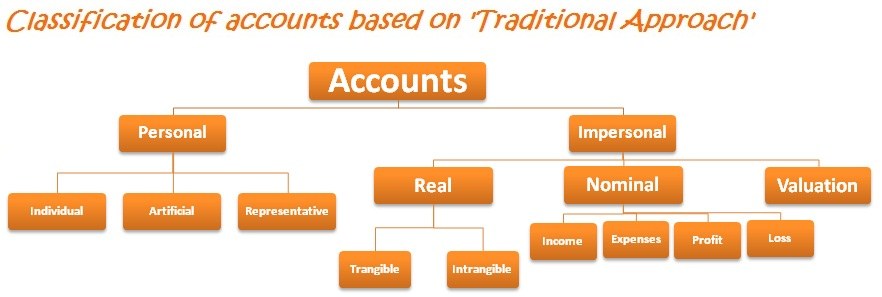
Personal: In this segment, all persons, who are either give something or takes something, are placed
- Individual – Individual personal accounts are for any living person like you & me. (Example: Ratan Tata A/c)
- Artificial – Artificial personal accounts referred to any non living, but artificially created entity. (Example: Tata motors Pvt. ltd. A/c)
- Representative – When an account indicate another person or group of persons, is called Representative personal account. Any prepaid or outstanding expenses accounts are fall in this category. (Example: Salary payable A/c , Prepaid office rent A/c)
Impersonal: All other accounts, which are not personal accounts.
- Real – Accounts of the asset. Also called ‘Permanent account’.
- Tangible: A real account with the physical entity is called ‘Tangible real account’, such as land, furniture, machinery, vehicles. These accounts are depreciated with time lapse, except ‘Land’.
- Intangible: You can not touch an intangible real account but it still have logical value, which can be measurable by money and it helps to increase the profitability of the business. (Example: Goodwill, patent, copyright, Trademark)
- Nominal – Accounts of income, expense, profit and loss. Nominal accounts are the root causes of the financial performance of a business.
- Income: Any account, which is a cause of inflow of asset without rising liability is called income. (Example: Sale A/c, Interest received A/c)
- Expenses: Any account, which is a cause of outflow of asset without minimizing liability is called income. (Example: Purchase A/c, Interest paid A/c)
- Profit : Profit is the excess part of income over expenses, where incomes are greater than expenses. (Example: Profit on sales on machine a/c, Profit& loss A/c – in case of net profit)
- Loss : Loss is the excess part of expenses over incomes, where incomes are less than expenses. (Example: Loss on sales on machine a/c, Profit& loss A/c – in case of net loss)
Valuation -When an account paired with another balance sheet account (Asset or Liability) to recognize the balance to be carry forward, is called ‘Valuation account’. Such accounts are linked with a ‘Provision for doubtful accounts’. (Example: ‘Provision for depreciation on furniture A/c’ which is linked to an asset account, say ‘Furniture A/c’. Another example is ‘Provision for tax A/c’ which is linked with a liability account, say ‘Tax payable A/c’.)